
[Paper Review] A comparative analysis of SRGAN models
This study evaluates EDSR-BASE, Real-ESRGAN, ESRGAN, and EDSR on real-world degraded images for super-resolution and OCR performance. EDSR-BASE outperforms all models in OCR accuracy (100% at 0.4 scale), PSNR, SSIM, and computational efficiency, making it optimal for high-fidelity, low-compute applications.
In this study, we evaluate the performance of multiple state-of-the-art SRGAN (Super Resolution Generative Adversarial Network) models, ESRGAN, Real-ESRGAN and EDSR, on a benchmark dataset of real-world images which undergo degradation using a pipeline. Our results show that some models seem to significantly increase the resolution of the input images while preserving their visual quality, this is assessed using Tesseract OCR engine. We observe that EDSR-BASE model from huggingface outperforms the remaining candidate models in terms of both quantitative metrics and subjective visual quality assessments with least compute overhead. Specifically, EDSR generates images with higher peak signal-to-noise ratio (PSNR) and structural similarity index (SSIM) values and are seen to return high quality OCR results with Tesseract OCR engine. These findings suggest that EDSR is a robust and effective approach for single-image super-resolution and may be particularly well-suited for applications where high-quality visual fidelity is critical and optimized compute.
Motivation & Objective
- To compare state-of-the-art SRGAN models—EDSR-BASE, Real-ESRGAN, ESRGAN, and EDSR—for image super-resolution on real-world degraded images.
- To assess the impact of super-resolution on downstream OCR accuracy using Tesseract OCR engine.
- To evaluate model performance across varying image degradation levels (low-resolution scales 0.1–0.5) and DPI (200–260 dpi).
- To identify the most efficient and accurate model for high-fidelity image restoration with minimal computational overhead.
- To determine whether GAN-based models (ESRGAN, Real-ESRGAN) or non-GAN, reconstruction-based models (EDSR) yield better OCR outcomes on real-world text images.
Proposed method
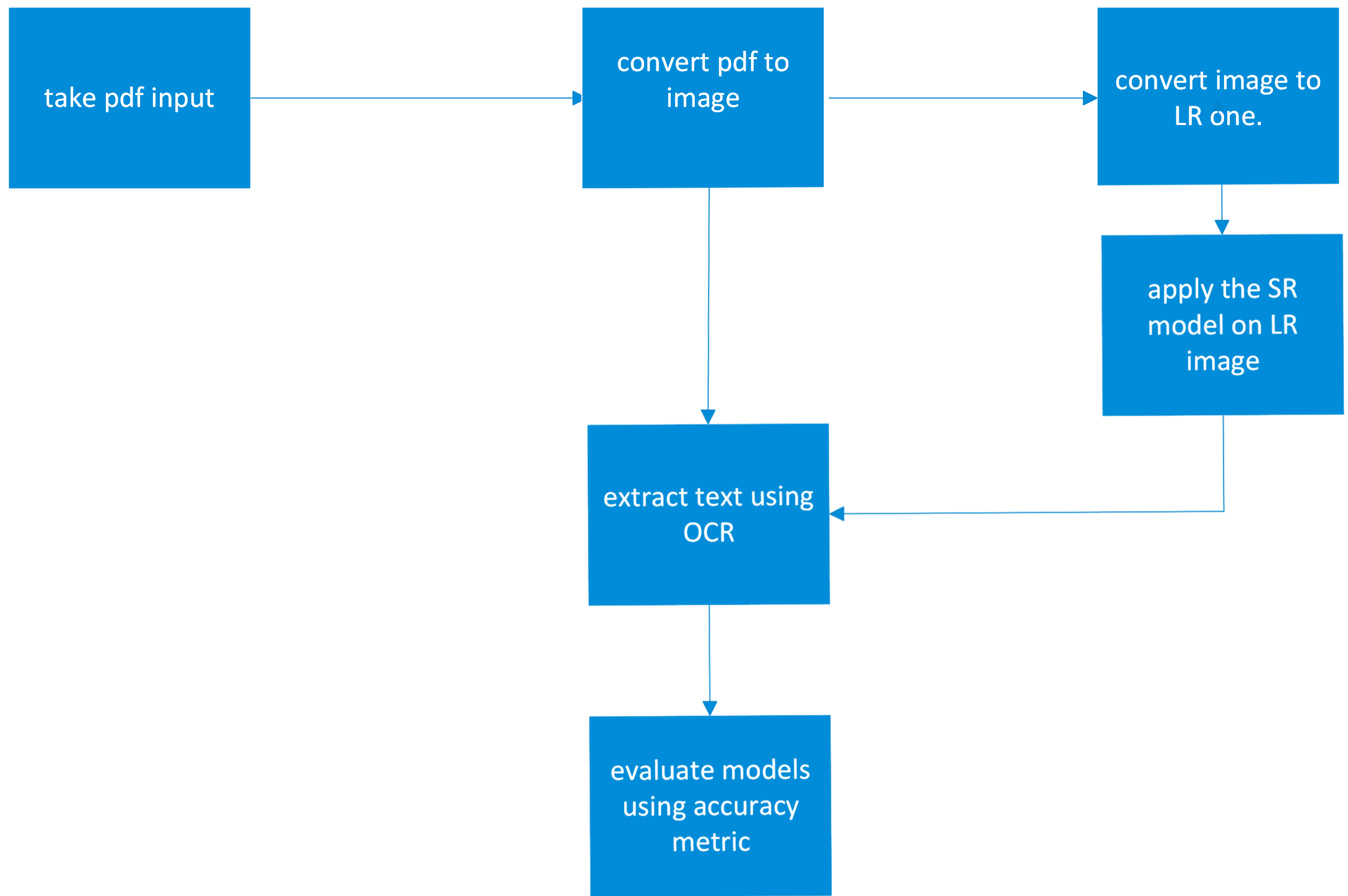
- Applied a pipeline to degrade real-world images to low-resolution (LR) scales from 0.1 to 0.5, simulating real-world image quality loss.
- Used four models: EDSR-BASE, Real-ESRGAN, ESRGAN, and EDSR (Hugging Face), all trained for single-image super-resolution.
- Applied Tesseract OCR to super-resolved outputs to measure OCR accuracy across different degradation levels and DPIs (200–260 dpi).
- Quantified performance using PSNR and SSIM metrics to evaluate image reconstruction quality.
- Evaluated models across six degradation scales and five DPI levels (200–260 dpi), with results aggregated per scale and DPI.
- Used adversarial training in GAN-based models (ESRGAN, Real-ESRGAN) and non-adversarial, residual-block-based training in EDSR for comparison.
Experimental results
Research questions
- RQ1Which SR model achieves the highest OCR accuracy across varying levels of image degradation (LR scales 0.1–0.5) and DPI (200–260 dpi)?
- RQ2How do PSNR and SSIM values correlate with OCR performance across the evaluated SR models?
- RQ3Does the use of adversarial training (in ESRGAN and Real-ESRGAN) lead to better OCR outcomes than non-adversarial, reconstruction-based training (in EDSR)?
- RQ4How does computational efficiency compare between EDSR-BASE and Real-ESRGAN, especially at scales where OCR accuracy reaches 100%?
- RQ5To what extent can super-resolution models recover text from highly degraded images (e.g., LR scale 0.1–0.3) for reliable OCR?
Key findings
- EDSR-BASE achieved 100% OCR accuracy at LR scale 0.4 across all DPI levels (220–260 dpi), outperforming all other models.
- At LR scale 0.4, EDSR-BASE maintained 100% OCR accuracy on 220 dpi (Table 3), 230 dpi (Table 4), 240 dpi (Table 5), 250 dpi (Table 6), and 260 dpi (Table 7).
- EDSR-BASE achieved higher PSNR and SSIM values than Real-ESRGAN, ESRGAN, and EDSR across all tested degradation levels.
- Real-ESRGAN outperformed EDSR-BASE only at LR scales 0.1, 0.2, and 0.3, but failed to reach 100% OCR accuracy even at scale 0.4.
- ESRGAN consistently underperformed, failing to remove blurs and compression artifacts, resulting in OCR accuracy below 98% even at scale 0.4.
- EDSR-BASE required less compute than Real-ESRGAN while achieving superior OCR accuracy, making it more efficient for large-scale deployment.
Read this paper
Open the full text in the Nubint reader and ask about any passage as you read.
Read this paper on NubintThis review was generated by AI from the original paper. Please check the paper before citing it.