
[Paper Review] A Comparative Study of Quality Evaluation Methods for Text Summarization
The paper compares eight automatic metrics and human evaluation for patent document summarization and introduces an LLM-based evaluation framework that aligns closely with human judgments, outperforming traditional metrics like ROUGE, BERTScore, and SummaC.
Evaluating text summarization has been a challenging task in natural language processing (NLP). Automatic metrics which heavily rely on reference summaries are not suitable in many situations, while human evaluation is time-consuming and labor-intensive. To bridge this gap, this paper proposes a novel method based on large language models (LLMs) for evaluating text summarization. We also conducts a comparative study on eight automatic metrics, human evaluation, and our proposed LLM-based method. Seven different types of state-of-the-art (SOTA) summarization models were evaluated. We perform extensive experiments and analysis on datasets with patent documents. Our results show that LLMs evaluation aligns closely with human evaluation, while widely-used automatic metrics such as ROUGE-2, BERTScore, and SummaC do not and also lack consistency. Based on the empirical comparison, we propose a LLM-powered framework for automatically evaluating and improving text summarization, which is beneficial and could attract wide attention among the community.
Motivation & Objective
- Evaluate the effectiveness of existing automatic summarization evaluation metrics on long-form patent texts.
- Assess how human evaluation compares to automatic metrics in judging summarization quality.
- Explore the viability of large language models (LLMs) as automatic evaluators for summaries.
- Propose an LLM-powered framework to automatically evaluate and iteratively improve summaries.
Proposed method
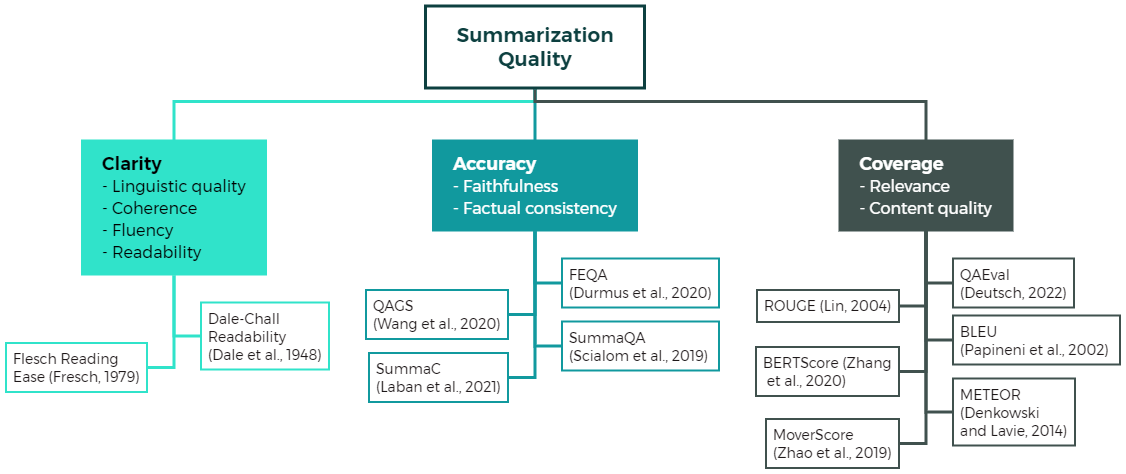
- Evaluate SOTA summarization models (T5, XLNet, BART, BigBird, Pegasus, GPT-3.5, LongT5, Llama-3) on a patent corpus using eight automatic metrics and human evaluation.
- Reassess widely-used automatic metrics (ROUGE-1/2/L, BLEU, BERTScore, SummaC, FRE, DCR) on long patent texts.
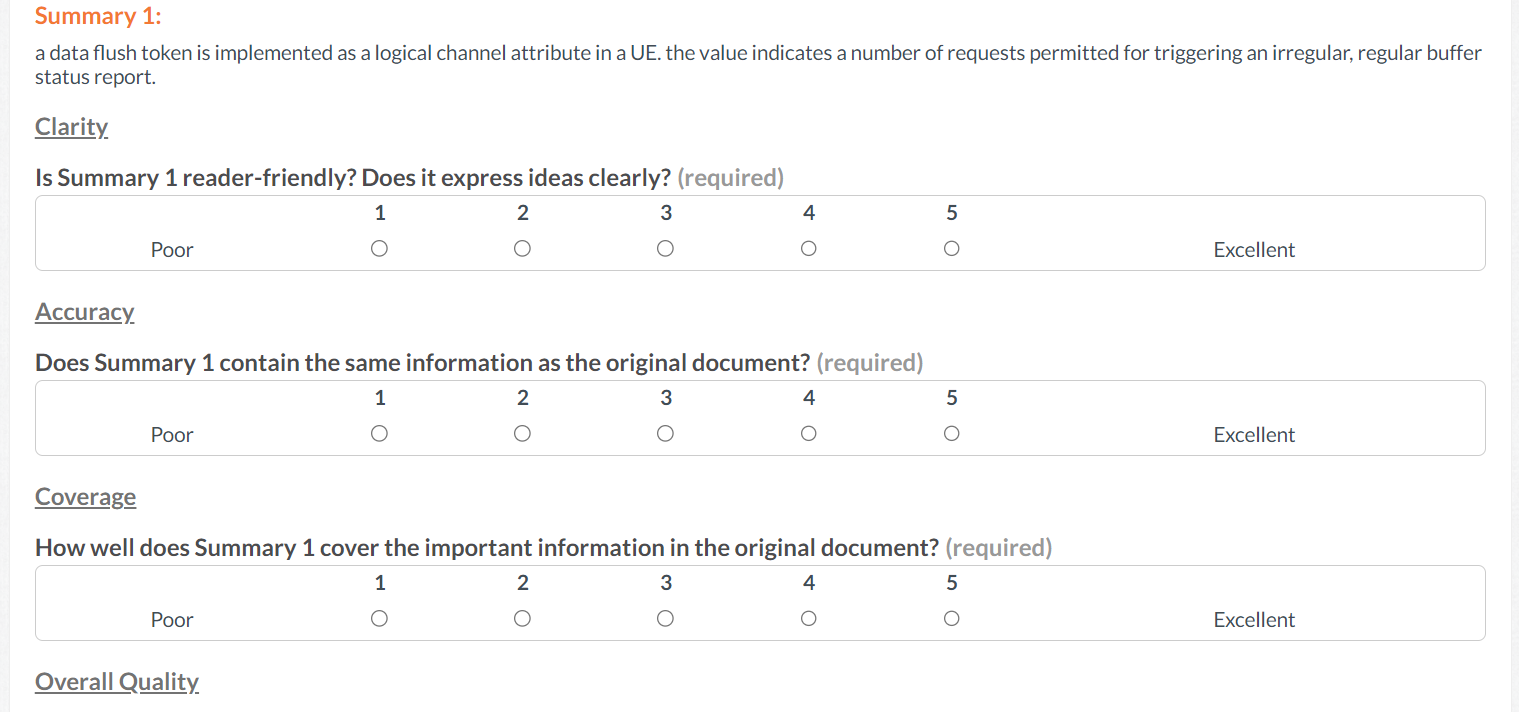
- Conduct manual human evaluation on four quality dimensions (clarity, accuracy, coverage, overall quality) with domain-aware judges.
- Implement an LLM-based evaluation approach using prompts identical to human instructions to assess summary quality.
- Perform meta-analysis (Kendall Tau-b, Spearman, Pearson) to compare automatic metrics, human evaluation, and LLM-based evaluation.
- Demonstrate an iterative improvement loop where LLM feedback informs subsequent summary generation.
Experimental results
Research questions
- RQ1How well do current automatic evaluation metrics correlate with human judgments for long-form patent summaries?
- RQ2Can LLM-based evaluation replicate or exceed human evaluation in judging summary quality?
- RQ3Does an iterative, LLM-guided refinement loop improve summary quality across key dimensions?
Key findings
- ROUGE-2, BERTScore, and SummaC show very weak or non-significant correlation with human evaluation on patent summaries.
- Readability metrics (FRE, DCR) negatively correlate with most metrics and human judgments.
- LLMs (including open-source Llama-3-8B and GPT-4) provide strong alignment with human evaluation across accuracy, coverage, and overall quality (high Kendall/Spearman correlations).
- GPT-3.5-turbo-16k produced the best overall summary quality among models evaluated in human and LLM assessments.
- Incorporating LLM verbal feedback into prompts for iterative refinement significantly improves clarity and coverage, with a slight drop in accuracy.
Read this paper
Open the full text in the Nubint reader and ask about any passage as you read.
Read this paper on NubintThis review was generated by AI from the original paper. Please check the paper before citing it.