
[Paper Review] A Comparative Study of Text Embedding Models for Semantic Text Similarity in Bug Reports
This study evaluates five text embedding models—TF-IDF, FastText, Gensim, BERT, and ADA (GPT-3.5)—for semantic text similarity in bug report duplicate detection. Using the Software Defects Dataset, BERT achieved the highest recall across multiple repositories, outperforming ADA, Gensim, FastText, and TF-IDF, demonstrating the superiority of contextualized embeddings for this task.
Bug reports are an essential aspect of software development, and it is crucial to identify and resolve them quickly to ensure the consistent functioning of software systems. Retrieving similar bug reports from an existing database can help reduce the time and effort required to resolve bugs. In this paper, we compared the effectiveness of semantic textual similarity methods for retrieving similar bug reports based on a similarity score. We explored several embedding models such as TF-IDF (Baseline), FastText, Gensim, BERT, and ADA. We used the Software Defects Data containing bug reports for various software projects to evaluate the performance of these models. Our experimental results showed that BERT generally outperformed the rest of the models regarding recall, followed by ADA, Gensim, FastText, and TFIDF. Our study provides insights into the effectiveness of different embedding methods for retrieving similar bug reports and highlights the impact of selecting the appropriate one for this task. Our code is available on GitHub.
Motivation & Objective
- To evaluate the effectiveness of various text embedding models in identifying duplicate bug reports using semantic textual similarity.
- To compare the performance of both traditional (TF-IDF, FastText, Gensim) and state-of-the-art (BERT, ADA) embedding models in real-world bug report datasets.
- To provide practical insights into model selection and evaluation methodology for efficient duplicate bug report detection in software engineering workflows.
- To highlight the limitations of restricting search space to only parent or unique reports, advocating for inclusion of all relevant reports in evaluation.
Proposed method
- Utilized the Software Defects Dataset containing bug reports from Firefox, Eclipse, MozillaCore, JDT, and Thunderbird projects.
- Applied five embedding models: TF-IDF (baseline), FastText, Gensim (LDA-based), BERT, and ADA (GPT-3.5), to generate dense vector representations of bug report summaries and descriptions.
- Computed semantic similarity using cosine similarity between query reports and all existing reports in the database.
- Evaluated model performance using recall@k (k=5) across multiple repositories, with and without date-based constraints.
- Conducted ablation studies on search space size and age-based filtering to assess practical impact on retrieval efficiency.
- Used a hash map to link child reports to their parent reports for ground truth labeling and evaluation.
Experimental results
Research questions
- RQ1How do different text embedding models compare in terms of recall@5 for duplicate bug report detection?
- RQ2Does the inclusion of both parent and unique bug reports in the search space lead to more realistic performance evaluation than using only parent reports?
- RQ3How does constraining the search space by creation date affect retrieval performance and model ranking?
- RQ4Can large language models like BERT and ADA outperform traditional models such as TF-IDF and FastText in semantic similarity tasks for bug reports?
- RQ5What are the practical implications of limiting top-k recommendations to improve triage engineer efficiency?
Key findings
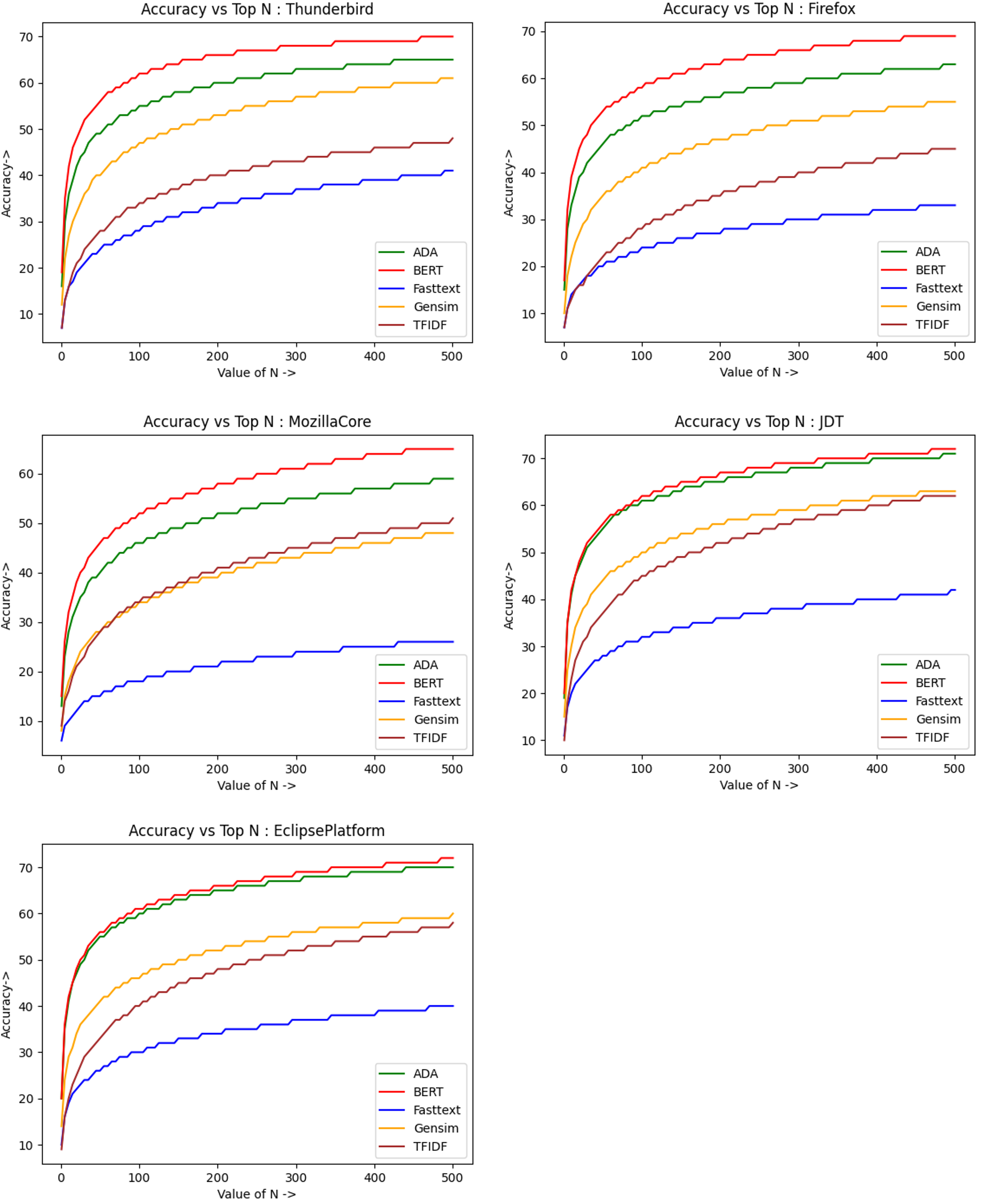
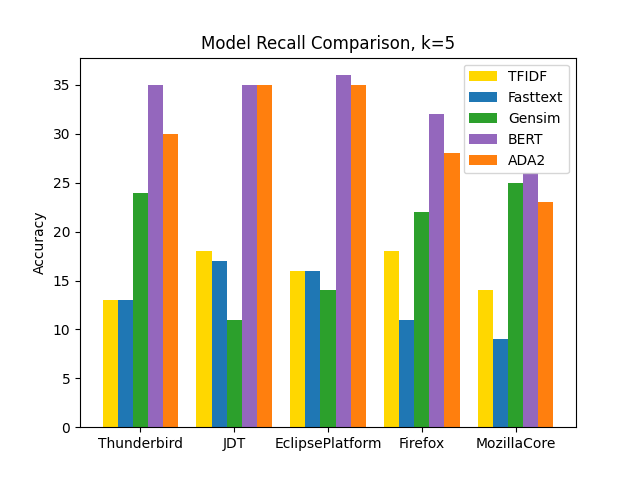
- BERT achieved the highest recall across all repositories, with a maximum recall@5 of 35 for Firefox and Eclipse, significantly outperforming other models.
- ADA (GPT-3.5) showed strong performance, ranking second with recall@5 values of 32–38, indicating strong generalization for semantic similarity.
- Gensim and FastText performed worse than BERT and ADA, with Gensim achieving up to 25 recall@5 and FastText only slightly above TF-IDF baseline in some cases.
- TF-IDF performed as a weak baseline, with recall@5 values ranging from 9 to 19, indicating limited semantic understanding.
- Limiting the search space to reports created within a specific date range reduced irrelevant results and improved ranking of actual parent reports.
- Excluding unique reports from the search space led to overestimated performance, as real-world triage involves searching through all existing reports, not just parents.
Read this paper
Open the full text in the Nubint reader and ask about any passage as you read.
Read this paper on NubintThis review was generated by AI from the original paper. Please check the paper before citing it.