
[论文解读] A Comparative Study on Non-Autoregressive Modelings for Speech-to-Text Generation
本论文通过ESPnet框架中的Conformer架构,对端到端语音转文本生成任务中的非自回归(NAR)建模技术进行了全面的对比研究。该研究在自动语音识别(ASR)和语音翻译任务上评估了多种NAR方法,包括Mask-CTC、Align-Denoise、Insertion Transformers以及基于CTC的变体,结果表明:结合中间CTC与Mask-CTC等技术可在不增加推理成本的前提下提升准确率;同时,NAR模型在语音翻译任务中也能实现具有竞争力的性能表现。
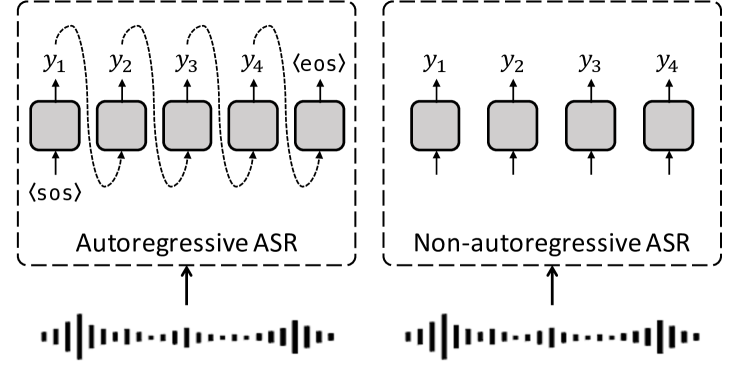
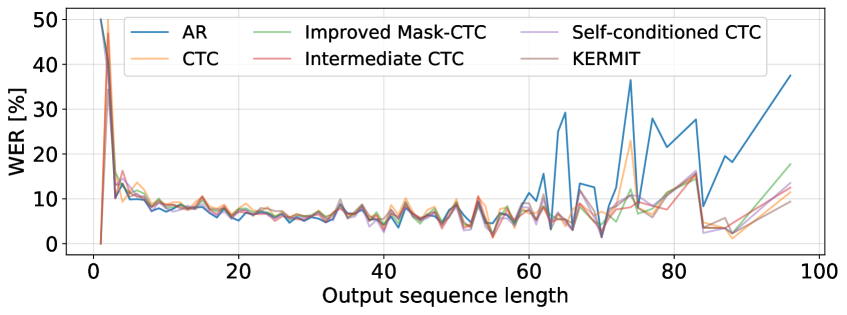
Non-autoregressive (NAR) models simultaneously generate multiple outputs in a sequence, which significantly reduces the inference speed at the cost of accuracy drop compared to autoregressive baselines. Showing great potential for real-time applications, an increasing number of NAR models have been explored in different fields to mitigate the performance gap against AR models. In this work, we conduct a comparative study of various NAR modeling methods for end-to-end automatic speech recognition (ASR). Experiments are performed in the state-of-the-art setting using ESPnet. The results on various tasks provide interesting findings for developing an understanding of NAR ASR, such as the accuracy-speed trade-off and robustness against long-form utterances. We also show that the techniques can be combined for further improvement and applied to NAR end-to-end speech translation. All the implementations are publicly available to encourage further research in NAR speech processing.
研究动机与目标
- 在最先进的设置下,对多种非自回归(NAR)建模技术在端到端自动语音识别(ASR)中的应用进行公平且全面的比较。
- 分析不同NAR架构在推理速度与识别准确率之间的权衡关系。
- 研究NAR模型在长时长及噪声语音输入下的鲁棒性表现。
- 探索结合多种NAR技术以提升性能的可行性。
- 拓展NAR模型在端到端语音翻译(E2E-ST)任务中的适用性。
提出的方法
- 在ESPnet框架中评估13种NAR模型,包括CTC、Mask-CTC、改进版Mask-CTC、Align-Denoise、Insertion Transformer、KERMIT、中间CTC、自条件CTC以及CIF-NA。
- 所有模型均采用基于Conformer的编码器-解码器架构,并使用16k词粒度子词单元。
- 应用迭代优化与精炼训练技术(如Align-Denoise和受CMLM启发的模型)以提升序列生成质量。
- 集成正则化技术(如中间CTC与自条件CTC)以稳定训练过程并改善对齐效果。
- 采用序列级知识蒸馏与预训练的自回归(AR)ASR编码器,用于E2E-ST的微调。
- 实现多阶段解码,结合帧级与词元级处理单元,以评估速度与准确率之间的权衡。
实验结果
研究问题
- RQ1在标准ASR基准测试中,不同NAR建模技术在词错误率(WER)与推理速度方面表现如何?
- RQ2噪声与长时语音输入对NAR模型鲁棒性有何影响?
- RQ3结合多种NAR技术(如Mask-CTC与中间CTC)是否能在不增加推理成本的前提下带来性能提升?
- RQ4与自回归基线模型相比,NAR模型在端到端语音翻译(E2E-ST)任务中的有效性如何?
- RQ5哪些NAR架构组件(如处理单元类型:帧 vs. 词元,或迭代次数)对模型性能影响最为显著?
主要发现
- 在LS-100测试集上,采用中间CTC微调的Mask-CTC将WER从7.5%降低至7.2%,表明正则化技术可在不增加推理成本的前提下提升NAR ASR性能。
- 在CHiME4噪声语音基准测试中,所有NAR模型均优于标准CTC,其中Mask-CTC在真实语音样本上达到24.9% WER,在模拟语音样本上达到25.8% WER。
- 在干净的LS-100数据集上,自条件CTC取得最低WER(14.6%);在Fisher-CallHome西班牙语测试集上,Orthros模型达到最高的BLEU分数(20.7),适用于E2E-ST任务。
- Mask-CTC与中间CTC的结合使LS-100的WER降低0.3个百分点,CHiME4的WER降低0.8个百分点,表明架构设计与正则化技术可实现协同增益。
- NAR模型在低质量、噪声输入下表现出较弱的鲁棒性,表明其对声学特征依赖更强,且对词元间依赖关系建模能力弱于自回归模型。
- 使用预训练的AR编码器与知识蒸馏技术显著提升了NAR E2E-ST的性能,其中Orthros在NAR模型中取得了最先进结果。
更好的研究,从现在开始
从阅读论文到最终审阅,大幅缩短您的研究时间。
无需绑定信用卡
本解读由 AI 生成,并经人工编辑审核。