
[Paper Review] A Comprehensive Scalable Framework for Cloud-Native Pattern Detection with Enhanced Expressiveness
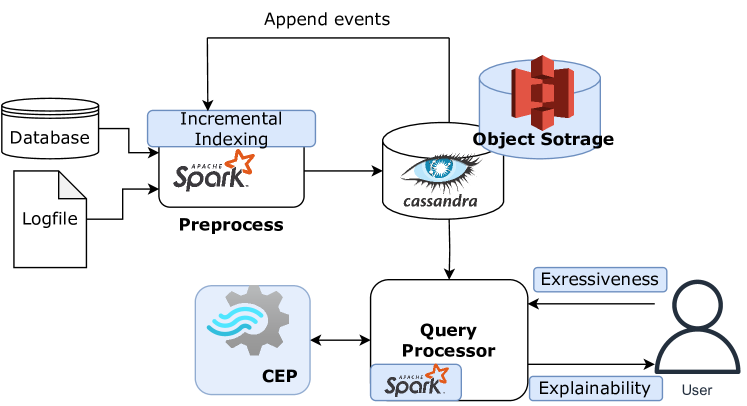
This paper proposes SIESTA, a cloud-native, scalable framework that integrates a Complex Event Processing (CEP) engine with a decoupled, index-based storage layer to enable efficient detection of complex event patterns in large-scale log data. By leveraging Spark for distributed processing and inverted indexing, SIESTA detects complex patterns in under 10 seconds—significantly outperforming ELK (which times out after 10 minutes) and FlinkCEP, while also providing explainability for non-matching traces.
Detecting complex patterns in large volumes of event logs has diverse applications in various domains, such as business processes and fraud detection. Existing systems like ELK are commonly used to tackle this challenge, but their performance deteriorates for large patterns, while they suffer from limitations in terms of expressiveness and explanatory capabilities for their responses. In this work, we propose a solution that integrates a Complex Event Processing (CEP) engine into a broader query processsor on top of a decoupled storage infrastructure containing inverted indices of log events. The results demonstrate that our system excels in scalability and robustness, particularly in handling complex queries. Notably, our proposed system delivers responses for large complex patterns within seconds, while ELK experiences timeouts after 10 minutes. It also significantly outperforms solutions relying on FlinkCEP and executing MATCH_RECOGNIZE SQL queries.
Motivation & Objective
- To address the scalability limitations of existing systems like ELK, FlinkCEP, and MATCH_RECOGNIZE SQL in detecting complex event patterns over large log databases.
- To enable efficient, real-time detection of arbitrary complex patterns—including negations, iterations, and duration constraints—across terabyte-scale event sequences.
- To enhance system explainability by identifying minimal timestamp adjustments needed to satisfy a pattern when no match is found.
- To decouple query processing from storage using a scalable, index-based architecture compatible with cloud-native deployment.
- To provide a fully open-source, reproducible system with support for both Cassandra and S3 storage backends.
Proposed method
- Integrates the SASE CEP engine within a Spark-based query processor to enable real-time pattern detection on large-scale data.
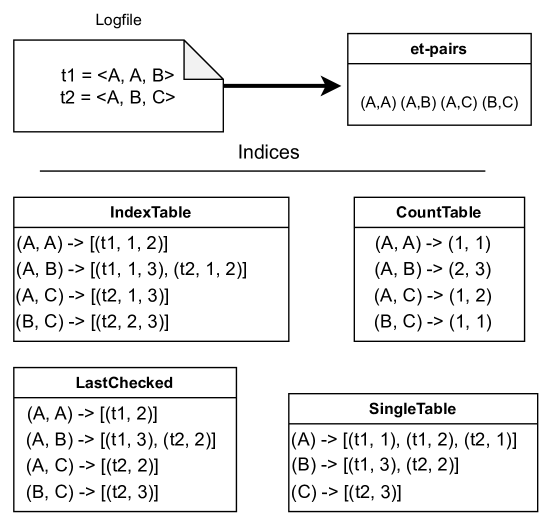
- Employs inverted indices over log events to drastically reduce the search space and accelerate query processing.
- Decouples storage from processing by using a separate, scalable storage layer (Cassandra or S3), enabling cloud-native deployment.
- Implements an incremental indexing mechanism to support dynamic log updates without full re-indexing.
- Extends the system with an explainability module that computes minimal timestamp perturbations to make a trace match a requested pattern.
- Supports complex pattern expressions including negations (!), repetitions (A*), and temporal constraints (e.g., duration limits between events).
Experimental results
Research questions
- RQ1Can a CEP-based system achieve sub-second to sub-10-second response times for complex pattern queries on terabyte-scale log data?
- RQ2How does the integration of inverted indexing and decoupled storage improve scalability compared to monolithic or stream-based CEP systems?
- RQ3To what extent can explainability features be efficiently computed without degrading performance for large queries?
- RQ4What are the performance trade-offs between using Cassandra and S3 as storage backends in cloud-native deployments?
- RQ5Can the system handle complex patterns with negations, repetitions, and duration constraints at scale, and how does it compare to FlinkCEP and ELK?
Key findings
- SIESTA detects complex patterns in under 10 seconds on large-scale data, while ELK times out after 10 minutes, demonstrating superior scalability.
- The system’s indexing and pruning mechanisms effectively reduce the search space, enabling efficient processing of complex queries even with high cardinality event types.
- Response times scale well with query size and remain stable across different data characteristics, indicating robustness in diverse workloads.
- Cassandra provides faster indexing and slightly better response times but is best suited for on-premise deployments, whereas S3 offers better cost efficiency for cloud-native environments.
- Explainability functionality increases response times, especially for longer queries (e.g., |q|=5), with the uncertainty parameter having a direct impact on latency.
- The k parameter in explainability helps achieve early termination and reduces search space, particularly in longer queries with more candidate events.
Read this paper
Open the full text in the Nubint reader and ask about any passage as you read.
Read this paper on NubintThis review was generated by AI from the original paper. Please check the paper before citing it.