
[Paper Review] A Comprehensive Survey of Few-shot Learning: Evolution, Applications, Challenges, and Opportunities
This paper surveys over 200 recent works on few-shot learning (FSL), offering a taxonomy based on knowledge abstraction and detailing challenges, applications, and future opportunities, with focus on cross-domain and multimodal aspects in computer vision.
Few-shot learning (FSL) has emerged as an effective learning method and shows great potential. Despite the recent creative works in tackling FSL tasks, learning valid information rapidly from just a few or even zero samples still remains a serious challenge. In this context, we extensively investigated 200+ latest papers on FSL published in the past three years, aiming to present a timely and comprehensive overview of the most recent advances in FSL along with impartial comparisons of the strengths and weaknesses of the existing works. For the sake of avoiding conceptual confusion, we first elaborate and compare a set of similar concepts including few-shot learning, transfer learning, and meta-learning. Furthermore, we propose a novel taxonomy to classify the existing work according to the level of abstraction of knowledge in accordance with the challenges of FSL. To enrich this survey, in each subsection we provide in-depth analysis and insightful discussion about recent advances on these topics. Moreover, taking computer vision as an example, we highlight the important application of FSL, covering various research hotspots. Finally, we conclude the survey with unique insights into the technology evolution trends together with potential future research opportunities in the hope of providing guidance to follow-up research.
Motivation & Objective
- Clarify definitions and relationships among few-shot learning, transfer learning, and meta-learning to reduce conceptual confusion.
- Propose a taxonomy of FSL organized by the level of knowledge abstraction and challenge.
- Systematically review recent FSL work (200+ papers) and summarize advances, strengths, and weaknesses.
- Highlight cross-domain and multimodal FSL as key directions and relate them to practical applications, especially in computer vision.
- Identify future research opportunities and evolution trends in FSL.
Proposed method
- Extensive literature review of 200+ FSL papers from the past three years.
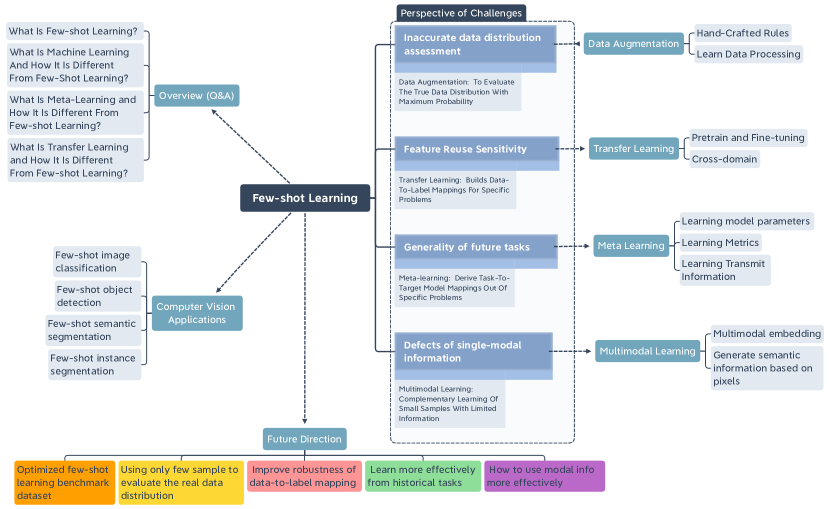
- Development of a novel taxonomy based on the level of knowledge abstraction and challenges in FSL.
- Use of knowledge graphs and heat maps to compare and contrast approaches.
- Sectional analyses anchored in data augmentation, transfer learning, meta-learning, and multimodal learning.
- Illustration of applications in computer vision tasks such as image classification, object detection, and segmentation.
Experimental results
Research questions
- RQ1What is few-shot learning and how does it relate to machine learning, transfer learning, and meta-learning?
- RQ2What are the main variants and benchmarks of FSL and how have they evolved recently?
- RQ3How can FSL be taxonomy-classified from the perspective of challenges and knowledge abstraction?
- RQ4What are the predominant challenges and how do data augmentation, transfer learning, meta-learning, and multimodal learning address them?
- RQ5What are the current advances and future opportunities in FSL with emphasis on cross-domain and computer vision applications?
Key findings
- The survey provides a timely, impartial overview of recent FSL advances and compares strengths and weaknesses across works.
- A novel taxonomy organizes FSL by the level of knowledge abstraction and by challenges, including a multimodal level.
- Cross-domain FSL and multimodal learning are highlighted as particularly challenging and promising directions.
- Data augmentation, transfer learning, and meta-learning are each analyzed as single-modal approaches addressing distinct facets of FSL.
- The paper documents FSL progress in computer vision tasks such as image classification, object detection, semantics segmentation, and instance segmentation.
Read this paper
Open the full text in the Nubint reader and ask about any passage as you read.
Read this paper on NubintThis review was generated by AI from the original paper. Please check the paper before citing it.