
[Paper Review] A Comprehensive Survey on Data Augmentation
This paper proposes a modality-independent, data-centric taxonomy for data augmentation and surveys techniques across five data modalities (image, text, graph, tabular, time-series).
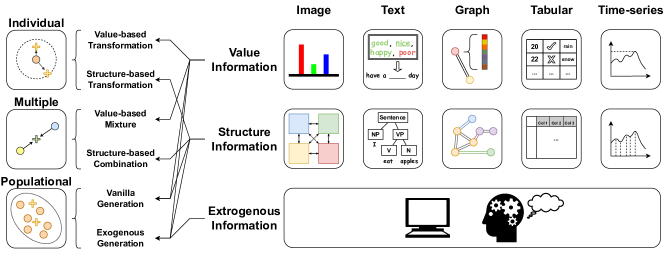
Data augmentation is a series of techniques that generate high-quality artificial data by manipulating existing data samples. By leveraging data augmentation techniques, AI models can achieve significantly improved applicability in tasks involving scarce or imbalanced datasets, thereby substantially enhancing AI models' generalization capabilities. Existing literature surveys only focus on a certain type of specific modality data and categorize these methods from modality-specific and operation-centric perspectives, which lacks a consistent summary of data augmentation methods across multiple modalities and limits the comprehension of how existing data samples serve the data augmentation process. To bridge this gap, this survey proposes a more enlightening taxonomy that encompasses data augmentation techniques for different common data modalities by investigating how to take advantage of the intrinsic relationship between and within instances. Additionally, it categorizes data augmentation methods across five data modalities through a unified inductive approach.
Motivation & Objective
- Motivate the need for data augmentation to address scarce or imbalanced datasets and improve generalization.
- Propose a modality-independent, data-centric taxonomy for data augmentation.
- Categorize augmentation techniques across five data modalities using a unified inductive approach.
- Analyze how information within each modality can be leveraged for augmentation.
- Provide up-to-date synthesis of data augmentation methods and their theoretical underpinnings.
Proposed method
- Formalize data augmentation as a function f_theta transforming a labeled dataset to an augmented dataset.
- Introduce a two-tier taxonomy based on information origin: Individual, Multiple, and Populational Augmentation.
- Further classify by: (i) which part of information is used (value-based vs structure-based), and (ii) how many samples are used to generate new data (sample-level, pairwise, population).
- Differentiate Vanilla (value/structure) vs Exogenous generation in populational augmentation.
- Apply the taxonomy to five modalities and review representative techniques per modality.
- Summarize core trends and up-to-date literature across modalities.
Experimental results
Research questions
- RQ1RQ1: How many samples are used to generate each new sample (individual, multiple, populational).
- RQ2RQ2: Which part of the information is used to generate new data (value-based vs structure-based).
- RQ3RQ3: How can a modality-independent taxonomy illuminate common patterns across different data types.
- RQ4RQ4: How latest data augmentation methods across image, text, graph, tabular, and time-series fit into the proposed taxonomy.
Key findings
- The paper provides a modality-independent, data-centric taxonomy applicable to all five data modalities.
- It identifies three augmentation types (individual, multiple, populational) and two-information sources (value vs structure) for classification.
- It consolidates and categorizes up-to-date data augmentation literature across image, text, graph, tabular, and time-series modalities.
- It highlights how information within each modality can be leveraged for augmentation through unified principles.
- It surveys and synthesizes current techniques, including automatic policy search and mixup-based strategies, within the proposed framework.
Read this paper
Open the full text in the Nubint reader and ask about any passage as you read.
Read this paper on NubintThis review was generated by AI from the original paper. Please check the paper before citing it.