
[Paper Review] A Critical Re-evaluation of Benchmark Datasets for (Deep) Learning-Based Matching Algorithms
This paper critically evaluates benchmark datasets for deep learning-based matching algorithms, revealing that most are too easy due to high linearity and low complexity. It proposes a dual methodology—using theoretical measures of linearity and complexity, and practical performance gaps between linear and non-linear models—to identify unsuitable benchmarks, and introduces a new framework to generate more challenging, realistic datasets for future research.
Entity resolution (ER) is the process of identifying records that refer to the same entities within one or across multiple databases. Numerous techniques have been developed to tackle ER challenges over the years, with recent emphasis placed on machine and deep learning methods for the matching phase. However, the quality of the benchmark datasets typically used in the experimental evaluations of learning-based matching algorithms has not been examined in the literature. To cover this gap, we propose four different approaches to assessing the difficulty and appropriateness of 13 established datasets: two theoretical approaches, which involve new measures of linearity and existing measures of complexity, and two practical approaches: the difference between the best non-linear and linear matchers, as well as the difference between the best learning-based matcher and the perfect oracle. Our analysis demonstrates that most of the popular datasets pose rather easy classification tasks. As a result, they are not suitable for properly evaluating learning-based matching algorithms. To address this issue, we propose a new methodology for yielding benchmark datasets. We put it into practice by creating four new matching tasks, and we verify that these new benchmarks are more challenging and therefore more suitable for further advancements in the field.
Motivation & Objective
- To address the lack of rigorous evaluation of benchmark datasets used in deep learning-based matching algorithms.
- To identify why many widely used datasets fail to properly assess the performance of complex, non-linear learning-based matching methods.
- To develop a principled framework for evaluating dataset difficulty based on both theoretical and empirical measures.
- To create new, more challenging benchmark datasets that better reflect real-world entity resolution challenges.
- To promote the use of higher-quality benchmarks that allow meaningful evaluation of advancements in deep learning-based matching.
Proposed method
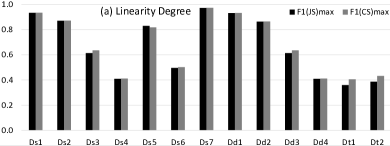
- Proposes two theoretical, a-priori measures: a novel linearity score to quantify the separability of candidate pairs and existing complexity measures applied to ER benchmarks for the first time.
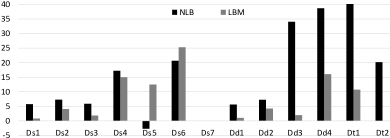
- Introduces two a-posteriori, empirical measures: the performance gap between the best non-linear and linear classifiers, and the gap between the best learning-based matcher and a perfect oracle.
- Employs seven open-source, non-linear ML/DL-based matching algorithms and introduces new linear baselines to estimate the performance ceiling of simpler models.
- Applies the framework to 13 established benchmark datasets, analyzing their difficulty through both theoretical and practical evaluation metrics.
- Uses a systematic approach to generate four new, more challenging matching tasks by tuning blocking strategies and data characteristics.
- Makes the full methodology, code, and new datasets available via a Docker image to ensure reproducibility and community adoption.
Experimental results
Research questions
- RQ1To what extent are existing benchmark datasets for deep learning-based matching algorithms actually challenging, based on theoretical and empirical measures?
- RQ2How do the performance gaps between linear and non-linear matching algorithms vary across existing benchmark datasets?
- RQ3How close do state-of-the-art learning-based matchers come to the performance of a perfect oracle on current benchmark datasets?
- RQ4Can a systematic methodology generate new benchmark datasets that are more suitable for evaluating complex, non-linear matching algorithms?
- RQ5What are the key characteristics of datasets that make them unsuitable for evaluating deep learning-based matching methods?
Key findings
- Most widely used benchmark datasets for entity resolution are nearly linearly separable, making them too easy for deep learning-based matching algorithms to demonstrate meaningful improvement.
- The performance gap between the best non-linear matcher and a linear baseline is minimal on most existing datasets, indicating limited room for advancement in model complexity.
- The gap between the best learning-based matcher and the perfect oracle is small on most benchmarks, suggesting that current datasets do not stress-test the full potential of deep learning models.
- The proposed methodology successfully generates four new benchmark datasets that are significantly more challenging, with increased complexity and reduced linearity.
- Training and prediction times vary widely: threshold-based baselines are the fastest (under 1 second per dataset), while DITTO is the slowest (up to ~219 seconds for 40 epochs), highlighting trade-offs in efficiency.
- The new benchmarks exhibit a more realistic distribution of difficulty, with higher imbalance ratios and greater demand for non-linear modeling, making them suitable for future evaluation of advanced matching algorithms.
Read this paper
Open the full text in the Nubint reader and ask about any passage as you read.
Read this paper on NubintThis review was generated by AI from the original paper. Please check the paper before citing it.