
[Paper Review] A Curriculum-style Self-training Approach for Source-Free Semantic Segmentation
This paper proposes ATP, a novel curriculum-style self-training framework for source-free semantic segmentation that enables domain adaptation without access to source data. By leveraging implicit feature alignment via hypothesis transfer, bidirectional self-training with positive and negative pseudo-labels, and information propagation for intra-domain consistency, ATP achieves state-of-the-art performance on GTA5→Cityscapes and cross-city driving benchmarks, outperforming methods requiring source data access.
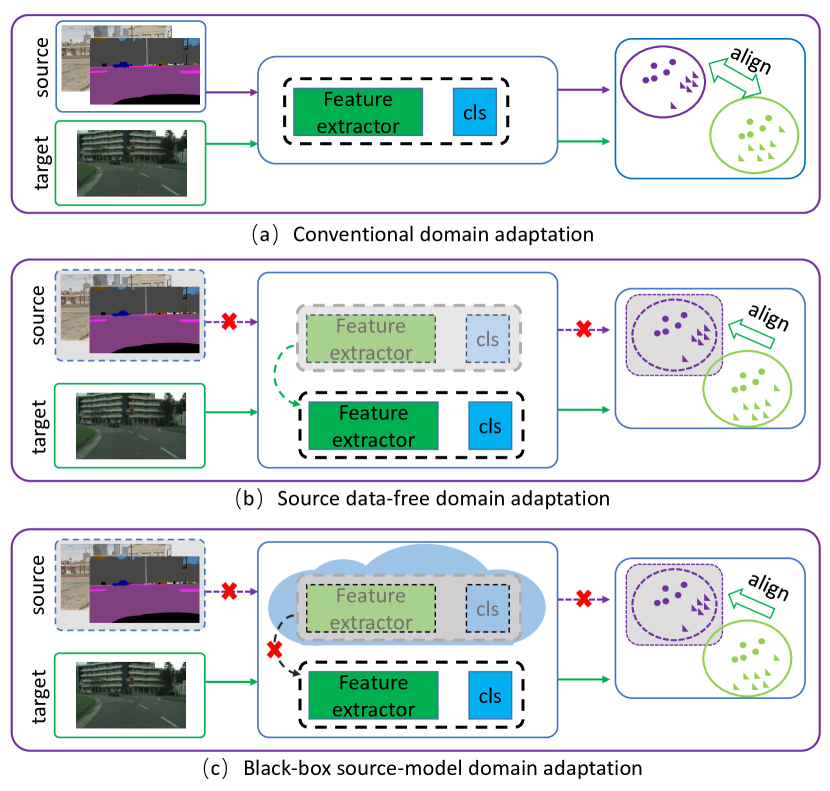
Source-free domain adaptation has developed rapidly in recent years, where the well-trained source model is adapted to the target domain instead of the source data, offering the potential for privacy concerns and intellectual property protection. However, a number of feature alignment techniques in prior domain adaptation methods are not feasible in this challenging problem setting. Thereby, we resort to probing inherent domain-invariant feature learning and propose a curriculum-style self-training approach for source-free domain adaptive semantic segmentation. In particular, we introduce a curriculum-style entropy minimization method to explore the implicit knowledge from the source model, which fits the trained source model to the target data using certain information from easy-to-hard predictions. We then train the segmentation network by the proposed complementary curriculum-style self-training, which utilizes the negative and positive pseudo labels following the curriculum-learning manner. Although negative pseudo-labels with high uncertainty cannot be identified with the correct labels, they can definitely indicate absent classes. Moreover, we employ an information propagation scheme to further reduce the intra-domain discrepancy within the target domain, which could act as a standard post-processing method for the domain adaptation field. Furthermore, we extend the proposed method to a more challenging black-box source model scenario where only the source model's predictions are available. Extensive experiments validate that our method yields state-of-the-art performance on source-free semantic segmentation tasks for both synthetic-to-real and adverse conditions datasets. The code and corresponding trained models are released at \url{https://github.com/yxiwang/ATP}.
Motivation & Objective
- Address the challenge of domain shift in semantic segmentation when source data is unavailable due to privacy or intellectual property constraints.
- Develop a source data-free domain adaptation framework that relies only on a pre-trained source model for adaptation to a new target domain.
- Extend the framework to the more practical black-box scenario where only the source model's predictions are accessible.
- Improve representation learning in the target domain by introducing negative pseudo-labels and intra-domain consistency regularization.
Proposed method
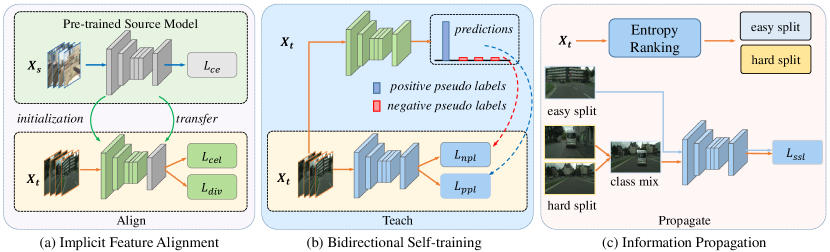
- Propose a curriculum-style entropy minimization objective to implicitly align target features with unseen source features using the source model’s predictions.
- Introduce bidirectional self-training with both positive and negative pseudo-labels to enhance feature learning by focusing on low-confidence and hard samples.
- Design an information propagation scheme that applies pseudo-semi-supervised learning to reduce intra-domain discrepancy within the target domain.
- Utilize hypothesis transfer with a frozen source classifier to stabilize feature alignment and prevent distribution shift during adaptation.
- Introduce a weighted diversity loss to encourage class-agnostic feature diversity and improve generalization.
- Extend the framework to the black-box setting by replacing access to source features with only the source model’s output predictions.
Experimental results
Research questions
- RQ1Can implicit feature alignment via hypothesis transfer effectively replace explicit domain alignment when source data is unavailable?
- RQ2Does incorporating negative pseudo-labels in self-training improve representation learning in source-free domain adaptation?
- RQ3Can information propagation via pseudo-semi-supervised learning reduce intra-domain discrepancy and improve segmentation accuracy?
- RQ4How robust is the proposed method to hyper-parameter choices, particularly in the absence of source data?
- RQ5Can the framework generalize to the black-box source model scenario where only predictions are available?
Key findings
- ATP achieves a mean Intersection over Union (mIoU) of 39.8 on the GTA5→Cityscapes benchmark, surpassing all prior source data-free methods and matching performance of methods that require source data.
- The method demonstrates strong robustness to hyper-parameters, particularly the negative pseudo-labeling threshold λ_neg, with optimal performance at λ_neg < 0.1.
- Ablation studies confirm that each component—implicit alignment, bidirectional self-training, and information propagation—contributes significantly to performance gains.
- The framework performs competitively in the black-box source model scenario, where only predictions from the source model are available, validating its practicality.
- The model converges quickly and maintains high performance even when the source classifier is not fine-tuned, indicating the stability of the hypothesis transfer mechanism.
- The method shows particular improvement on common classes but still struggles with rare or large-domain-gap categories like fence, pole, signal, and train.
Better researchstarts right now
From reading papers to final review, dramatically reduce your research time.
No credit card · Free plan available
This review was created by AI and reviewed by human editors.