
[Paper Review] A Data- and Workload-Aware Algorithm for Range Queries Under Differential Privacy
This paper proposes DAWA, a two-stage differentially private algorithm for range queries that adaptively partitions the data domain and tunes noise scaling to both data distribution and workload. By combining data-aware partitioning with workload-aware noise allocation, DAWA achieves significantly lower error than state-of-the-art methods—up to 6.86× better on easy datasets—while maintaining performance comparable to data-independent methods on complex datasets.
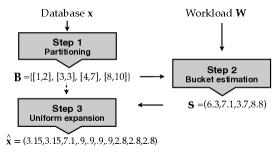
We describe a new algorithm for answering a given set of range queries under $ε$-differential privacy which often achieves substantially lower error than competing methods. Our algorithm satisfies differential privacy by adding noise that is adapted to the input data and to the given query set. We first privately learn a partitioning of the domain into buckets that suit the input data well. Then we privately estimate counts for each bucket, doing so in a manner well-suited for the given query set. Since the performance of the algorithm depends on the input database, we evaluate it on a wide range of real datasets, showing that we can achieve the benefits of data-dependence on both "easy" and "hard" databases.
Motivation & Objective
- Address the limitation of existing differentially private mechanisms that either ignore data structure (data-independent) or fail on complex, non-uniform datasets (data-dependent).
- Develop a mechanism that leverages data structure to reduce error without sacrificing performance on hard-to-exploit datasets.
- Integrate workload-aware noise allocation into a data-aware partitioning framework to improve accuracy for range query workloads.
- Design a computationally efficient, differentially private partitioning algorithm that adapts to data uniformity and automatically selects optimal bucket count.
- Achieve a balance between data-dependent accuracy gains and robustness across diverse data distributions, especially in real-world scenarios where data properties are unknown in advance.
Proposed method
- Use a novel differentially private algorithm to partition the domain into approximately uniform regions using ε₁ of the privacy budget, minimizing a cost function based on L1 deviation from uniformity.
- Apply a hierarchical query strategy in the second stage, where noise scaling factors are computed for range queries at different levels of granularity using ε₂ of the budget.
- Introduce non-uniform budget distribution across queries at the same hierarchical level, enabling fine-tuned noise allocation tailored to the specific workload.
- Leverage the structure of the workload to guide noise allocation, improving accuracy by prioritizing queries that contribute most to overall error.
- Ensure overall ε-differential privacy by splitting the privacy budget into ε₁ for partitioning and ε₂ for query estimation, with formal privacy guarantees via composition theorems.
- Use private estimation of bucket counts via a hierarchical measurement system, combining noisy answers with least-squares inference to produce consistent estimates.
Experimental results
Research questions
- RQ1Can a differentially private mechanism achieve significantly lower error than existing data-independent and data-dependent methods across diverse real-world datasets?
- RQ2How can data-aware partitioning be combined with workload-aware noise allocation to improve accuracy for range queries under differential privacy?
- RQ3To what extent does the performance of data-dependent mechanisms degrade on complex, non-uniform datasets, and can this be mitigated?
- RQ4What is the impact of adaptive, non-uniform noise allocation across hierarchical queries on overall workload error?
- RQ5Can a mechanism automatically select the optimal number of partitions without requiring user-specified parameters like k?
Key findings
- On datasets with large uniform regions, DAWA reduces average per-query error by up to a factor of 6.86 compared to the state-of-the-art data-dependent method MWEM.
- On complex datasets such as the HEP-PH citation network, DAWA achieves an average per-query error of 722.3 at ε=0.1, which is comparable to the 196.6 error of the data-independent Privelet mechanism.
- DAWA outperforms the data-independent Privelet mechanism by a factor of 3.27 on the IP-level network trace dataset, demonstrating strong gains on real-world data with exploitable structure.
- The private partitioning algorithm generates higher-quality partitions than existing methods like P-HP and StructureFirst, with better uniformity and lower cost, while running in quasilinear time.
- DAWA’s workload-aware noise allocation allows for non-uniform budget distribution across queries at the same hierarchical level, leading to more accurate estimates than uniform allocation strategies.
- The mechanism achieves the best of both worlds: high accuracy on easy datasets and robust performance on hard datasets, without requiring prior knowledge of data complexity.

Read this paper
Open the full text in the Nubint reader and ask about any passage as you read.
Read this paper on NubintThis review was generated by AI from the original paper. Please check the paper before citing it.