
[Paper Review] A decoder-only foundation model for time-series forecasting
TimesFM is a decoder-only time-series foundation model pretrained on real and synthetic data, achieving near state-of-the-art zero-shot forecasting on unseen datasets across domains.
Motivated by recent advances in large language models for Natural Language Processing (NLP), we design a time-series foundation model for forecasting whose out-of-the-box zero-shot performance on a variety of public datasets comes close to the accuracy of state-of-the-art supervised forecasting models for each individual dataset. Our model is based on pretraining a patched-decoder style attention model on a large time-series corpus, and can work well across different forecasting history lengths, prediction lengths and temporal granularities.
Motivation & Objective
- Motivate building a general zero-shot forecaster for diverse time-series without dataset-specific covariates.
- Design a decoder-style transformer with input patching suitable for varying context and horizon lengths.
- Show that a 200M-parameter model trained on ~100B timepoints can approach supervised-state accuracy on unseen data.
- Demonstrate zero-shot performance across different domains, granularities, and horizons.
- Provide ablations to justify architectural choices and pretraining data impact.
Proposed method
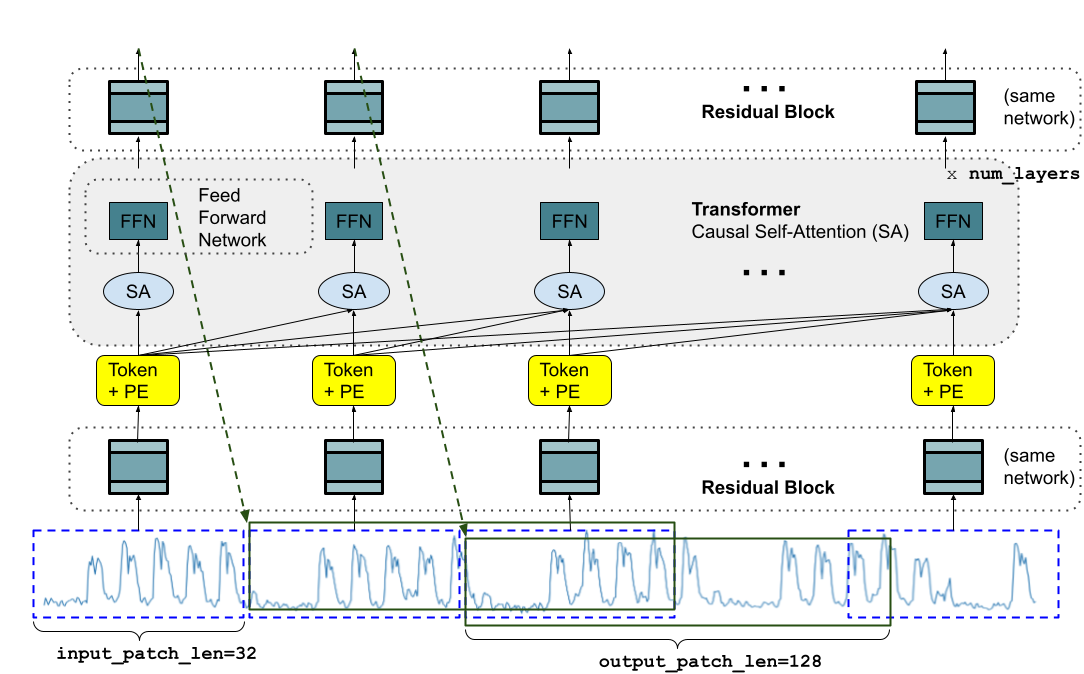
- Patch-based input processing to convert time-series into patches and feed into a decoder-only transformer.
- Use longer output patches to forecast longer horizons with fewer autoregressive steps.
- Apply patch masking during training to enable variable context lengths from 1 up to a maximum context length.
- Train a decoder-only model (TimesFM) with residual blocks and causal multi-head self-attention.
- Pretrain on a large, mixed corpus of real-world (Google Trends, Wiki Pageviews) and synthetic time-series (~100B timepoints).
- Train with MSE loss for point forecasting, with potential for probabilistic heads in future work.
Experimental results
Research questions
- RQ1Can a single pre-trained time-series foundation model achieve strong zero-shot forecasting on unseen datasets across domains?
- RQ2What architectural choices (patching, decoder-only design, patch length trade-offs) enable effective zero-shot generalization in time-series forecasting?
- RQ3How do data sources and pretraining scale affect zero-shot forecasting performance across varied horizons and granularities?
- RQ4Is longer output patch decoding beneficial for long-horizon forecasting in a foundation-model setting?
- RQ5What is the impact of patch size and masking strategies on context-length robustness and accuracy?
Key findings
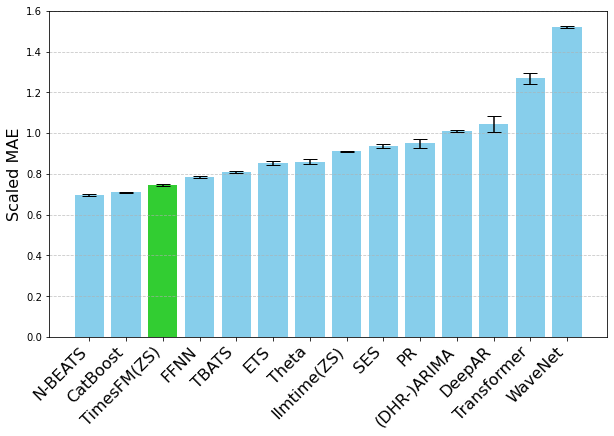
- TimesFM achieves zero-shot forecasting performance close to state-of-the-art supervised models on diverse, previously unseen datasets.
- The model, with 200M parameters, pretrained on ~100B timepoints, can generalize across different horizons and granularities.
- TimesFM is competitive with top baselines on Monash, Darts, and Informer dataset groups in zero-shot settings.
- Ablations show parameter scaling improves performance, longer output patches reduce autoregressive steps and improve accuracy for long horizons.
- Large, diverse pretraining data (real + synthetic) substantially improves zero-shot performance compared to smallerreal-only pretraining.
Read this paper
Open the full text in the Nubint reader and ask about any passage as you read.
Read this paper on NubintThis review was generated by AI from the original paper. Please check the paper before citing it.