
[Paper Review] A dormant, overmassive black hole in the early Universe
The study reports the detection of a broad H-alpha line in a z=6.68 galaxy (JADES GN+189.09144+62.22811) indicating a ~4×10^8 solar mass black hole accreting at ~2.4% Eddington, yielding an overmassive BH relative to its host's stellar mass and suggesting a population of dormant, overmassive BHs in the early Universe.
Recent observations have found a large number of supermassive black holes already in place in the first few hundred million years after Big Bang. The channels of formation and growth of these early, massive black holes are not clear, with scenarios ranging from heavy seeds to light seeds experiencing bursts of high accretion rate. Here we present the detection, from the JADES survey, of broad Halpha emission in a galaxy at z=6.68, which traces a black hole with mass of ~ 4 * 10^8 Msun and accreting at a rate of only 0.02 times the Eddington limit. The host galaxy has low star formation rate (~ 1 Msun/yr, a factor of 3 below the star forming main sequence). The black hole to stellar mass ratio is ~ 0.4, i.e. about 1,000 times above the local relation, while the system is closer to the local relations in terms of dynamical mass and velocity dispersion of the host galaxy. This object is most likely the tip of the iceberg of a much larger population of dormant black holes around the epoch of reionisation. Its properties are consistent with scenarios in which short bursts of super-Eddington accretion have resulted in black hole overgrowth and massive gas expulsion from the accretion disk; in between bursts, black holes spend most of their life in a dormant state.
Motivation & Objective
- Motivate understanding of how supermassive black holes formed and grew in the first billion years after the Big Bang.
- Characterize the central BH in JADES GN+189.09144+62.22811 through broad H-alpha emission to estimate BH mass and accretion rate.
- Assess the host galaxy properties (stellar mass, SFR, morphology) and their relation to local BH-galaxy scaling relations.
- Compare observations with theoretical models and simulations to evaluate seeding scenarios (heavy vs light seeds) and accretion modes (including super-Eddington bursts).
- Discuss implications for the prevalence of dormant, overmassive BHs at high redshift and feedback effects on host galaxy evolution
Proposed method
- Obtain JWST NIRSpec/prism and NIRCam imaging data from the JADES survey for the z=6.677 galaxy.
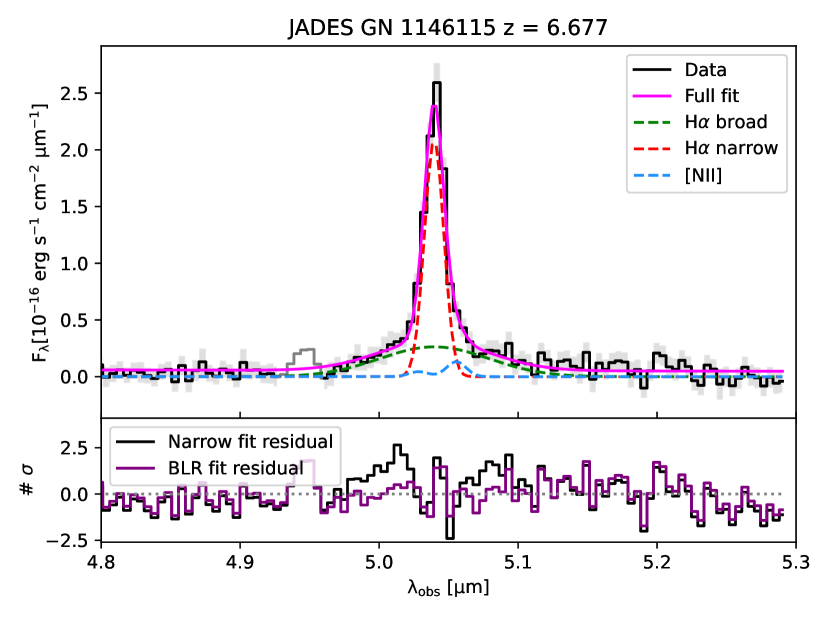
- Fit the H-alpha region with a two-component model (narrow + broad) to identify a broad BLR signature and estimate black hole mass.
- Use local virial relations with dust obscuration considerations to derive M_BH from the broad H-alpha width and flux.
- Estimate bolometric luminosity from the broad H-alpha component and from nuclear SED fitting to derive Eddington ratio (lambda_Edd).
- Decompose the host galaxy light with ForcePho to separate nuclear and host contributions; perform SED fitting with BAGPIPES and Prospector to derive M_* and SFR.
- Analyze ancillary lines (H-beta, [O III], [O II], [N II], [S II]) to constrain metallicity, electron temperature, and ionization state; assess potential outflows.
Experimental results
Research questions
- RQ1What is the black hole mass and accretion rate in the z=6.677 galaxy JADES GN+189.09144+62.22811?
- RQ2How does the black hole–host galaxy mass relation at high redshift compare to local scaling relations, particularly for overmassive BHs?
- RQ3Do observations favor light-seed or heavy-seed scenarios, and are super-Eddington accretion bursts required to explain the BH growth?
- RQ4What are the host galaxy properties (stellar mass, SFR, morphology, metallicity) and what do they imply about BH feedback and coevolution?
Key findings
- Broad H-alpha emission with FWHM ≈ 5700 km/s indicates a central AGN with M_BH ≈ 10^8.61 M_⊙ (≈ 4×10^8 M_⊙) and L_bol/L_Edd ≈ 0.024.
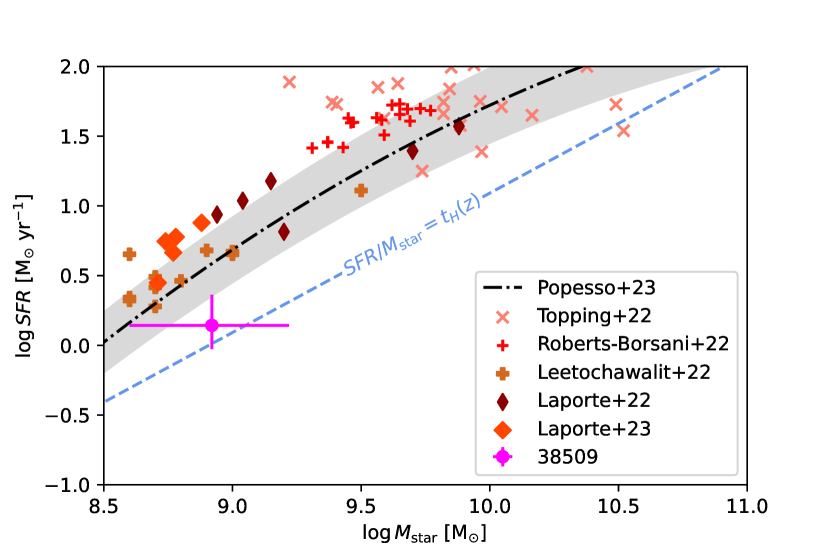
- Host galaxy stellar mass ≈ 10^8.92 M_⊙ and SFR ≈ 1.38 M_⊙ yr^-1, placing it below the star-forming main sequence by about a factor of 3.
- BH-to-stellar mass ratio is ~0.43 (M_BH/M_* ≈ 0.43), about 1,000× above the local relation, while dynamical mass and velocity dispersion place it closer to local relations.
- Evidence suggests short bursts of super-Eddington accretion with strong feedback lead to rapid BH growth followed by long dormant periods; models with light seeds + super-Eddington bursts can reproduce observed properties.
- The object appears underluminous for an AGN given its mass, implying a dormant phase with low accretion rate, and indicating such dormant, overmassive BHs may be common at high redshift.
- Metallicity inferred from [O III] 4363 yields Z ≈ 0.04 Z_⊙, and gas mass fraction is high (~0.74) with a long depletion time (~1.6 Gyr), suggesting recent metal-poor gas accretion and potential AGN feedback effects on star formation.
Read this paper
Open the full text in the Nubint reader and ask about any passage as you read.
Read this paper on NubintThis review was generated by AI from the original paper. Please check the paper before citing it.