
[Paper Review] A Dual-Augmentor Framework for Domain Generalization in 3D Human Pose Estimation
This paper proposes a dual-augmentor framework for domain generalization in 3D human pose estimation, using a weak augmentor to preserve source-domain knowledge and a strong augmentor to explore out-of-distribution poses, while meta-optimization simulates domain shifts during training. The method achieves state-of-the-art performance, improving MPJPE by 2.4mm and AUC by 0.8% on 3DHP and outperforming prior methods across multiple benchmarks.
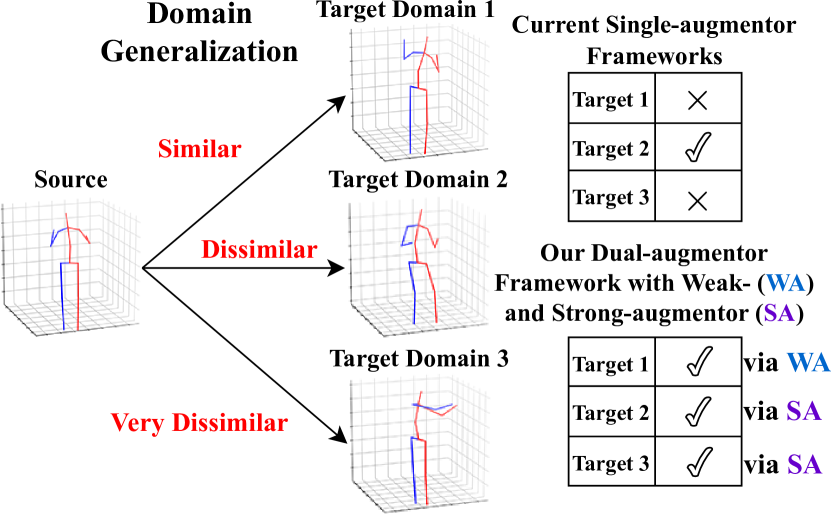
3D human pose data collected in controlled laboratory settings present challenges for pose estimators that generalize across diverse scenarios. To address this, domain generalization is employed. Current methodologies in domain generalization for 3D human pose estimation typically utilize adversarial training to generate synthetic poses for training. Nonetheless, these approaches exhibit several limitations. First, the lack of prior information about the target domain complicates the application of suitable augmentation through a single pose augmentor, affecting generalization on target domains. Moreover, adversarial training's discriminator tends to enforce similarity between source and synthesized poses, impeding the exploration of out-of-source distributions. Furthermore, the pose estimator's optimization is not exposed to domain shifts, limiting its overall generalization ability. To address these limitations, we propose a novel framework featuring two pose augmentors: the weak and the strong augmentors. Our framework employs differential strategies for generation and discrimination processes, facilitating the preservation of knowledge related to source poses and the exploration of out-of-source distributions without prior information about target poses. Besides, we leverage meta-optimization to simulate domain shifts in the optimization process of the pose estimator, thereby improving its generalization ability. Our proposed approach significantly outperforms existing methods, as demonstrated through comprehensive experiments on various benchmark datasets.Our code will be released at \url{https://github.com/davidpengucf/DAF-DG}.
Motivation & Objective
- To address domain generalization in 3D human pose estimation where labeled data are limited to controlled lab settings.
- To overcome limitations of single-augmentor methods that fail to balance preserving source knowledge and exploring out-of-distribution poses.
- To reduce reliance on adversarial training that enforces similarity between source and synthesized poses, limiting diversity.
- To improve pose estimator generalization by simulating domain shifts during optimization via meta-optimization.
- To enable effective training without target domain data, relying solely on source data.
Proposed method
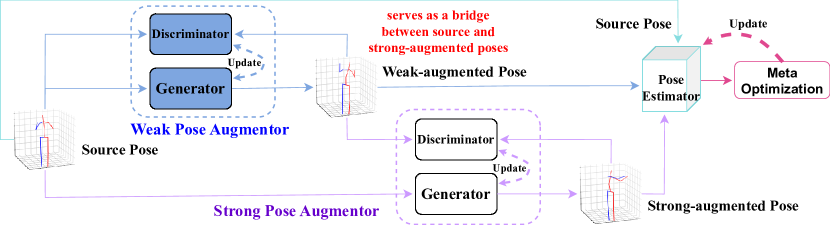
- Introduces two distinct pose augmentors: a weak augmentor for preserving source-like poses and a strong augmentor for exploring out-of-source distributions.
- Employs differential strategies in generation and discrimination: weak-augmented poses are used as a bridge to allow the discriminator to distinguish between strong-augmented and weak-augmented poses.
- Uses proximate pairs (W-PP, S-PP) to maintain local pose consistency and one-state gap pairs (W-OG, S-OG) to enforce structural differences between weak and strong generators.
- Applies meta-optimization across source, weak-augmented, and strong-augmented poses to simulate domain shifts during training and improve domain-invariant feature learning.
- Leverages adversarial training with a modified discriminator setup that avoids forcing similarity between source and all augmented poses.
- Employs VPose as the backbone network and evaluates on 3DHP and 3DPW datasets with standard metrics including PCK, AUC, and MPJPE.
Experimental results
Research questions
- RQ1Can a dual-augmentor framework better balance preserving source-domain knowledge and exploring out-of-distribution poses than single-augmentor methods?
- RQ2Does decoupling the discrimination process between weak and strong augmentors improve generalization without relying on adversarial similarity enforcement?
- RQ3To what extent does meta-optimization among source, weak-augmented, and strong-augmented data enhance the pose estimator’s robustness to domain shifts?
- RQ4How do the proximate and one-state gap pair components contribute to the quality and diversity of synthesized poses?
- RQ5Does the dual-augmentor framework achieve superior performance on standard 3D HPE benchmarks compared to state-of-the-art domain generalization methods?
Key findings
- The proposed dual-augmentor framework achieves a 1.2% improvement in PCK and 0.8% in AUC on 3DHP, along with a 2.4mm reduction in MPJPE, compared to prior SOTA methods.
- On 3DPW, the method improves PA-MPJPE by 1.3mm and MPJPE by 1.8mm, demonstrating consistent gains across datasets.
- Abllation studies show that removing the weak-augmented proximate pairs (W-PP) causes a 4.6% drop in PCK and a 9.5mm increase in MPJPE on 3DHP, highlighting their critical role in pose consistency.
- Excluding one-state gap pairs in the strong augmentor (S-OG) leads to a 1.5% drop in PCK and 3.4mm increase in MPJPE, indicating their importance in differentiating generator outputs.
- The dual-augmentor framework outperforms both single-augmentor baselines (WA and SA), with WA achieving only 87.3% PCK and SA 89.8% PCK on 3DHP, while the full method reaches 92.9% PCK.
- The ablation study confirms that all components—differential generation, differential discrimination, and meta-optimization—are essential, as removing any leads to significant performance drops.
Read this paper
Open the full text in the Nubint reader and ask about any passage as you read.
Read this paper on NubintThis review was generated by AI from the original paper. Please check the paper before citing it.