
[Paper Review] A Dynamical Model of Neural Scaling Laws
This paper proposes a solvable dynamical model based on random feature networks with gradient descent to explain neural scaling laws. It derives asymmetric compute-optimal scaling rules where training time scales faster than model size, predicts late-time width-dependent loss exponents, and explains finite-width corrections due to data reuse—offering a unified theory for key empirical scaling phenomena in deep learning.
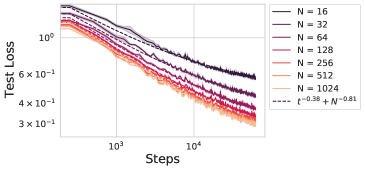
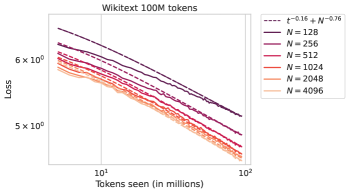
On a variety of tasks, the performance of neural networks predictably improves with training time, dataset size and model size across many orders of magnitude. This phenomenon is known as a neural scaling law. Of fundamental importance is the compute-optimal scaling law, which reports the performance as a function of units of compute when choosing model sizes optimally. We analyze a random feature model trained with gradient descent as a solvable model of network training and generalization. This reproduces many observations about neural scaling laws. First, our model makes a prediction about why the scaling of performance with training time and with model size have different power law exponents. Consequently, the theory predicts an asymmetric compute-optimal scaling rule where the number of training steps are increased faster than model parameters, consistent with recent empirical observations. Second, it has been observed that early in training, networks converge to their infinite-width dynamics at a rate $1/ extit{width}$ but at late time exhibit a rate $ extit{width}^{-c}$, where $c$ depends on the structure of the architecture and task. We show that our model exhibits this behavior. Lastly, our theory shows how the gap between training and test loss can gradually build up over time due to repeated reuse of data.
Motivation & Objective
- To understand the origin of neural scaling laws, particularly the asymmetric scaling of model size and training time under fixed compute.
- To explain why scaling exponents for training time and model size differ, leading to non-uniform compute-optimal strategies.
- To model how finite-width effects and data reuse accumulate over time, causing performance gaps between training and test loss.
- To derive late-time scaling exponents that depend on architecture and task, contrasting with early-time $1/\text{width}$ behavior.
- To clarify the limitations of ensembling versus width scaling in infinite-width limits, showing they are not equivalent in finite settings.
Proposed method
- Analyzes a random feature model trained with gradient descent as a solvable proxy for deep network training.
- Applies mean field theory and dynamical message passing (DMP) to compute correlation and response functions in the infinite-width limit.
- Derives order parameters for loss, correlation, and response functions using self-consistent equations in discrete time.
- Uses Fourier transform methods to handle singularities in the model/data bottleneck regime ($\alpha < 1$ or $\nu < 1$) via principal value and delta-function decomposition.
- Solves the optimization problem for compute-optimal scaling by minimizing a sum of power laws under fixed compute $C = Nt$.
- Numerically iterates the self-consistent equations for response and correlation functions to compute test loss and scaling exponents.
Experimental results
Research questions
- RQ1Why do scaling exponents for training time and model size differ, and how does this lead to asymmetric compute-optimal scaling?
- RQ2How do finite-width corrections evolve over time, and why do they transition from $1/\text{width}$ to $\text{width}^{-c}$ behavior?
- RQ3What causes the gradual increase in the generalization gap due to data reuse during training?
- RQ4Why do wider models not always generalize better, especially in late training with repeated data?
- RQ5How do the scaling behaviors of ensembling and increasing width compare in finite-width regimes?
Key findings
- The model predicts asymmetric compute-optimal scaling with $t \propto C^{c_2}$ and $N \propto C^{c_1}$, where $c_2 > c_1$, consistent with empirical observations in large language models.
- The theory reproduces the transition from early-time $1/\text{width}$ finite-width corrections to late-time $\text{width}^{-c}$ scaling, with $c$ dependent on architecture and task.
- The generalization gap between training and test loss grows gradually due to repeated data reuse, even in the absence of explicit overfitting.
- The model shows that ensembling does not replicate the benefits of increasing width in finite-width regimes, challenging the equivalence of the two in practice.
- Compute-optimal loss scales as $\mathcal{L}_\star(C) \propto C^{-\frac{r_t r_N}{r_t + r_N}}$, derived from minimizing a sum of power laws under fixed compute.
- The model captures the non-monotonic behavior in test loss with width under data repetition, explaining the reversal of the 'wider is better' trend in late training.
Read this paper
Open the full text in the Nubint reader and ask about any passage as you read.
Read this paper on NubintThis review was generated by AI from the original paper. Please check the paper before citing it.