
[Paper Review] A feature-based information-theoretic approach for detecting interpretable, long-timescale pairwise interactions from time series
This paper proposes a feature-based information-theoretic method that detects interpretable, long-timescale pairwise interactions in time series by modeling dependence through time-series features (e.g., mean, autocorrelation, mode) rather than raw values. It outperforms traditional methods like mutual information on raw data in low-sample, high-noise, and long-memory scenarios, especially for features with smoother statistical surfaces.
Quantifying relationships between components of a complex system is critical to understanding the rich network of interactions that characterize the behavior of the system. Traditional methods for detecting pairwise dependence of time series, such as Pearson correlation, Granger causality, and mutual information, are computed directly in the space of measured time-series values. But for systems in which interactions are mediated by statistical properties of the time series (`time-series features') over longer timescales, this approach can fail to capture the underlying dependence from limited and noisy time-series data, and can be challenging to interpret. Addressing these issues, here we introduce an information-theoretic method for detecting dependence between time series mediated by time-series features that provides interpretable insights into the nature of the interactions. Our method extracts a candidate set of time-series features from sliding windows of the source time series and assesses their role in mediating a relationship to values of the target process. Across simulations of three different generative processes, we demonstrate that our feature-based approach can outperform a traditional inference approach based on raw time-series values, especially in challenging scenarios characterized by short time-series lengths, high noise levels, and long interaction timescales. Our work introduces a new tool for inferring and interpreting feature-mediated interactions from time-series data, contributing to the broader landscape of quantitative analysis in complex systems research, with potential applications in various domains including but not limited to neuroscience, finance, climate science, and engineering.
Motivation & Objective
- To address the limitations of traditional time-series dependence measures—like Pearson correlation and mutual information on raw values—when detecting long-timescale, feature-mediated interactions in noisy or short time-series data.
- To develop a method that captures interactions mediated by statistical properties (features) of time series over extended timescales, which are common in complex systems such as neural dynamics and financial markets.
- To improve interpretability by explicitly identifying which time-series features (e.g., mean, mode, time-reversibility) mediate the dependence between source and target processes.
- To enhance detection sensitivity and reliability in challenging conditions—short time-series lengths, high noise, and long interaction timescales—where standard methods fail.
Proposed method
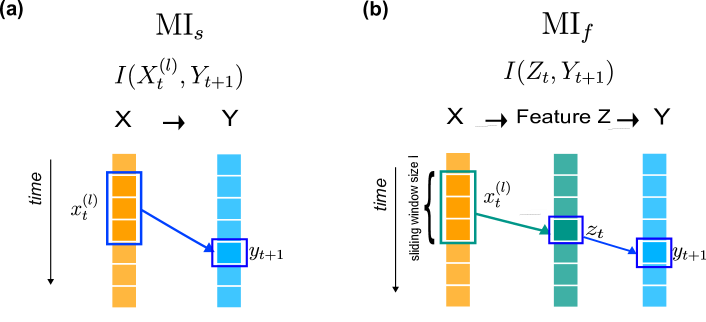
- The method extracts time-series features (e.g., mean, standard deviation, autocorrelation timescale, mode, time-reversibility) from sliding windows of the source time series.
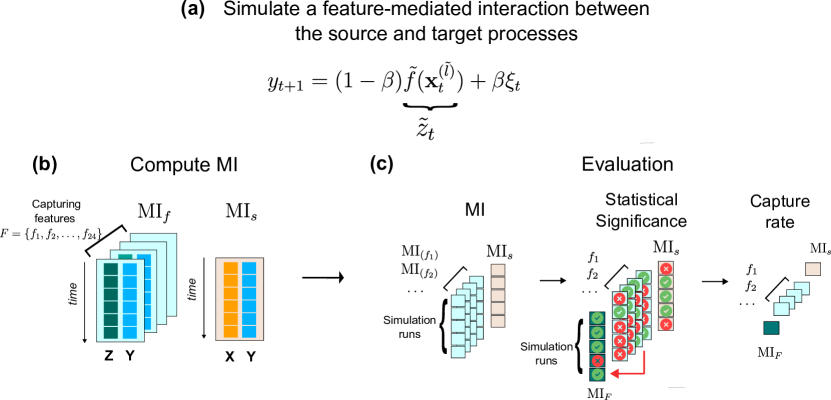
- It computes mutual information (MI) between the target process and each extracted feature, using a sliding window to model the source’s recent history.
- The approach models the target process as responding to a single time-series feature from the source’s past, with a linear noisy response model used in simulations to validate performance.
- It uses time-delay embedding to represent the source process in a higher-dimensional space, enabling feature computation over temporal windows.
- The method evaluates dependence via mutual information between the target and feature vectors, allowing detection of non-Markovian, long-memory interactions.
- It compares performance against standard mutual information on raw values (MI_raw) and assesses sensitivity across different features and data conditions.
Experimental results
Research questions
- RQ1Can a feature-based information-theoretic approach detect long-timescale, feature-mediated interactions more effectively than standard methods relying on raw time-series values?
- RQ2How does the performance of the method vary across different time-series features (e.g., mean, mode, autocorrelation) under varying noise levels and time-series lengths?
- RQ3To what extent does the smoothness of the feature surface in time-delay embedding space influence the reliability of dependence detection?
- RQ4Can the method reliably detect interactions when the target process depends on a statistical property of the source process over extended timescales, even with limited data?
- RQ5How does the method’s interpretability compare to traditional approaches in identifying the specific dynamical property mediating the interaction?
Key findings
- The feature-based mutual information (MI_F) method significantly outperforms standard mutual information on raw values (MI_raw) in detecting long-timescale interactions, especially under high noise and short time-series lengths.
- The detection performance varies by feature type, with smoother features like mean and standard deviation showing faster convergence and higher capture rates than rougher features like mode_5.
- The dependence capture rate for mode_5 increases slowly with time-series length, indicating that feature-mediated interactions involving non-smooth statistical properties are harder to detect.
- The method’s performance is non-monotonic with respect to interaction timescale and feature type, reflecting complex interplay between data length, noise, and feature surface roughness.
- Theoretical analysis suggests that smoother feature surfaces in time-delay embedding space are less sensitive to noise, explaining the observed performance differences across features.
- The approach enables interpretable detection by identifying which specific time-series feature (e.g., volatility, oscillation frequency) mediates the interaction, offering insight into the underlying dynamical mechanism.
Read this paper
Open the full text in the Nubint reader and ask about any passage as you read.
Read this paper on NubintThis review was generated by AI from the original paper. Please check the paper before citing it.