
[Paper Review] A fully hybrid integrated Erbium-based laser
Demonstrates a fully integrated chip-scale Erbium laser on Er:Si3N4 with a Vernier filter, achieving sub-100 Hz intrinsic linewidth, high SMSR (>72 dB), wide tunability (>40 nm), and ~17 mW output power with a III-V pump laser.
Erbium-doped fiber lasers exhibit high coherence and low noise as required for applications in fiber optic sensing, gyroscopes, LiDAR, and optical frequency metrology. Endowing Erbium-based gain in photonic integrated circuits can provide a basis for miniaturizing low-noise fiber lasers to chip-scale form factor, and enable large-volume applications. Yet, while major progress has been made in the last decade on integrated lasers based on silicon photonics with III-V gain media, the integration of Erbium lasers on chip has been compounded by large laser linewidth. Recent advances in photonic integrated circuit-based high-power Erbium-doped amplifiers, make a new class of rare-earth-ion-based lasers possible. Here, we demonstrate a fully integrated chip-scale Erbium laser that achieves high power, narrow linewidth, frequency agility, and the integration of a III-V pump laser. The laser circuit is based on an Erbium-implanted ultralow-loss silicon nitride Si$_3$N$4$ photonic integrated circuit. This device achieves single-mode lasing with a free-running intrinsic linewidth of 50 Hz, a relative intensity noise of $<$-150 dBc/Hz at $>$10 MHz offset, and output power up to 17 mW, approaching the performance of fiber lasers and state-of-the-art semiconductor extended cavity lasers. An intra-cavity microring-based Vernier filter enables wavelength tunability of $>$ 40 nm within the C- and L-bands while attaining side mode suppression ratio (SMSR) of $>$ 70 dB, surpassing legacy fiber lasers in tuning and SMRS performance. This new class of low-noise, tuneable Erbium waveguide laser could find applications in LiDAR, microwave photonics, optical frequency synthesis, and free-space communications. Our approach is extendable to other wavelengths, and more broadly, constitutes a novel way to photonic integrated circuit-based rare-earth-ion-doped lasers.
Motivation & Objective
- Motivate integration of Erbium gain on photonic chips to combine fiber-laser coherence with chip-scale form factors.
- Demonstrate a fully hybrid integrated Erbium laser using Er:Si3N4 circuitry with meter-scale Erbium gain for substantial net gain.
- Achieve single-mode lasing with narrow linewidth, low noise, and tunable operation within the Erbium emission band.
- Integrate a III-V pump laser to enable a compact, packaged laser platform.
Proposed method
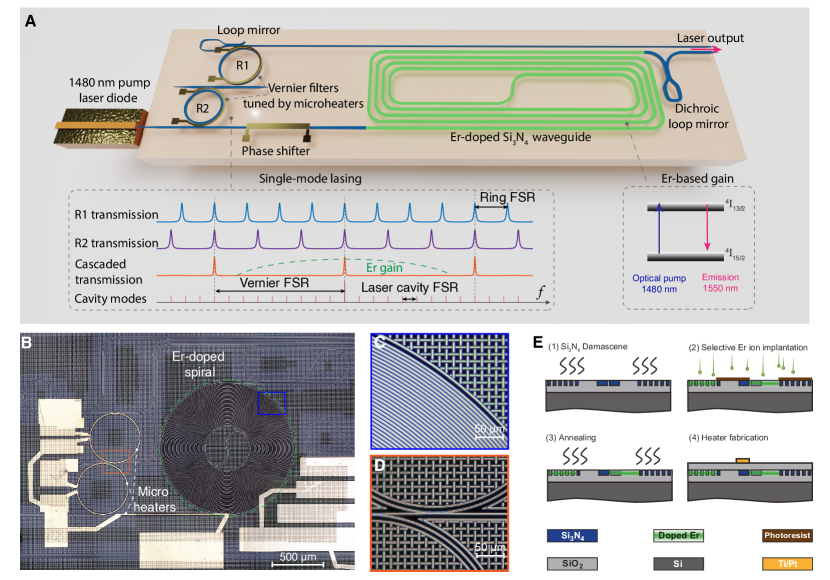
- Use Erbium-implanted ultralow-loss Si3N4 photonic integrated circuits to provide Er-based gain along a spiral waveguide.
- Implement a linear cavity with Sagnac loop mirrors and a dichroic pump/reflection loop to form an intra-cavity Vernier filter.
- Employ two cascaded add-drop microring resonators to create a Vernier filter with ~4.65 THz FSR and ~600 MHz 3-dB bandwidth for single-mode operation.
- Integrate microheaters and a phase shifter to tune the Vernier filter and align cavity modes with the filter passband.
- Package the device by edge-coupling a 1480 nm III-V pump laser and fiber-coupling the output, enabling a fully integrated laser assembly.
- Characterize frequency noise, intrinsic linewidth via delayed self-heterodyne, and RIN against a reference laser.
Experimental results
Research questions
- RQ1Can Er3+-doped Si3N4 waveguides realize a low-noise, chip-scale Erbium laser with competitive linewidth and SMSR?
- RQ2What wavelength tuning range and SMSR can be achieved with an on-chip Vernier filter in a hybrid integrated Erbium laser?
- RQ3Is it feasible to integrate a pump laser and achieve stable, packaged operation with high output power in a chip-scale Erbium laser?
- RQ4How do the frequency noise and RIN of the fully integrated Erbium laser compare to conventional fiber and semiconductor lasers?
Key findings
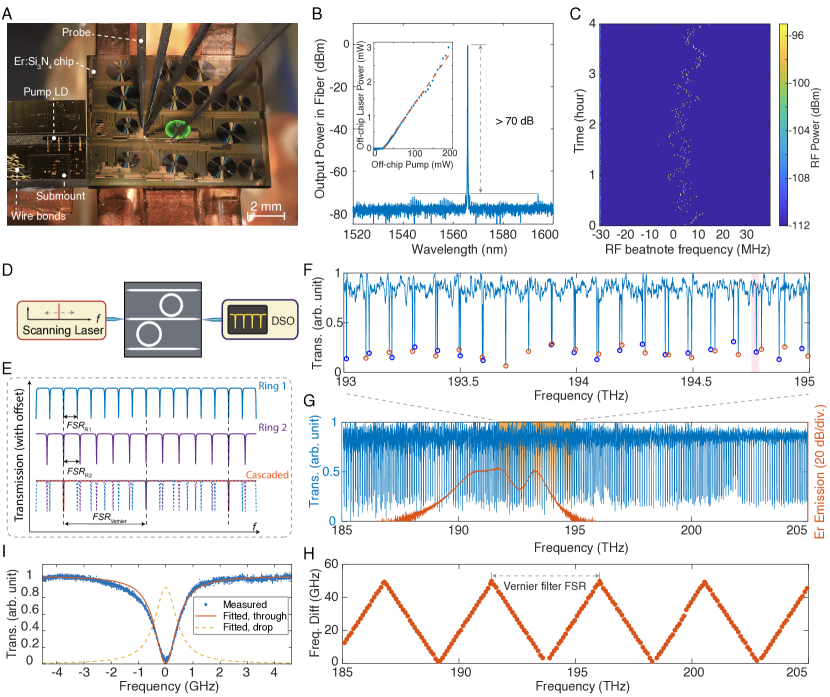
- Achieved single-mode lasing with an intrinsic linewidth of 50 Hz, and an output power up to 17 mW.
- Observed relative intensity noise (RIN) below -130 to -155 dBc/Hz over mid to high offset frequencies.
- Demonstrated a Vernier-filter-based wavelength tuning of over 40 nm in the C- and L-bands with SMSR > 70 dB.
- Packaged the device with a III-V pump laser achieving wavelength tuning and stable operation with frequency drift < 20 MHz over 4 hours and < 140 MHz over 24 hours.
- Measured a large Vernier filter FSR of 4.65 THz (37.1 nm) enabling continuous single-mode operation within the Er emission band.
- Reached a record high SMSR of 72 dB, surpassing many integrated and fiber-based Erbium laser implementations.
Read this paper
Open the full text in the Nubint reader and ask about any passage as you read.
Read this paper on NubintThis review was generated by AI from the original paper. Please check the paper before citing it.