
[Paper Review] A Guide to Regression Discontinuity Designs in Medical Applications
This paper provides a comprehensive, practical guide for applying regression discontinuity (RD) designs in biomedical research, focusing on both continuity-based and local randomization methods for sharp and fuzzy RD with continuous and discrete scores. It demonstrates that RD validity hinges on strict assumptions, and presents diagnostics and code to ensure robust causal inference in real-world medical applications.
We present a practical guide for the analysis of regression discontinuity (RD) designs in biomedical contexts. We begin by introducing key concepts, assumptions, and estimands within both the continuity-based framework and the local randomization framework. We then discuss modern estimation and inference methods within both frameworks, including approaches for bandwidth or local neighborhood selection, optimal treatment effect point estimation, and robust bias-corrected inference methods for uncertainty quantification. We also overview empirical falsification tests that can be used to support key assumptions. Our discussion focuses on two particular features that are relevant in biomedical research: (i) fuzzy RD designs, which often arise when therapeutic treatments are based on clinical guidelines but patients with scores near the cutoff are treated contrary to the assignment rule; and (ii) RD designs with discrete scores, which are ubiquitous in biomedical applications. We illustrate our discussion with three empirical applications: the effect of CD4 guidelines for anti-retroviral therapy on retention of HIV patients in South Africa, the effect of genetic guidelines for chemotherapy on breast cancer recurrence in the United States, and the effects of age-based patient cost-sharing on healthcare utilization in Taiwan. We provide replication materials employing publicly available statistical software in Python, R and Stata, offering researchers all necessary tools to conduct an RD analysis.
Motivation & Objective
- To address the growing need for rigorous causal inference in biomedical research where randomized trials are infeasible or unethical.
- To provide researchers with a clear, step-by-step guide to implementing RD designs in medical contexts, especially with clinical guidelines and discrete diagnostic scores.
- To highlight the importance of validating RD assumptions through falsification tests and robust inference methods.
- To demonstrate the limitations of RD applications when key assumptions—like compliance and covariate balance—are violated.
- To offer accessible, reproducible tools using R, Stata, and Python for widespread adoption in health services and outcomes research.
Proposed method
- Uses the continuity-based framework to estimate treatment effects by modeling potential outcomes as continuous functions around the cutoff, relying on local polynomial regression.
- Applies the local randomization framework to treat units near the cutoff as if randomly assigned, enabling nonparametric inference under weaker smoothness assumptions.
- Employs bandwidth selection methods (e.g., bias-corrected, plug-in, or cross-validation) to optimize precision and reduce bias in estimation.
- Implements robust bias-corrected inference procedures to quantify uncertainty, especially in small samples or with discrete scores.
- Conducts falsification tests by examining pre-treatment covariates around the cutoff to validate the assumption of conditional independence.
- Uses first-stage estimation of compliance (e.g., P(T=1|X≥c) − P(T=1|X<c)) to assess instrument strength in fuzzy RD designs.
Experimental results
Research questions
- RQ1How can regression discontinuity designs be reliably applied in biomedical research with clinical guidelines based on diagnostic thresholds?
- RQ2What are the key differences in estimation and inference between continuity-based and local randomization frameworks in RD designs?
- RQ3How do discrete scores—common in medical diagnostics—affect the validity and implementation of RD analyses?
- RQ4To what extent can falsification tests detect violations of the key identifying assumptions in RD designs?
- RQ5Under what conditions does a fuzzy RD design fail to produce reliable causal estimates, and how can this be diagnosed?
Key findings
- The application of RD to genetic assay guidelines for chemotherapy in breast cancer patients failed diagnostic checks: key pre-treatment covariates like lymphovascular invasion were imbalanced even in the smallest window around the cutoff.
- The first-stage effect of reaching an oncotype score of 26 on chemotherapy receipt was weak, with a treatment probability increase of only 0.15 and a Fisherian p-value of 0.32, indicating weak instrument problems.
- The large-sample F-statistic of 1.51 confirmed weak instruments, undermining the reliability of fuzzy RD estimates in this application.
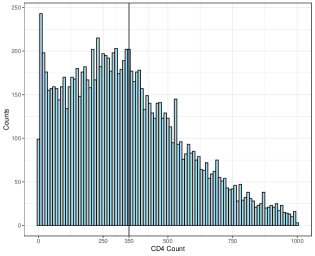
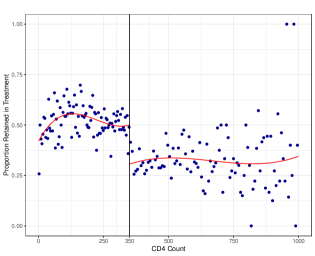
- The ART and retention study in South Africa passed falsification tests, showing no imbalance in pre-treatment covariates near the cutoff, supporting the validity of the RD design.
- The cost-sharing study in Taiwan demonstrated that discrete scores (age-based thresholds) can be effectively analyzed using RD methods when assumptions hold.
- Replication materials and code in R, Stata, and Python are publicly available, enabling reproducibility and broad adoption of modern RD methods in biomedical research.
Read this paper
Open the full text in the Nubint reader and ask about any passage as you read.
Read this paper on NubintThis review was generated by AI from the original paper. Please check the paper before citing it.