
[Paper Review] A large-scale magnetic field produced by a solar-like dynamo in binary neutron star mergers
This study demonstrates via super-high-resolution, full general relativistic magnetohydrodynamics simulations that the $α\Omega$ dynamo driven by the magnetorotational instability can generate a large-scale magnetic field in the remnant of a binary neutron star merger. The resulting field powers a Poynting-flux-dominated outflow with luminosity $\sim 10^{51}$ erg/s and drives magnetically driven mass ejection of $\sim 0.1M_\odot$, supporting the magnetar scenario for short-hard gamma-ray bursts and bright kilonovae.
The merger of neutron stars drives a relativistic jet which can be observed as a short gamma-ray burst. A strong large-scale magnetic field is necessary to launch the relativistic jet. However, the magnetohydrodynamical mechanism to build up this magnetic field remains uncertain. Here we show that the $αΩ$ dynamo mechanism driven by the magnetorotational instability builds up the large-scale magnetic field inside the long-lived binary neutron star merger remnant by performing an {\it ab initio} super-high resolution neutrino-radiation magnetohydrodynamics merger simulation in full general relativity. As a result, the magnetic field induces the Poynting-flux dominated relativistic outflow with the luminosity $\sim 10^{51}$\,erg/s and magnetically-driven post-merger mass ejection with the mass $\sim 0.1M_\odot$. Therefore, the magnetar scenario in binary neutron star mergers is possible. These can be the engines of short-hard gamma-ray bursts and very bright kilonovae. Therefore, this scenario is testable in future observation.
Motivation & Objective
- To determine the mechanism responsible for generating a large-scale magnetic field in the long-lived remnant of a binary neutron star merger.
- To investigate whether the $α\Omega$ dynamo driven by the magnetorotational instability can produce the strong, coherent magnetic fields required to launch relativistic jets.
- To test the viability of the magnetar scenario in binary neutron star mergers by simulating the formation of Poynting-flux-dominated outflows and magnetically driven mass ejection.
- To establish a quantitative link between the merger remnant's magnetic field evolution and observable signatures such as short-hard gamma-ray bursts and kilonovae.
Proposed method
- Performs ab initio, super-high-resolution neutrino-radiation magnetohydrodynamics simulations in full general relativity using a static mesh refinement with 2:1 refinement levels.
- Employs a 16-domain Cartesian grid structure with $N=361$, achieving a finest grid resolution of $\Delta x_{\rm finest} = 12.5$ m, the highest to date in binary neutron star merger simulations.
- Uses the DD2 equation of state for neutron star matter and a symmetric binary with total mass $2.7M_\odot$, forming a hypermassive neutron star remnant surviving for over 1 second.
- Implements an initial purely poloidal magnetic field loop with $B_{0,\mathrm{max}} = 10^{15.5}$ G to seed the dynamo process.
- Analyzes the growth of electromagnetic energy and magnetic field components over time, identifying the $\alpha\Omega$ dynamo mechanism through correlations between electromotive force and mean magnetic fields.
- Applies the Bernoulli criterion to identify ejecta and tracks baryon mass conservation to validate simulation accuracy.
Experimental results
Research questions
- RQ1Can the $\alpha\Omega$ dynamo mechanism driven by the magnetorotational instability generate a large-scale magnetic field in the remnant of a binary neutron star merger?
- RQ2What is the role of numerical resolution in the amplification of magnetic fields via the Kelvin-Helmholtz and magnetorotational instabilities?
- RQ3Does the simulated magnetic field growth lead to a Poynting-flux-dominated outflow with luminosity comparable to observed short-hard gamma-ray bursts?
- RQ4To what extent do magnetically driven mass ejections contribute to the formation of kilonovae?
- RQ5Is the observed magnetic field amplification and outflow activity robust against variations in initial magnetic field strength and grid resolution?
Key findings
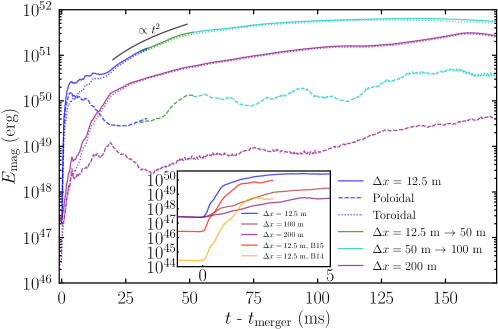
- The electromagnetic energy grows exponentially within $1$ ms post-merger due to the Kelvin-Helmholtz instability, independent of initial magnetic field strength but dependent on grid resolution.
- By $t - t_{\mathrm{merger}} \approx 5$ ms, the electromagnetic energy settles at $\approx 3 \times 10^{50}$ erg, with toroidal magnetic field contributions rising significantly after $20$ ms.
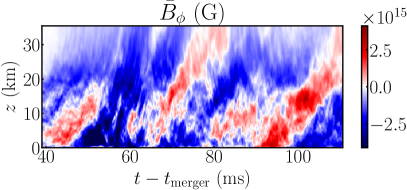
- The toroidal magnetic field grows proportionally to $t^2$, indicating efficient magnetic winding driven by a coherent poloidal field, consistent with $\alpha\Omega$ dynamo action.
- The $\alpha\Omega$ dynamo mechanism is confirmed by time-averaged correlations between the electromotive force and magnetic field components, particularly in the core region with $\rho \geq 10^{13}$ g/cm$^3$.
- A Poynting-flux-dominated outflow with luminosity $\sim 10^{51}$ erg/s is launched, consistent with the engine of short-hard gamma-ray bursts.
- Magnetized mass ejection of $\sim 0.1M_\odot$ is driven by the Lorentz force, with the ejecta mass and outflow luminosity strongly dependent on resolution and dynamo activity.
Read this paper
Open the full text in the Nubint reader and ask about any passage as you read.
Read this paper on NubintThis review was generated by AI from the original paper. Please check the paper before citing it.