
[Paper Review] A machine-learning pipeline for real-time detection of gravitational waves from compact binary coalescences
This paper presents Aframe, the first fully machine learning-based pipeline for real-time detection of gravitational waves from compact binary coalescences (CBCs), using a 1D convolutional neural network with aggressive data augmentation. It achieves state-of-the-art sensitivity for high-mass binary black holes with latency orders of magnitude lower than traditional matched filtering pipelines.
The promise of multi-messenger astronomy relies on the rapid detection of gravitational waves at very low latencies ($\mathcal{O}$(1\,s)) in order to maximize the amount of time available for follow-up observations. In recent years, neural-networks have demonstrated robust non-linear modeling capabilities and millisecond-scale inference at a comparatively small computational footprint, making them an attractive family of algorithms in this context. However, integration of these algorithms into the gravitational-wave astrophysics research ecosystem has proven non-trivial. Here, we present the first fully machine learning-based pipeline for the detection of gravitational waves from compact binary coalescences (CBCs) running in low-latency. We demonstrate this pipeline to have a fraction of the latency of traditional matched filtering search pipelines while achieving state-of-the-art sensitivity to higher-mass stellar binary black holes.
Motivation & Objective
- To develop a fully machine learning-based pipeline for low-latency detection of gravitational wave signals from compact binary coalescences (CBCs) in real-time production environments.
- To overcome infrastructure and sensitivity validation challenges that have hindered deployment of neural networks in gravitational-wave astrophysics.
- To demonstrate that deep learning models can achieve sensitivity competitive with matched filtering pipelines, particularly for high-mass binary black holes.
- To establish a scalable, modular software stack for rapid prototyping, testing, and deployment of new ML models in gravitational-wave detection.
Proposed method
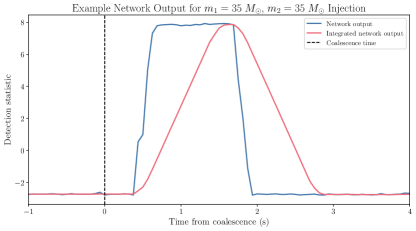
- The pipeline uses a 1D convolutional neural network (CNN) to process time-series gravitational wave data from two LIGO detectors.
- Extensive data augmentation techniques are applied to simulate diverse signal and noise conditions, improving model generalization.
- The model is trained end-to-end on simulated CBC signals embedded in real detector noise from the LIGO Open Science Center.
- A custom data loading and preprocessing pipeline, built with the ml4gw library, enables efficient on-GPU processing of whitened strain data and power spectral density estimation.
- Model inference is deployed via Triton Inference Server using the hermes library, enabling low-latency, scalable inference in an IaaS environment.
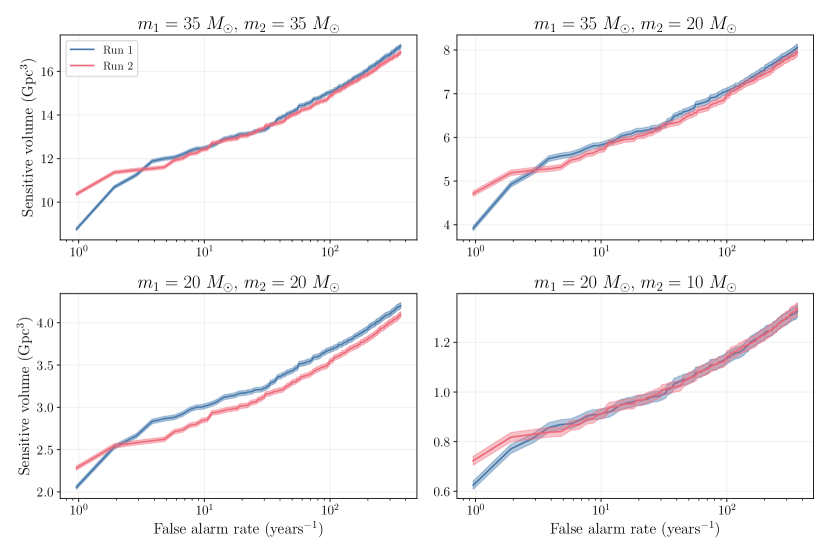
- Performance is evaluated using false alarm rates (FAR) and sensitive volume calculations, comparing against established pipelines like GstLAL, PyCBC-BBH, and cWB.
Experimental results
Research questions
- RQ1Can a fully end-to-end deep learning pipeline achieve real-time, low-latency detection of compact binary coalescence signals in a production gravitational-wave detection environment?
- RQ2How does the sensitivity of a learned model compare to traditional matched filtering pipelines, particularly for high-mass binary black holes?
- RQ3What role do aggressive data augmentation and robust software infrastructure play in enabling reliable, low-latency inference with neural networks in gravitational-wave detection?
- RQ4Can a machine learning-based pipeline be deployed and maintained at scale in the LIGO/Virgo/KAGRA network with comparable or better performance than existing methods?
Key findings
- Aframe achieves a latency of approximately 100–200 milliseconds, which is orders of magnitude lower than traditional matched filtering pipelines.
- For high-mass binary black holes (e.g., GW190521), Aframe achieves a sensitive volume that is competitive with or exceeds that of established pipelines like GstLAL and PyCBC-BBH.
- The pipeline demonstrates a false alarm rate of 0.0013 per year for GW190521, comparable to the 0.0045 per year reported by PyCBC-BBH, indicating strong sensitivity.
- The model shows superior performance on high-mass systems (e.g., GW190521 with 98.4 M☉) compared to lower-mass systems, where sensitivity remains suboptimal.
- The use of data augmentation and robust software infrastructure (ml4gw, hermes) enables reliable, low-latency deployment of the model in a production IaaS environment.
- The framework is extensible and supports future integration of additional detectors such as Virgo and KAGRA, and can be adapted for longer-duration signals like binary neutron star mergers.
Read this paper
Open the full text in the Nubint reader and ask about any passage as you read.
Read this paper on NubintThis review was generated by AI from the original paper. Please check the paper before citing it.