
[Paper Review] A Multi-Agent Conversational Recommender System
This paper proposes MACRS, a multi-agent conversational recommender system that uses four LLM-based agents to control dialogue flow through structured dialogue act planning and a feedback-aware reflection mechanism to dynamically adapt to user preferences. Experiments show MACRS significantly improves recommendation accuracy and user engagement over LLM-only baselines, especially for low-popularity items.
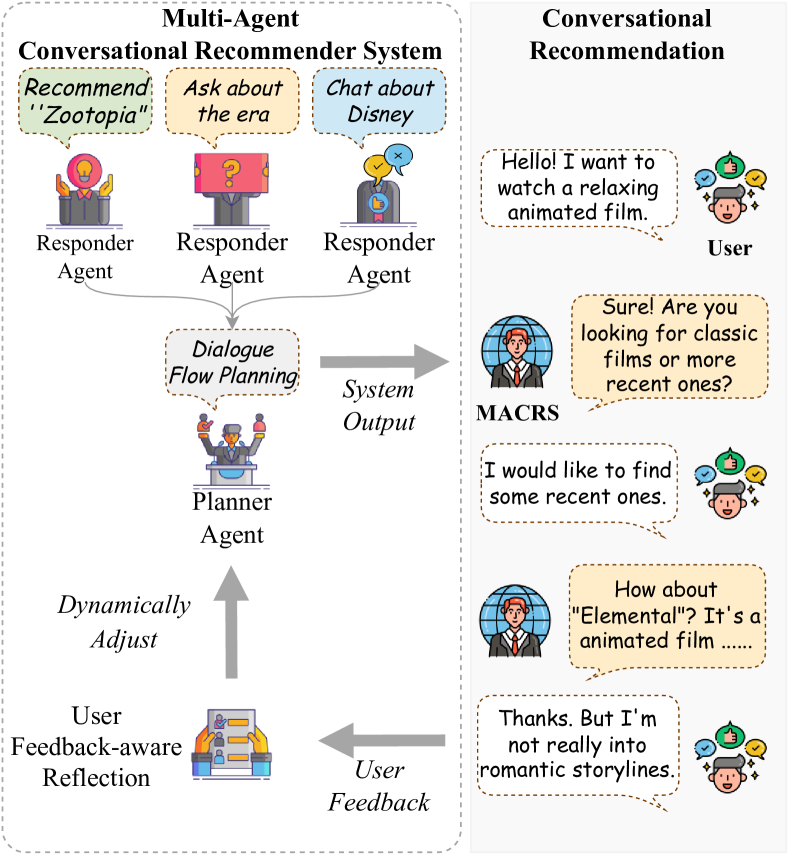
Due to strong capabilities in conducting fluent, multi-turn conversations with users, Large Language Models (LLMs) have the potential to further improve the performance of Conversational Recommender System (CRS). Unlike the aimless chit-chat that LLM excels at, CRS has a clear target. So it is imperative to control the dialogue flow in the LLM to successfully recommend appropriate items to the users. Furthermore, user feedback in CRS can assist the system in better modeling user preferences, which has been ignored by existing studies. However, simply prompting LLM to conduct conversational recommendation cannot address the above two key challenges. In this paper, we propose Multi-Agent Conversational Recommender System (MACRS) which contains two essential modules. First, we design a multi-agent act planning framework, which can control the dialogue flow based on four LLM-based agents. This cooperative multi-agent framework will generate various candidate responses based on different dialogue acts and then choose the most appropriate response as the system response, which can help MACRS plan suitable dialogue acts. Second, we propose a user feedback-aware reflection mechanism which leverages user feedback to reason errors made in previous turns to adjust the dialogue act planning, and higher-level user information from implicit semantics. We conduct extensive experiments based on user simulator to demonstrate the effectiveness of MACRS in recommendation and user preferences collection. Experimental results illustrate that MACRS demonstrates an improvement in user interaction experience compared to directly using LLMs.
Motivation & Objective
- To address the challenge of uncontrolled dialogue flow in LLM-based conversational recommender systems (CRS), where unguided generation leads to irrelevant or off-target interactions.
- To overcome the limitation of existing LLM-only CRS in effectively capturing and utilizing user feedback to refine dialogue strategies and preference modeling.
- To design a cooperative multi-agent framework that enables structured, goal-directed dialogue by assigning specialized roles to LLM agents for different dialogue acts.
- To improve recommendation performance—especially for low-popularity items—by enabling deeper user preference elicitation through feedback-aware reflection.
- To enhance user experience by dynamically adjusting dialogue strategies based on implicit user feedback and preference evolution.
Proposed method
- A multi-agent act planning framework with four specialized LLM-based agents: a planner agent to select dialogue acts, and three responder agents to generate responses for asking, recommending, and chit-chatting acts.
- The planner agent evaluates candidate responses from responder agents based on dialogue strategy and current user context, selecting the most appropriate act to maintain goal-directed flow.
- A user feedback-aware reflection mechanism that analyzes user feedback to detect errors in previous dialogue turns and generate strategy-level suggestions for future planning.
- The reflection mechanism operates on two levels: information-level reflection to extract high-level user preferences from implicit semantics, and strategy-level reflection to suggest improved dialogue policies.
- The system integrates feedback into dialogue planning by updating user preference representations and adjusting future dialogue act selection accordingly.
- The framework is evaluated using a user simulator on a benchmark CRS dataset, comparing MACRS against LLM-only baselines like ChatGPT.
Experimental results
Research questions
- RQ1How can a multi-agent framework improve dialogue flow control in LLM-based conversational recommender systems?
- RQ2To what extent can user feedback be leveraged to refine dialogue strategies and improve preference modeling in CRS?
- RQ3Can a cooperative multi-agent architecture outperform single LLM agents in recommendation accuracy and user engagement?
- RQ4How does the system perform on low-popularity items, where preference ambiguity is higher?
- RQ5What is the impact of strategy-level reflection on response quality and dialogue effectiveness?
Key findings
- MACRS achieves a 45.4% win rate over ChatGPT in response quality comparisons, with 33.0% ties and 21.6% losses, demonstrating superior response quality across recommendation accuracy, user information gain, conciseness, and engagement.
- The system significantly improves recommendation accuracy, especially for low-popularity items, due to better preference elicitation enabled by feedback-aware reflection.
- MACRS reduces the number of dialogue turns required to reach a recommendation by effectively scheduling dialogue acts, improving efficiency.
- The strategy-level reflection mechanism increases the quality of responses, as shown by evaluator preference in 45.4% of comparisons.
- User feedback is critical for detecting implicit preferences—e.g., recognizing dissatisfaction with a director’s work—enabling the system to adapt and improve recommendations.
- The cumulative success rate of recommendations decreases over time in baselines, but MACRS maintains higher performance due to sustained preference modeling.

Read this paper
Open the full text in the Nubint reader and ask about any passage as you read.
Read this paper on NubintThis review was generated by AI from the original paper. Please check the paper before citing it.