
[Paper Review] A Multi-view Multi-task Learning Framework for Multi-variate Time Series Forecasting
This paper proposes a multi-view multi-task (MVMT) learning framework for multi-variate time series (MTS) forecasting that leverages spatial and temporal views to decompose forecasting into task-specific subproblems. By applying task-wise normalization and affine transformation with prior knowledge, the model enhances representation distinguishability, improving both prediction accuracy and efficiency across three real-world datasets.
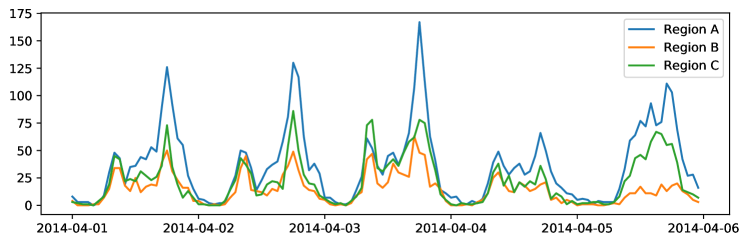
Multi-variate time series (MTS) data is a ubiquitous class of data abstraction in the real world. Any instance of MTS is generated from a hybrid dynamical system and their specific dynamics are usually unknown. The hybrid nature of such a dynamical system is a result of complex external attributes, such as geographic location and time of day, each of which can be categorized into either spatial attributes or temporal attributes. Therefore, there are two fundamental views which can be used to analyze MTS data, namely the spatial view and the temporal view. Moreover, from each of these two views, we can partition the set of data samples of MTS into disjoint forecasting tasks in accordance with their associated attribute values. Then, samples of the same task will manifest similar forthcoming pattern, which is less sophisticated to be predicted in comparison with the original single-view setting. Considering this insight, we propose a novel multi-view multi-task (MVMT) learning framework for MTS forecasting. Instead of being explicitly presented in most scenarios, MVMT information is deeply concealed in the MTS data, which severely hinders the model from capturing it naturally. To this end, we develop two kinds of basic operations, namely task-wise affine transformation and task-wise normalization, respectively. Applying these two operations with prior knowledge on the spatial and temporal view allows the model to adaptively extract MVMT information while predicting. Extensive experiments on three datasets are conducted to illustrate that canonical architectures can be greatly enhanced by the MVMT learning framework in terms of both effectiveness and efficiency. In addition, we design rich case studies to reveal the properties of representations produced at different phases in the entire prediction procedure.
Motivation & Objective
- To address the challenge of forecasting non-stationary, complex multi-variate time series with unknown hybrid dynamics.
- To exploit hidden multi-view multi-task (MVMT) structures in MTS data that are typically underutilized in existing models.
- To improve forecasting performance by explicitly modeling intra-task similarity and inter-task distinction through task-specific operations.
- To enhance representation learning by strengthening intra-task correlation and weakening inter-task correlation in feature space.
Proposed method
- The framework introduces two core operations: task-wise affine transformation and task-wise normalization, applied per task derived from spatial or temporal views.
- Tasks are defined based on shared external attributes—e.g., time of day (temporal view) or geographic region (spatial view)—to group data with similar dynamics.
- The model integrates these operations into canonical deep learning architectures (e.g., Wavenet, Transformer) without architectural overhaul, enabling plug-and-play enhancement.
- The method leverages prior knowledge (e.g., daily periodicity) to guide task partitioning and improve representation quality.
- Principal component analysis (PCA) is used to visualize and validate that the enhanced representations exhibit stronger intra-task correlation and weaker inter-task correlation.
- The framework is flexible and extensible, allowing integration of additional views depending on application-specific attributes.
Experimental results
Research questions
- RQ1How can hidden multi-view multi-task structures in multi-variate time series be effectively uncovered and exploited for improved forecasting?
- RQ2To what extent can task-wise normalization and affine transformation enhance representation quality and prediction performance in MTS forecasting?
- RQ3Does the MVMT framework improve both accuracy and efficiency compared to standard models across diverse real-world datasets?
- RQ4How do the representations learned at different stages of the model differ in terms of intra-task and inter-task correlation?
- RQ5Can the framework preserve scale and pattern information in representations, especially under complex, non-stationary dynamics?
Key findings
- The MVMT framework significantly improves forecasting performance across three real-world datasets, demonstrating both higher accuracy and faster convergence compared to baseline models.
- Case studies using PCA show that the enhanced model produces representations with the strongest intra-task correlation and weakest inter-task correlation, indicating improved feature distinguishability.
- The representations learned by the enhanced model encode not only pattern similarity within tasks but also scale information, as confirmed by recoloring visualizations based on observation magnitude.
- The framework boosts the effectiveness of canonical deep learning models like Wavenet and Transformer without architectural changes, proving its generalizability and plug-in compatibility.
- The proposed operations lead to a more linear and structured representation space, as evidenced by the variance explained by the first few principal components.
- The model maintains robustness and efficiency, with consistent improvements across different time horizons and task groupings.
Read this paper
Open the full text in the Nubint reader and ask about any passage as you read.
Read this paper on NubintThis review was generated by AI from the original paper. Please check the paper before citing it.