
[Paper Review] A New Look at Spike-Timing-Dependent Plasticity Networks for Spatio-Temporal Feature Learning
This paper proposes a theoretically grounded framework for unsupervised spiking neural networks (SNNs) with Spike-Timing-Dependent Plasticity (STDP) that enables efficient spatio-temporal feature learning from event-based camera data. By linking STDP dynamics to joint dictionary learning and LASSO basis pursuit, the method eliminates empirical hyperparameter tuning and achieves state-of-the-art accuracy on N-MNIST (+9.3%), CIFAR10-DVS (+8.2%), and IBM DVS128 Gesture (+7.74%) datasets while enabling ultra-low-power edge inference.
We present new theoretical foundations for unsupervised Spike-Timing-Dependent Plasticity (STDP) learning in spiking neural networks (SNNs). In contrast to empirical parameter search used in most previous works, we provide novel theoretical grounds for SNN and STDP parameter tuning which considerably reduces design time. Using our generic framework, we propose a class of global, action-based and convolutional SNN-STDP architectures for learning spatio-temporal features from event-based cameras. We assess our methods on the N-MNIST, the CIFAR10-DVS and the IBM DVS128 Gesture datasets, all acquired with a real-world event camera. Using our framework, we report significant improvements in classification accuracy compared to both conventional state-of-the-art event-based feature descriptors (+8.2% on CIFAR10-DVS), and compared to state-of-the-art STDP-based systems (+9.3% on N-MNIST, +7.74% on IBM DVS128 Gesture). Our work contributes to both ultra-low-power learning in neuromorphic edge devices, and towards a biologically-plausible, optimization-based theory of cortical vision.
Motivation & Objective
- To address the lack of a principled, top-down theory for designing high-performance SNN-STDP networks for event-based vision.
- To eliminate time-consuming empirical hyperparameter tuning in STDP-based SNNs by deriving theoretical guidelines for STDP parameters, neuron thresholds, time constants, and learning termination.
- To develop a generic, convolutional, action-based SNN-STDP architecture that learns spatio-temporal features directly from real-world event camera data.
- To demonstrate competitive performance against state-of-the-art event-based descriptors and SNN-STDP systems on standard benchmarks.
- To provide power consumption estimates validating the suitability of the framework for ultra-low-power neuromorphic edge devices.
Proposed method
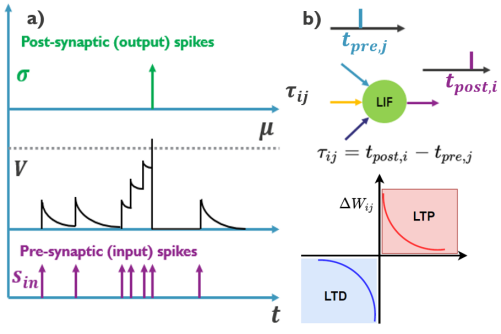
- The framework formulates SNN-STDP learning as a joint dictionary learning and basis pursuit problem using LASSO coding, linking STDP dynamics to optimization objectives.
- A theoretical derivation establishes conditions under which STDP approximates sparse coding via LASSO, enabling principled parameter tuning.
- The method introduces an Akaike-based pursuit algorithm for estimating the sparsity parameter μ, which guides network initialization and learning termination.
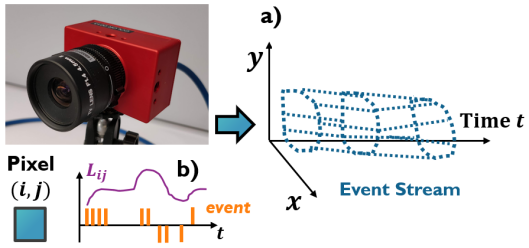
- The architecture employs a global, action-based, and convolutional SNN design with STDP learning applied to event streams from DVS cameras.
- Network parameters such as STDP window shape, neuron thresholds, and time constants are derived analytically rather than tuned empirically.
- Power consumption is estimated using hardware metrics from the μBrain SNN chip, modeling dynamic spike energy, static leakage, and SRAM access costs.
Experimental results
Research questions
- RQ1Can STDP in SNNs be theoretically linked to a well-defined optimization objective such as sparse coding via LASSO?
- RQ2Can theoretical derivations eliminate the need for empirical hyperparameter tuning in SNN-STDP networks?
- RQ3Can a convolutional, action-based SNN-STDP architecture achieve state-of-the-art performance on event-based spatio-temporal recognition tasks?
- RQ4Does the proposed framework enable ultra-low-power learning and inference suitable for edge neuromorphic devices?
- RQ5How does the performance of the proposed SNN-STDP system compare to conventional event-based descriptors and prior SNN-STDP methods?
Key findings
- The proposed framework achieves a 9.3% accuracy gain on the N-MNIST dataset compared to prior SNN-STDP systems, significantly outperforming them.
- On the CIFAR10-DVS dataset, the method improves classification accuracy by 8.2% compared to conventional state-of-the-art event-based feature descriptors.
- For the IBM DVS128 Gesture dataset, the system achieves a 7.74% improvement over state-of-the-art STDP-based methods, demonstrating strong performance on action recognition.
- The theoretical framework enables analytical tuning of STDP parameters, neuron thresholds, and time constants, reducing reliance on time-intensive empirical search.
- Power consumption estimates show the system operates at 5 mW during STDP training and 1 mW during inference on the N-MNIST dataset, comparable to state-of-the-art SNN-STDP circuits while achieving higher accuracy.
- The framework contributes to a biologically plausible, optimization-based theory of cortical vision by linking STDP to sparse coding and dictionary learning.
Read this paper
Open the full text in the Nubint reader and ask about any passage as you read.
Read this paper on NubintThis review was generated by AI from the original paper. Please check the paper before citing it.