
[Paper Review] A Novel Deep Learning based Model for Erythrocytes Classification and Quantification in Sickle Cell Disease
This study proposes a custom 18-layer deep convolutional neural network (CNN) to classify and quantify three erythrocyte morphologies—discocytes, oval, and sickle—using 428 raw microscopic images from sickle cell disease (SCD) patients, generating a dataset of 10,377 single-cell images. The model achieves 81% accuracy, outperforming baseline models, and enhances interpretability using SHAP and LIME for clinical decision support.
The shape of erythrocytes or red blood cells is altered in several pathological conditions. Therefore, identifying and quantifying different erythrocyte shapes can help diagnose various diseases and assist in designing a treatment strategy. Machine Learning (ML) can be efficiently used to identify and quantify distorted erythrocyte morphologies. In this paper, we proposed a customized deep convolutional neural network (CNN) model to classify and quantify the distorted and normal morphology of erythrocytes from the images taken from the blood samples of patients suffering from Sickle cell disease ( SCD). We chose SCD as a model disease condition due to the presence of diverse erythrocyte morphologies in the blood samples of SCD patients. For the analysis, we used 428 raw microscopic images of SCD blood samples and generated the dataset consisting of 10, 377 single-cell images. We focused on three well-defined erythrocyte shapes, including discocytes, oval, and sickle. We used 18 layered deep CNN architecture to identify and quantify these shapes with 81% accuracy, outperforming other models. We also used SHAP and LIME for further interpretability. The proposed model can be helpful for the quick and accurate analysis of SCD blood samples by the clinicians and help them make the right decision for better management of SCD.
Motivation & Objective
- To develop a deep learning model for automated classification and quantification of abnormal erythrocyte morphologies in sickle cell disease (SCD) blood samples.
- To address the clinical challenge of manual erythrocyte morphology assessment, which is time-consuming and prone to inter-observer variability.
- To create a scalable, interpretable AI system that supports clinicians in early diagnosis and treatment planning for SCD.
- To extend the utility of deep learning beyond SCD by enabling adaptation to other hematological disorders with morphological changes.
Proposed method
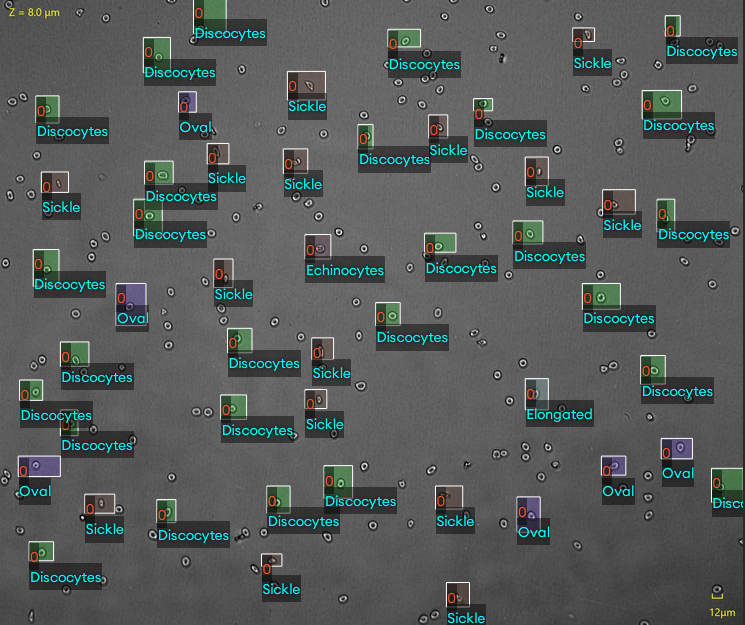
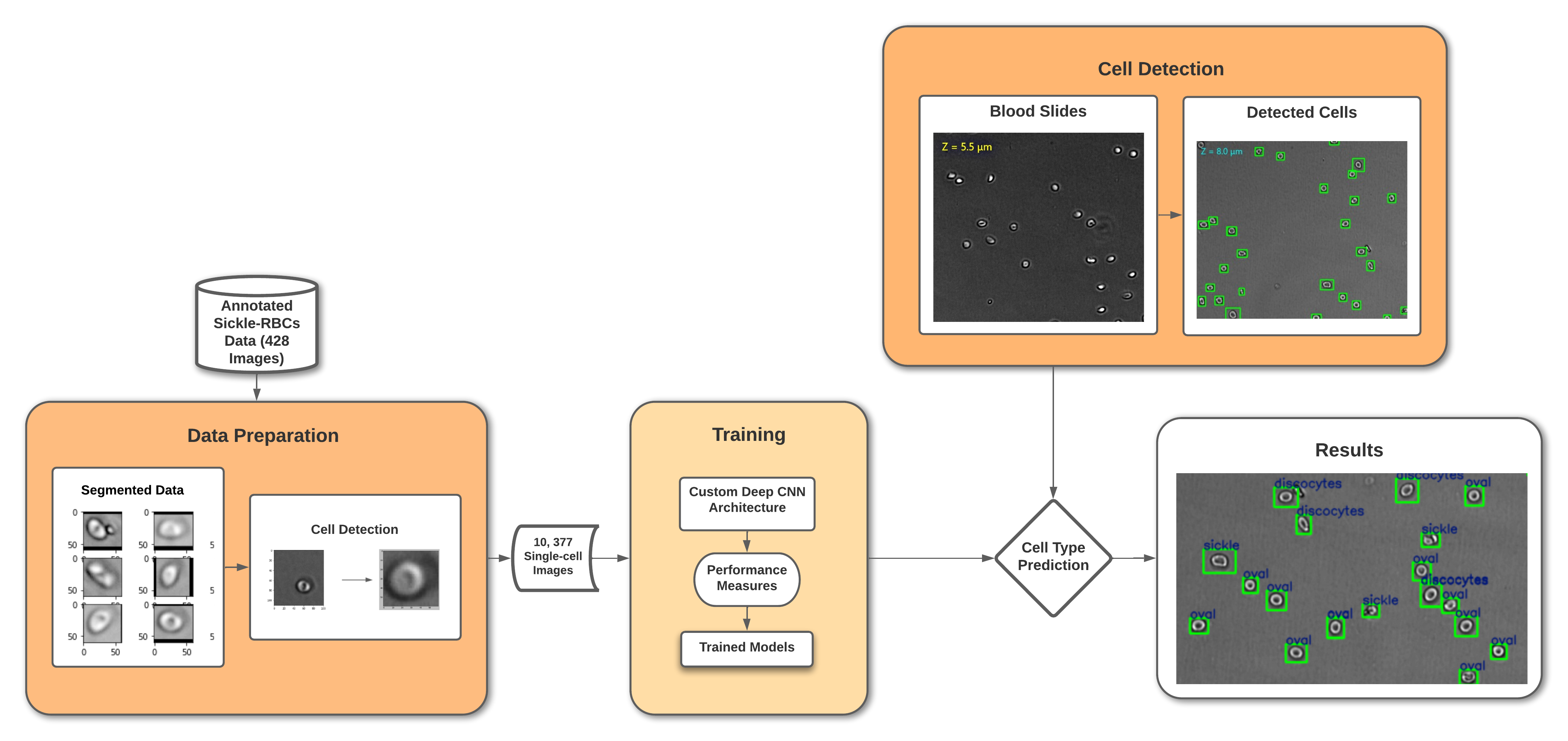
- A custom 18-layer deep convolutional neural network (CNN) was designed for multi-class classification of erythrocyte shapes: discocytes, oval, and sickle.
- The method involved preprocessing raw microscopic images and applying instance segmentation to isolate individual erythrocytes, generating 10,377 single-cell images from 428 original images.
- Nine deep neural network architectures were evaluated, including transfer learning models, with a tuned LightGBM used for comparative benchmarking.
- Model interpretability was enhanced using SHAP and LIME to explain predictions and improve clinical trust and transparency.
- Data augmentation and normalization techniques were applied to improve generalization and mitigate class imbalance.
- The model was trained and validated using a 70-15-15 split of the dataset, with evaluation metrics including accuracy, precision, recall, and F1-score.
Experimental results
Research questions
- RQ1Can a custom deep CNN effectively classify and quantify three distinct erythrocyte morphologies—discocytes, oval, and sickle—in SCD patient blood samples?
- RQ2How does the proposed deep CNN model compare in performance to established baseline models and LightGBM in classifying erythrocyte shapes?
- RQ3To what extent can SHAP and LIME enhance the interpretability of the model’s predictions for clinical usability?
- RQ4Can the model be generalized to other morphological pathologies in hematological diseases beyond SCD?
Key findings
- The proposed 18-layer deep CNN achieved 81% accuracy in classifying erythrocyte morphologies, outperforming all baseline models and the tuned LightGBM.
- The model demonstrated superior precision, recall, and F1-score across all three classes (discocytes, oval, sickle), indicating robust multi-class performance.
- SHAP and LIME analyses revealed that the model focused on morphological features such as cell shape, curvature, and membrane irregularities, aligning with clinical expertise.
- The dataset of 10,377 single-cell images provides a valuable, annotated resource for future research in erythrocyte morphology classification.
- The model’s performance on a limited dataset of 428 raw images suggests strong potential for scalability with larger, more diverse data.
- The study demonstrates that deep learning can significantly reduce the time and subjectivity of manual erythrocyte morphology assessment in SCD, supporting faster clinical decisions.
Read this paper
Open the full text in the Nubint reader and ask about any passage as you read.
Read this paper on NubintThis review was generated by AI from the original paper. Please check the paper before citing it.