
[Paper Review] A Novel Multi-Task Tensor Correlation Neural Network for Facial Attribute Prediction
This paper proposes a Multi-Task Correlation Neural Network (MTCN) that enhances facial attribute prediction by sharing low-level features across tasks while learning task-specific high-level representations with cross-network feature enhancement. It introduces a novel Tensor Correlation Analysis (NTCCA) to model detailed, task-specific correlations in deep features, achieving state-of-the-art accuracy on CelebA and LFWA datasets by leveraging hierarchical feature correlations.
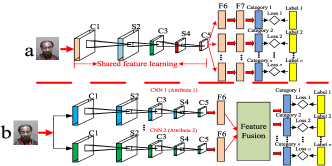
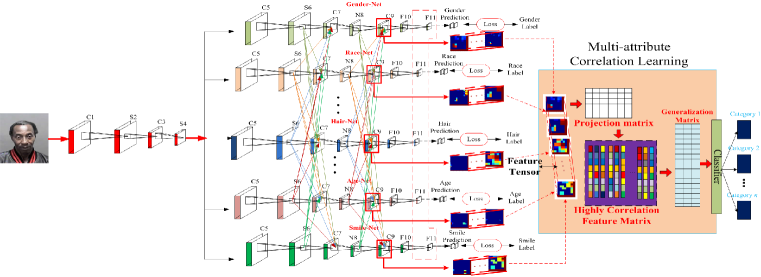
Face multi-attribute prediction benefits substantially from multi-task learning (MTL), which learns multiple face attributes simultaneously to achieve shared or mutually related representations of different attributes. The most widely used MTL convolutional neural network is heuristically or empirically designed by sharing all of the convolutional layers and splitting at the fully connected layers for task-specific losses. However, it is improper to view all low and mid-level features for different attributes as being the same, especially when these attributes are only loosely related. In this paper, we propose a novel multi-attribute tensor correlation neural network (MTCN) for face attribute prediction. The structure shares the information in low-level features (e.g., the first two convolutional layers) but splits that in high-level features (e.g., from the third convolutional layer to the fully connected layer). At the same time, during high-level feature extraction, each subnetwork (e.g., Age-Net, Gender-Net, ..., and Smile-Net) excavates closely related features from other networks to enhance its features. Then, we project the features of the C9 layers of the fine-tuned subnetworks into a highly correlated space by using a novel tensor correlation analysis algorithm (NTCCA). The final face attribute prediction is made based on the correlation matrix. Experimental results on benchmarks with multiple face attributes (CelebA and LFWA) show that the proposed approach has superior performance compared to state-of-the-art methods.
Motivation & Objective
- To address the limitations of existing multi-task learning methods that over-share features across all layers, which fails to capture task-specific differences and nuanced attribute correlations.
- To improve facial attribute prediction performance by modeling both shared low-level representations and task-specific high-level feature correlations.
- To develop a novel tensor correlation analysis (NTCCA) method that projects high-level features into a highly correlated space to enhance mutual benefit among attributes.
- To validate the effectiveness of the proposed MTCN framework on benchmark datasets, especially under low-data regimes.
Proposed method
- The MTCN architecture shares the first two convolutional layers (low-level features) across all attribute prediction heads (e.g., Age-Net, Gender-Net), while splitting from the third convolutional layer onward to allow task-specific learning.
- Each subnetwork (e.g., Smile-Net) actively extracts and integrates related features from other subnetworks during high-level feature learning to enhance representation quality.
- A novel Nonlinear Tensor Correlation Correlation Analysis (NTCCA) algorithm projects the C9-layer features of fine-tuned subnetworks into a shared, highly correlated space to model detailed inter-attribute relationships.
- The final prediction is made based on the correlation matrix generated by NTCCA, which generalizes feature interactions across attributes.
- A generalization matrix is trained on a subset of the data to stabilize and improve the correlation learning process.
Experimental results
Research questions
- RQ1Can hierarchical feature sharing—sharing low-level features while splitting high-level features—improve facial attribute prediction compared to full parameter sharing?
- RQ2How can task-specific correlations among facial attributes be effectively modeled at the high-level feature level?
- RQ3Does a dedicated tensor correlation analysis method (NTCCA) lead to better performance than standard multi-task learning or feature fusion?
- RQ4How does the proposed MTCN perform on small datasets like LFWA, where data scarcity limits performance?
Key findings
- On the CelebA dataset, MTCN achieved a 92.77% average accuracy across 40 attributes, significantly outperforming prior state-of-the-art methods such as MCNN+AUX (91.38%) and DMTL (91.67%).
- The inclusion of NTCCA in MTCN improved performance by 1.39% in average accuracy compared to MTCN without NTCCA, demonstrating its effectiveness in modeling high-level feature correlations.
- On the smaller LFWA dataset, MTCN maintained strong performance, with 19 attributes achieving over 90% accuracy and 19 others exceeding 80%, indicating robustness to data scarcity.
- Attributes like 'Bangs' and 'Blurry', which are typically hard to predict, saw notable performance gains, highlighting the model's ability to benefit from inter-attribute correlations.
- The model's performance was stable across different attribute categories, with category I attributes (e.g., 'Male', 'Attractive') achieving over 90% accuracy, while category II (e.g., 'Bald', 'Mustache') remained challenging but improved with the new framework.
Read this paper
Open the full text in the Nubint reader and ask about any passage as you read.
Read this paper on NubintThis review was generated by AI from the original paper. Please check the paper before citing it.