
[Paper Review] A Parametric Model for Self-Interacting Dark Matter Halos
This paper proposes a computationally efficient parametric model that transforms cold dark matter (CDM) halos into self-interacting dark matter (SIDM) halos across all gravothermal evolution phases—core-forming and core-collapsing—using a calibrated, universal density profile. The model leverages a normalized collapse timescale and requires only two z=0 CDM halo parameters as input, enabling accurate prediction of SIDM halo properties in both isolated systems and subhalos, validated against cosmological zoom-in simulations.
We propose a parametric model for studying self-interacting dark matter (SIDM) halos. The model uses an analytical density profile, calibrated using a controlled N-body SIDM simulation that covers the entire gravothermal evolution, including core-forming and -collapsing phases. By normalizing the calibrated density profile, we obtain a universal description for SIDM halos at any evolution phase. The model allows us to infer properties of SIDM halos based on their cold dark matter (CDM) counterparts. As a basic application, we only require two characteristic parameters of an isolated CDM halo at $z=0$. We then extend the model to incorporate effects induced by halo mass changes, such as major mergers or tidal stripping, making it applicable to both isolated halos and subhalos. The parametric model is tested and validated using cosmological zoom-in SIDM simulations available in the literature.
Motivation & Objective
- To develop a fast, parametric model that predicts SIDM halo structure across all gravothermal evolution phases, including core formation and core collapse.
- To calibrate a universal density profile using high-resolution N-body simulations covering the full SIDM evolution history.
- To enable transfer of CDM halo properties (e.g., concentration, mass) into SIDM counterparts with minimal input, enhancing computational efficiency.
- To extend the model to subhalos by incorporating effects from mass changes such as mergers and tidal stripping.
- To validate the model against cosmological zoom-in SIDM simulations and demonstrate its utility in scanning particle physics parameter space.
Proposed method
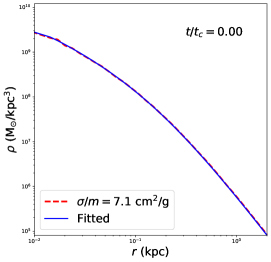
- The model uses a calibrated analytical density profile derived from a controlled N-body SIDM simulation of an isolated halo, covering the entire gravothermal evolution from core formation to core collapse.
- The profile is normalized using the halo's collapse timescale, achieving universality across different initial conditions and cross-sections.
- The model employs two approaches: a basic method using z=0 CDM halo parameters, and an integral approach that accounts for mass evolution due to mergers or stripping.
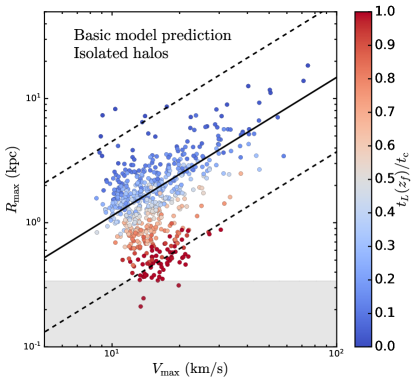
- The parametric model is validated by comparing predicted density profiles, V_max, and R_max against results from a cosmological zoom-in SIDM simulation of a Milky Way analog.
- The model is extended to the Read profile, showing comparable fit quality to the original cored profile, with adjusted coefficients for evolution trajectories.
- The model enables efficient scanning of SIDM particle physics parameter space by replacing costly N-body simulations with fast analytical predictions.
Experimental results
Research questions
- RQ1Can a single parametric model accurately describe SIDM halo structure across all gravothermal evolution phases, including core collapse?
- RQ2How can the properties of a CDM halo at z=0 be transformed into those of its SIDM counterpart, including during dynamic evolution?
- RQ3To what extent can the model account for mass changes in halos, such as those induced by major mergers or tidal stripping, in both isolated halos and subhalos?
- RQ4How well does the parametric model reproduce key halo properties—such as V_max and R_max—compared to high-resolution cosmological SIDM simulations?
- RQ5Can the model be used to efficiently explore the full parameter space of SIDM particle physics models?
Key findings
- The calibrated parametric model successfully reproduces SIDM halo density profiles across all gravothermal evolution phases, with accuracy validated against high-resolution N-body simulations.
- The model achieves universality by normalizing evolution with the collapse timescale, eliminating explicit dependence on the self-interaction cross section.
- The model predicts V_max and R_max within 10% accuracy when compared to simulation data, demonstrating strong quantitative agreement.
- The model extends effectively to subhalos, accurately capturing structural changes due to tidal stripping and mass loss.
- The Read profile provides a viable alternative parametrization, with evolution trajectories of ρ_s, r_s, and r_c well-fit by polynomial functions with adjusted coefficients.
- The model enables efficient, large-scale scanning of SIDM particle physics parameter space, replacing computationally expensive simulations with fast analytical predictions.
Read this paper
Open the full text in the Nubint reader and ask about any passage as you read.
Read this paper on NubintThis review was generated by AI from the original paper. Please check the paper before citing it.