
[Paper Review] A parsimonious neural network approach to solve portfolio optimization problems without using dynamic programming
This paper proposes a parsimonious neural network approach to solve dynamic portfolio optimization problems without relying on dynamic programming or reinforcement learning. By formulating the problem as a single optimization over a neural network with parameters independent of rebalancing frequency, the method achieves convergence to the optimal strategy under general conditions and successfully recovers both time-consistent and pre-commitment solutions across mean-variance, CVaR, and Sortino-inspired objectives using parametric, resampled, and GAN-generated returns.
We present a parsimonious neural network approach, which does not rely on dynamic programming techniques, to solve dynamic portfolio optimization problems subject to multiple investment constraints. The number of parameters of the (potentially deep) neural network remains independent of the number of portfolio rebalancing events, and in contrast to, for example, reinforcement learning, the approach avoids the computation of high-dimensional conditional expectations. As a result, the approach remains practical even when considering large numbers of underlying assets, long investment time horizons or very frequent rebalancing events. We prove convergence of the numerical solution to the theoretical optimal solution of a large class of problems under fairly general conditions, and present ground truth analyses for a number of popular formulations, including mean-variance and mean-conditional value-at-risk problems. We also show that it is feasible to solve Sortino ratio-inspired objectives (penalizing only the variance of wealth outcomes below the mean) in dynamic trading settings with the proposed approach. Using numerical experiments, we demonstrate that if the investment objective functional is separable in the sense of dynamic programming, the correct time-consistent optimal investment strategy is recovered, otherwise we obtain the correct pre-commitment (time-inconsistent) investment strategy. The proposed approach remains agnostic as to the underlying data generating assumptions, and results are illustrated using (i) parametric models for underlying asset returns, (ii) stationary block bootstrap resampling of empirical returns, and (iii) generative adversarial network (GAN)-generated synthetic asset returns.
Motivation & Objective
- To develop a neural network-based approach for dynamic portfolio optimization that avoids dynamic programming and reinforcement learning.
- To ensure the number of network parameters remains independent of the number of rebalancing events, enabling scalability for long horizons and frequent rebalancing.
- To prove convergence of the numerical solution to the theoretical optimal strategy under general conditions for a broad class of objective functions.
- To demonstrate the method's ability to recover both time-consistent and pre-commitment optimal strategies depending on the problem formulation.
- To validate the approach across diverse data assumptions, including parametric models, block bootstrap resampling, and GAN-generated returns.
Proposed method
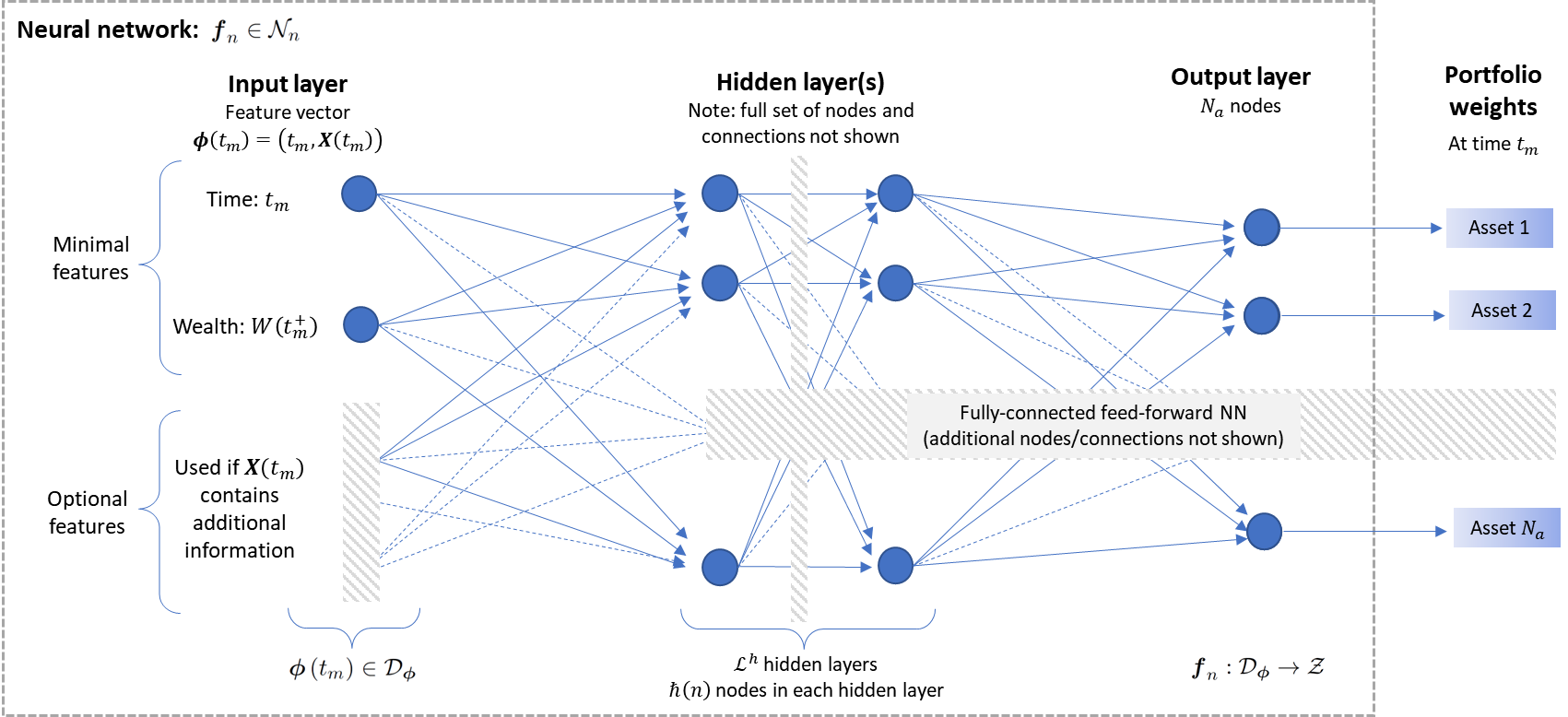
- The method formulates the portfolio optimization problem as a single optimization over a neural network, parameterizing the investment strategy directly as a function of time and wealth.
- The network architecture is designed to be parsimonious, with the number of parameters independent of the number of rebalancing events, avoiding the computational burden of dynamic programming.
- The approach avoids estimating high-dimensional conditional expectations, a key challenge in reinforcement learning, by directly optimizing the objective functional.
- The method is agnostic to the underlying data-generating process, allowing use of parametric models, empirical returns via stationary block bootstrap, or GAN-generated synthetic returns.
- Convergence to the optimal solution is proven under fairly general conditions, including for problems with multiple constraints and path-dependent objectives.
- The approach is applied to mean-variance, mean-CVaR, and mean-semi-variance (Sortino-inspired) objectives, with numerical experiments validating accuracy and robustness.
Experimental results
Research questions
- RQ1Can a neural network approach solve dynamic portfolio optimization problems without relying on dynamic programming or reinforcement learning?
- RQ2Does the proposed method maintain computational feasibility and convergence when the number of rebalancing events increases?
- RQ3Can the method recover both time-consistent and pre-commitment optimal strategies depending on the objective function's separability?
- RQ4How does the method perform across different data assumptions, including empirical returns and synthetic data from GANs?
- RQ5Can the method effectively solve non-standard objectives such as mean-semi-variance optimization inspired by the Sortino ratio?
Key findings
- The proposed neural network approach successfully recovers the correct time-consistent optimal strategy when the objective functional is separable in the sense of dynamic programming.
- When the objective is not separable, the method recovers the correct pre-commitment (time-inconsistent) optimal strategy, demonstrating its theoretical soundness.
- Numerical experiments confirm convergence to ground truth solutions for mean-variance and mean-CVaR problems under various data assumptions.
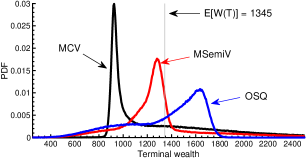
- The method achieves accurate results for the mean-semi-variance (Sortino-inspired) objective, producing a strategy with distinct downside protection and left-skewed terminal wealth distribution.
- The approach remains robust and accurate when using parametric models, stationary block bootstrap resampling of empirical returns, and GAN-generated synthetic returns.
- The number of network parameters remains constant regardless of the number of rebalancing events, ensuring scalability for long investment horizons and frequent trading.
Read this paper
Open the full text in the Nubint reader and ask about any passage as you read.
Read this paper on NubintThis review was generated by AI from the original paper. Please check the paper before citing it.