
[Paper Review] A Pathway Towards Responsible AI Generated Content
This paper surveys 8 key risks of AI Generated Content (AIGC) and outlines directions to develop responsible AIGC by addressing privacy, bias, IP, robustness, open source, abuse, consent/credit, and environmental concerns.
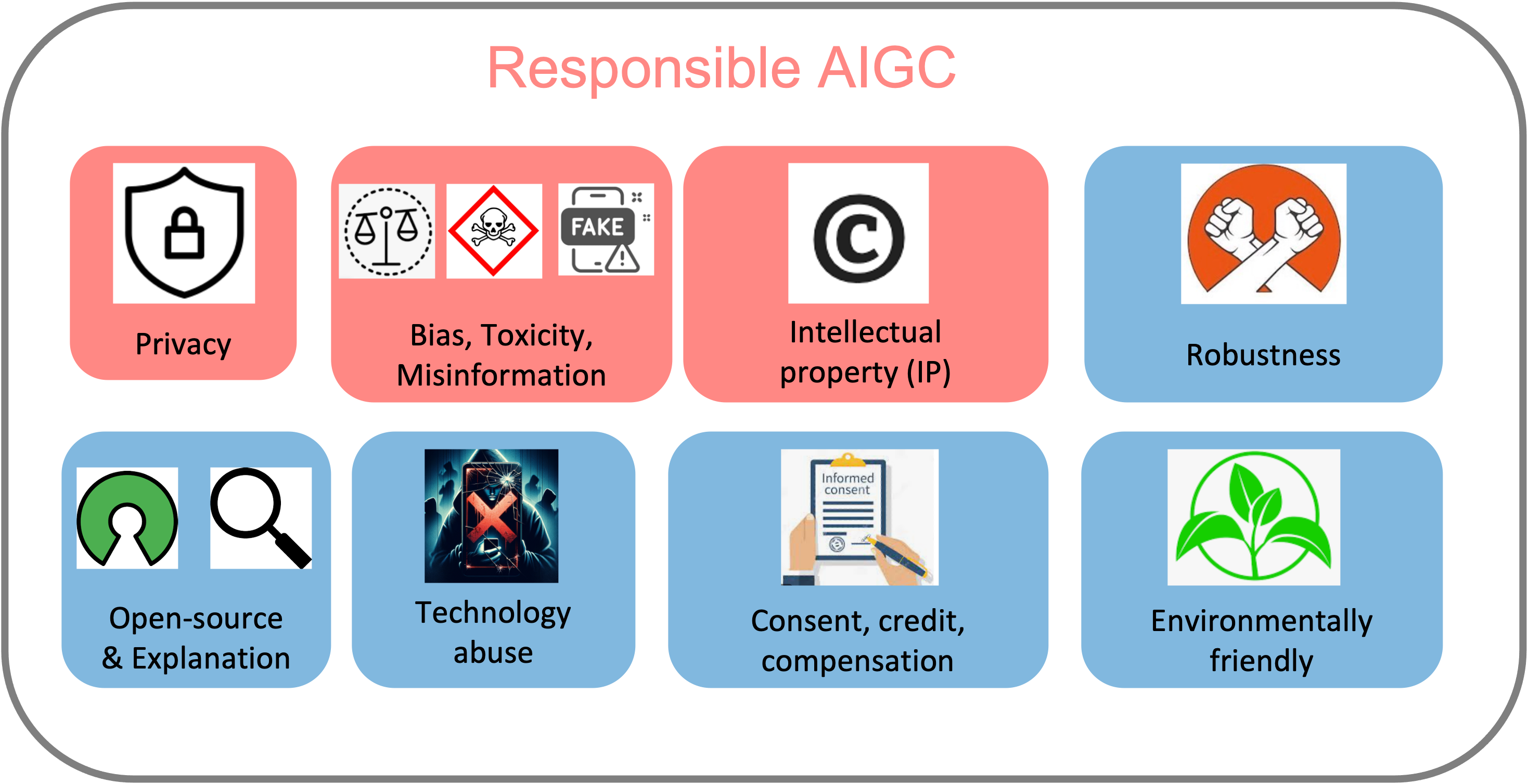
AI Generated Content (AIGC) has received tremendous attention within the past few years, with content generated in the format of image, text, audio, video, etc. Meanwhile, AIGC has become a double-edged sword and recently received much criticism regarding its responsible usage. In this article, we focus on 8 main concerns that may hinder the healthy development and deployment of AIGC in practice, including risks from (1) privacy; (2) bias, toxicity, misinformation; (3) intellectual property (IP); (4) robustness; (5) open source and explanation; (6) technology abuse; (7) consent, credit, and compensation; (8) environment. Additionally, we provide insights into the promising directions for tackling these risks while constructing generative models, enabling AIGC to be used more responsibly to truly benefit society.
Motivation & Objective
- Identify the eight main concerns hindering responsible AIGC deployment (privacy, bias/toxicity/misinformation, IP, robustness, open source and explainability, technology abuse, consent/credit/compensation, environment).
- Provide insights and directions for mitigating these risks in the construction and deployment of generative models.
- Discuss how foundation models enable AIGC and how risks propagate across modalities (text, image, video, audio).
Proposed method
- Review and synthesize existing literature and industry practices on AIGC risks.
- Map risk categories to concrete mitigation strategies (data curation, filtering, watermarking, access controls, governance).
- Propose discussion of policy, technical, and societal approaches to responsible AIGC across lifecycle stages.
- Highlight representative models and datasets to illustrate risk areas (privacy leakage, dataset biases, memorization, IP concerns).
Experimental results
Research questions
- RQ1What are the principal risks associated with AI Generated Content across privacy, bias/toxicity/misinformation, IP, robustness, open source, abuse, consent/credit, and environment?
- RQ2What directions and strategies can be pursued to mitigate these risks while enabling beneficial uses of AIGC?
- RQ3How do foundation models contribute to risks and how can mitigation be integrated into model design and deployment?
Key findings
- AIGC faces interconnected risks spanning privacy, bias, misinformation, IP, robustness, openness, abuse, and environmental impact.
- Mitigation approaches include data filtering, deduplication, watermarking, output filtering, model recalibration, and governance mechanisms.
- Content ownership and IP attribution remain legally unresolved, prompting practices like DMCA takedown policies, watermarking, and attribution considerations.
- Hallucinations and misinformation stem from training data quality, overfitting, and prompt design; regular data updates and user feedback can help reduce them.
- Open-source transparency is debated; while openness aids explanation, it also raises risks of misuse and competitive concerns.
- There is a need for governance, consent, and compensation models so data contributors can benefit from AIGC training data.
- Environmental costs of large models motivate exploring slimmer models and efficiency-focused research.

Better researchstarts right now
From reading papers to final review, dramatically reduce your research time.
No credit card · Free plan available
This review was created by AI and reviewed by human editors.