
[Paper Review] A Performance-Driven Benchmark for Feature Selection in Tabular Deep Learning
This paper introduces a performance-driven benchmark for feature selection in tabular deep learning, evaluating methods on real datasets with synthetic extraneous features (noise, corruption, second-order). It proposes Deep Lasso, an input-gradient-based Lasso analogue for neural networks, which outperforms classical methods—especially on challenging corrupted or engineered features—by improving downstream model accuracy and robustness.
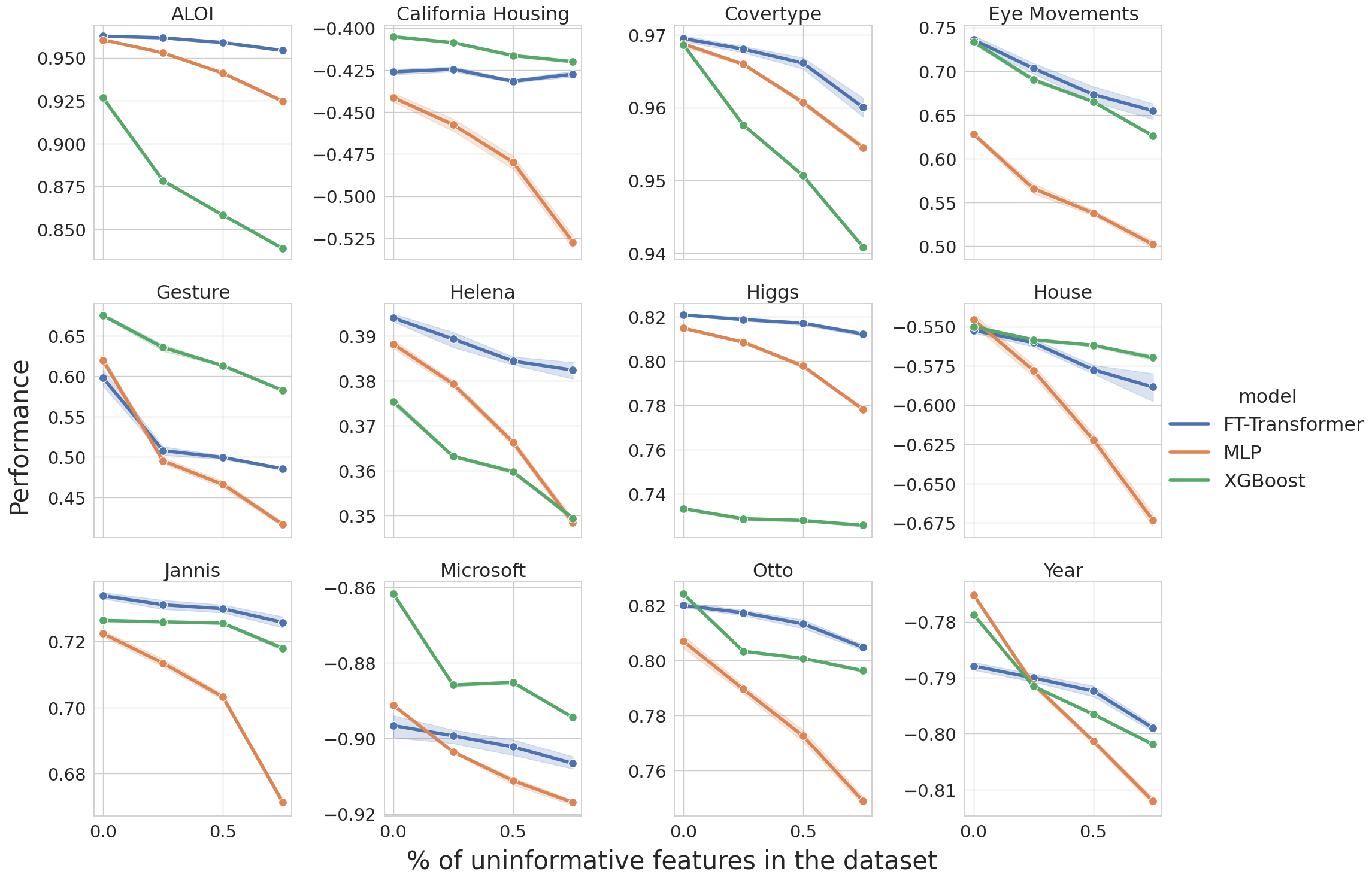
Academic tabular benchmarks often contain small sets of curated features. In contrast, data scientists typically collect as many features as possible into their datasets, and even engineer new features from existing ones. To prevent overfitting in subsequent downstream modeling, practitioners commonly use automated feature selection methods that identify a reduced subset of informative features. Existing benchmarks for tabular feature selection consider classical downstream models, toy synthetic datasets, or do not evaluate feature selectors on the basis of downstream performance. Motivated by the increasing popularity of tabular deep learning, we construct a challenging feature selection benchmark evaluated on downstream neural networks including transformers, using real datasets and multiple methods for generating extraneous features. We also propose an input-gradient-based analogue of Lasso for neural networks that outperforms classical feature selection methods on challenging problems such as selecting from corrupted or second-order features.
Motivation & Objective
- Address the lack of realistic, performance-based benchmarks for feature selection in tabular deep learning.
- Evaluate feature selection methods on real-world datasets with diverse types of extraneous features (noise, corrupted, second-order).
- Develop and validate a deep learning-compatible feature selection method that improves downstream neural network performance.
- Demonstrate that classical feature selection methods fail under realistic, complex feature settings common in practice.
- Establish a reproducible benchmark to guide future research in deep tabular feature selection.
Proposed method
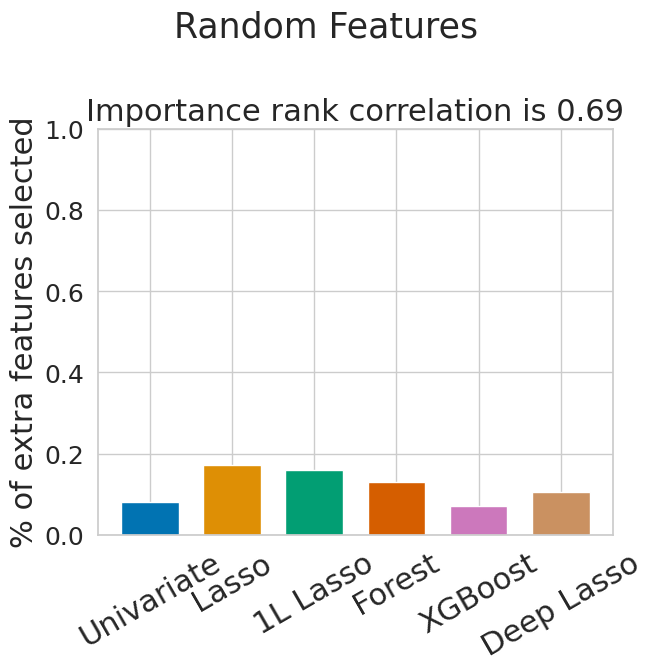
- Construct a benchmark using real tabular datasets augmented with three types of extraneous features: random noise, corrupted features (e.g., shuffled or perturbed), and second-order features (e.g., pairwise interactions).
- Evaluate feature selection methods using downstream performance of deep neural networks (MLP, Transformer, XGBoost, Random Forest) as the primary metric.
- Propose Deep Lasso, a differentiable, input-gradient-based feature selection method inspired by Lasso, which penalizes features based on their gradient influence on model predictions.
- Train the model with a differentiable L1 penalty on input gradients, enabling end-to-end optimization that identifies and suppresses uninformative features.
- Use attention maps from tabular transformers as an additional feature selection signal for comparison.
- Apply multiple baseline methods (Lasso, LassoNet, AGL, XGBoost, Random Forest) and compare their performance on the same benchmark.
Experimental results
Research questions
- RQ1Can existing feature selection methods effectively identify informative features when trained on deep neural networks with real tabular data?
- RQ2How do feature selection methods perform under realistic challenges such as feature corruption or high-order feature engineering?
- RQ3Does a gradient-based, differentiable feature selection method like Deep Lasso outperform classical, non-differentiable methods in deep tabular learning?
- RQ4To what extent do attention mechanisms in tabular transformers improve feature selection compared to traditional methods?
- RQ5Is there a significant performance gap between feature selection methods when evaluated on downstream neural network accuracy rather than surrogate metrics?
Key findings
- Deep Lasso achieves the highest downstream performance on both MLP and Transformer models, outperforming all baselines across all benchmark settings.
- On corrupted features, Deep Lasso achieves a test AUC of 0.805±0.002 (with MLP) and 0.819±0.001 (with FT), significantly outperforming Lasso (0.807±0.001) and XGBoost (0.803±0.003).
- In the second-order feature setting, Deep Lasso achieves a test AUC of 0.805±0.002 with MLP and 0.819±0.001 with FT, outperforming the next best method (AGL) by over 0.01 AUC.
- Classical methods like Lasso and XGBoost show degraded performance on corrupted features, with AUC dropping to 0.793±0.003 and 0.803±0.003 respectively, indicating poor robustness.
- The use of attention maps from tabular transformers yields competitive results but does not surpass Deep Lasso, especially in high-noise or corrupted settings.
- The benchmark reveals that feature selection performance varies significantly across methods, and only Deep Lasso maintains high performance across all challenging feature types.
Read this paper
Open the full text in the Nubint reader and ask about any passage as you read.
Read this paper on NubintThis review was generated by AI from the original paper. Please check the paper before citing it.