
[Paper Review] A physics and data co-driven surrogate modeling approach for temperature field prediction on irregular geometric domain
This paper proposes a physics- and data co-driven surrogate model for fast and accurate temperature field prediction on irregular geometric domains. By mapping irregular geometries to a regular computational plane via body-fitted coordinates and combining a physics-driven meshing surrogate with a multi-level reduced-order data-driven thermal surrogate, the method achieves high accuracy with small datasets and significantly reduced training time compared to standard CNNs like U-Net and FNO.
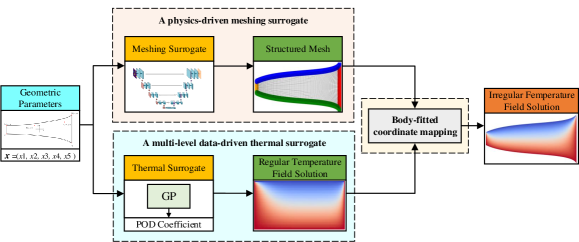
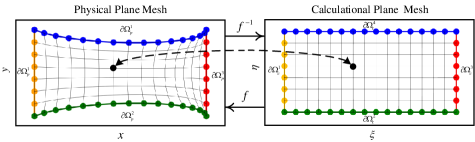
In the whole aircraft structural optimization loop, thermal analysis plays a very important role. But it faces a severe computational burden when directly applying traditional numerical analysis tools, especially when each optimization involves repetitive parameter modification and thermal analysis followed. Recently, with the fast development of deep learning, several Convolutional Neural Network (CNN) surrogate models have been introduced to overcome this obstacle. However, for temperature field prediction on irregular geometric domains (TFP-IGD), CNN can hardly be competent since most of them stem from processing for regular images. To alleviate this difficulty, we propose a novel physics and data co-driven surrogate modeling method. First, after adapting the Bezier curve in geometric parameterization, a body-fitted coordinate mapping is introduced to generate coordinate transforms between the irregular physical plane and regular computational plane. Second, a physics-driven CNN surrogate with partial differential equation (PDE) residuals as a loss function is utilized for fast meshing (meshing surrogate); then, we present a data-driven surrogate model based on the multi-level reduced-order method, aiming to learn solutions of temperature field in the above regular computational plane (thermal surrogate). Finally, combining the grid position information provided by the meshing surrogate with the scalar temperature field information provided by the thermal surrogate (combined model), we reach an end-to-end surrogate model from geometric parameters to temperature field prediction on an irregular geometric domain. Numerical results demonstrate that our method can significantly improve accuracy prediction on a smaller dataset while reducing the training time when compared with other CNN methods.
Motivation & Objective
- To address the high computational cost of traditional PDE solvers in thermal analysis for aircraft structural optimization.
- To overcome the limitations of standard CNNs in handling irregular geometric domains due to their reliance on regular grids.
- To develop a surrogate model that combines physical PDE constraints with data-driven learning for improved generalization and efficiency.
- To reduce training time and data requirements while maintaining high prediction accuracy for temperature fields on complex geometries.
Proposed method
- Parameterize irregular geometries using Bézier curves to enable consistent geometric representation.
- Apply body-fitted coordinate mapping to transform the irregular physical domain into a regular computational plane.
- Develop a physics-driven convolutional neural network (CNN) surrogate that uses PDE residual loss to generate high-quality meshes.
- Construct a multi-level reduced-order model (ROM) based on Proper Orthogonal Decomposition (POD) to predict temperature fields in the regularized domain.
- Combine the meshing surrogate (providing grid positions) and thermal surrogate (providing scalar temperature values) into an end-to-end model for irregular domain prediction.
- Train the combined model using a small dataset, leveraging both physical laws and data to improve generalization and reduce overfitting.
Experimental results
Research questions
- RQ1Can a co-driven surrogate model effectively predict temperature fields on irregular geometric domains where standard CNNs fail due to grid irregularity?
- RQ2How does the integration of PDE-based physics constraints with data-driven learning improve prediction accuracy with limited training data?
- RQ3To what extent does the multi-level reduced-order modeling strategy reduce training complexity and improve generalization in temperature field prediction?
- RQ4How does the proposed method compare in accuracy and training efficiency to state-of-the-art CNN-based surrogate models like U-Net and FNO on small datasets?
- RQ5Can the proposed framework be extended to three-dimensional or more complex thermal problems with arbitrary boundary conditions?
Key findings
- The proposed multi-level model achieves a mean absolute error (MAE) of 0.0123 and a mean relative error (MRE) of 0.0299, significantly outperforming the single-level model (MAE: 0.0185, MRE: 0.0448).
- The multi-level model maintains low error and high accuracy even with small dataset sizes, showing minimal performance degradation as data scale increases.
- Training time for the proposed model is approximately 2 minutes, which is about 10 times faster than U-Net and FNO models (around 20 minutes) to reach convergence.
- The U-Net and FNO models show high sensitivity to dataset size, with performance degrading significantly on small datasets, whereas the proposed model remains stable and accurate.
- The meshing surrogate produces high-quality meshes with low error, validating the effectiveness of the physics-driven approach in grid generation.
- The combined model enables end-to-end prediction from geometric parameters to temperature fields on irregular domains, demonstrating strong potential for real-time design optimization.
Better researchstarts right now
From reading papers to final review, dramatically reduce your research time.
No credit card · Free plan available
This review was created by AI and reviewed by human editors.