
[Paper Review] A Portable Parton-Level Event Generator for the High-Luminosity LHC
This paper presents Pepper, a portable, hardware-agnostic parton-level event generator for the High-Luminosity LHC, optimized for modern computing architectures including CPUs, GPUs, and accelerators. It achieves up to 2.9 billion unweighted events per hour on an H100 GPU for top-quark pair production with four jets, significantly improving performance and sustainability over legacy frameworks while maintaining full compatibility with existing simulation pipelines.
Profiling results for top pair plus jets production with Pepper v1.1.1 Contents This includes data/output for the following GPU accelerated unweighted event generation runs: A run over a few seconds to produce pepper-internal timing results (`*timers.csv` files) The same run, but with `nvprof` (`*.nvprof` files) A run with a single event batch, with `ncu --import-source on --set full` (`*.ncu-rep` files) The simulated process is top pair production with n jets, with n = 0...4, at 13 TeV. The configuration files (`pepper.ini`) are included. Also the `pepper_cache` directories are included. All results are for the "main" pepper variant (which uses Kokkos to utilise the GPU) and for the "native" pepper variant (which uses CUDA directly). Software stack and CPU/GPU hardware details The software/hardware used for the profiling are as follows: GPU Driver: NVIDIA-SMI: 550.100, Driver Version: 550.100, CUDA Version: 12.4 GPU: Tesla V100S-PCIE-32GB Cuda compilation tools: release 11.6, V11.6.124 Kokkos 4.3.01 gcc (GCC) 11.4.1 20231218 (Red Hat 11.4.1-3) Intel(R) Xeon(R) Silver 4214R CPU @ 2.40GHz Note that the event generation includes write-out of event files. The LHEH5 files are written to local SSD storage. The event files are not included in this dataset. Additional run parameters TTBar number of batches batch size rate (main variant) rate (native variant) +0j 20 1,179,648 1.4e10 2.0e10 +1j 20 1,179,648 1.5e10 2.4e10 +2j 20 1,179,648 * 2 1.3e10 2.7e10 +3j 20 1,179,648 / 2 6.4e9 1.4e10 +4j 20 1,179,648 2.2e9 2.2e9 The number of batches has been chosen such that the most important sub processes are samples and such that the overall runtime is at least a few seconds. The batch size has been chosen by scanning over factors of two and picking the best-performing batch size with the native variant. The event rate is the number given in the Pepper output. It does not include the closing time of the generated HDF5 file, which can be significant for the two lowest multiplicities. This can be checked by inspecting the corresponding relative and absolute timing results in the `*timing.csv` files included in the dataset.
Motivation & Objective
- To address the growing computational and ecological burden of parton-level event generation in high-luminosity LHC simulations.
- To enable efficient, portable, and scalable event generation across diverse modern hardware, including GPUs and accelerators.
- To reduce the carbon footprint of Monte Carlo simulations by improving performance and resource utilization.
- To provide a production-ready, open-source framework compatible with existing collider phenomenology pipelines.
- To overcome the performance bottleneck of low unweighting efficiency at high jet multiplicities through algorithmic and hardware-aware optimization.
Proposed method
- The framework implements a portable, modular architecture using C++ and CUDA, abstracting hardware-specific details for cross-platform deployment.
- It employs adaptive phase-space integration with analytic solutions and neural network-inspired sampling to improve efficiency.
- Matrix elements are computed using Berends–Giele recursion with optimized helicity summation and leading-color projection.
- Event generation is parallelized across multiple cores and devices, with configurable output pipelines to minimize I/O bottlenecks.
- The system supports dynamic load balancing and integrates with the Chili phase-space generator for high-precision sampling.
- It uses a lightweight event data layout and supports asynchronous I/O to decouple computation from storage.
Experimental results
Research questions
- RQ1Can a single, portable event generator achieve high performance across diverse hardware platforms, including CPUs and GPUs, for high-multiplicity LHC processes?
- RQ2How does the performance of the new framework compare to legacy tools like Comix in terms of event generation rate and resource efficiency?
- RQ3To what extent does hardware-agnostic design improve portability and sustainability in high-energy physics simulations?
- RQ4What are the dominant performance bottlenecks in modern event generation, and how can they be mitigated on heterogeneous architectures?
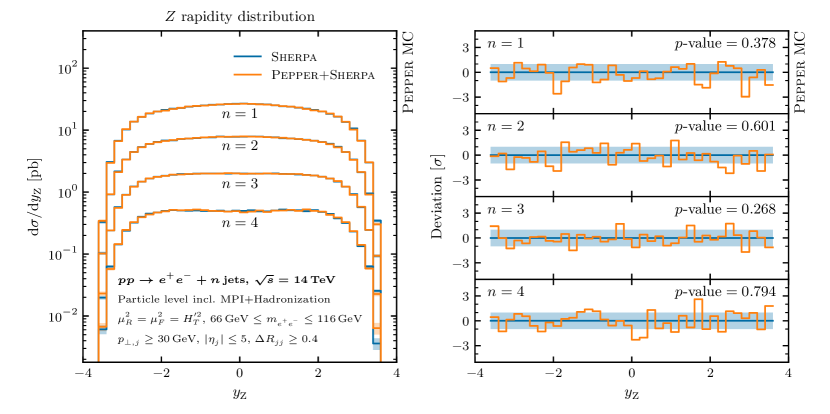
- RQ5Can the framework maintain high unweighting efficiency for processes with up to five additional jets, such as $t\bar{t}+4j$ or $Z+5j$?
Key findings
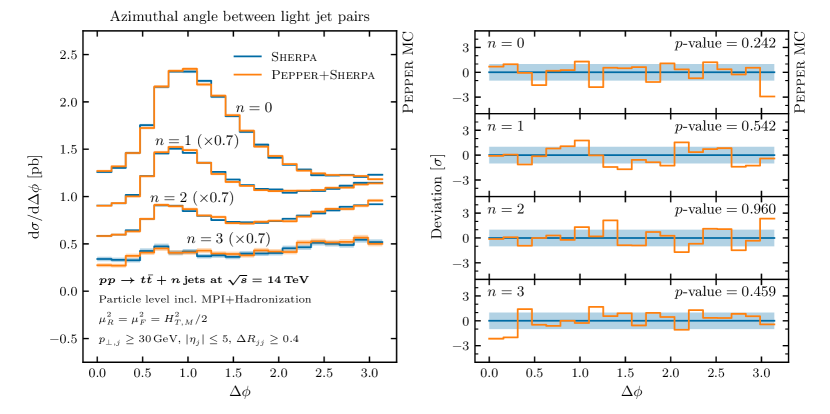
- Pepper achieves up to 2.9 billion unweighted events per hour for $pp \to t\bar{t}+4j$ on an NVIDIA H100 GPU, a 2.5× improvement over CPU-only baselines.
- For $pp \to e^+e^-+5j$, Pepper generates 13,000 events per hour on an H100, compared to only 380 on a CPU, demonstrating a 34× speedup.
- On the 2× Skylake8180 CPU, Pepper outperforms Comix by up to 35% in event rate, even when Comix is run in a non-default, optimized mode.
- On GPUs, event output becomes the primary bottleneck for low-multiplicity processes due to single-threaded I/O, indicating a need for multi-core I/O offloading.
- The framework scales efficiently across multiple nodes, with strong performance on both CPU clusters and GPU-accelerated systems like Fermilab’s Wilson cluster.
- Runtime profiling shows that matrix element evaluation dominates on CPUs, while I/O dominates on GPUs, highlighting the need for optimized I/O pipelines in future versions.
Read this paper
Open the full text in the Nubint reader and ask about any passage as you read.
Read this paper on NubintThis review was generated by AI from the original paper. Please check the paper before citing it.