
[Paper Review] A Practical Mixed Precision Algorithm for Post-Training Quantization
The paper introduces a post-training mixed-precision quantization method that builds a per-layer sensitivity list using SQNR, then uses a Pareto-frontier greedy search to assign bit-widths under hardware and accuracy budgets, with AdaRound integration to boost low-bit performance, all without training data.
Neural network quantization is frequently used to optimize model size, latency and power consumption for on-device deployment of neural networks. In many cases, a target bit-width is set for an entire network, meaning every layer get quantized to the same number of bits. However, for many networks some layers are significantly more robust to quantization noise than others, leaving an important axis of improvement unused. As many hardware solutions provide multiple different bit-width settings, mixed-precision quantization has emerged as a promising solution to find a better performance-efficiency trade-off than homogeneous quantization. However, most existing mixed precision algorithms are rather difficult to use for practitioners as they require access to the training data, have many hyper-parameters to tune or even depend on end-to-end retraining of the entire model. In this work, we present a simple post-training mixed precision algorithm that only requires a small unlabeled calibration dataset to automatically select suitable bit-widths for each layer for desirable on-device performance. Our algorithm requires no hyper-parameter tuning, is robust to data variation and takes into account practical hardware deployment constraints making it a great candidate for practical use. We experimentally validate our proposed method on several computer vision tasks, natural language processing tasks and many different networks, and show that we can find mixed precision networks that provide a better trade-off between accuracy and efficiency than their homogeneous bit-width equivalents.
Motivation & Objective
- Motivate improving on-device performance by exploiting per-layer robustness to quantization rather than uniform bit-widths.
- Develop a post-training quantization method that requires minimal data and no hyper-parameter tuning.
- Incorporate practical hardware constraints through quantizer groups and efficiency metrics.
- Demonstrate robustness to calibration data variations and out-of-domain inputs.
- Show that the proposed method yields better accuracy-efficiency trade-offs than homogeneous quantization across diverse models.
Proposed method
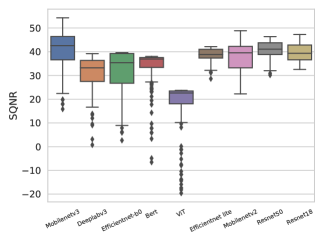
- Phase 1 creates a per-layer sensitivity list by measuring network loss with different quantization options for each layer, using SQNR as the sensitivity metric.
- Phase 2 starts from the highest-precision quantization and iteratively lowers bit-widths guided by the sensitivity list to achieve a predefined performance budget via a Pareto frontier greedy search.
- Quantizer groups are introduced to enforce hardware-imposed dependencies so that shared operations use consistent precision across a group.
- AdaRound is integrated to improve low-bit quantization performance by using AdaRounded weights in Phase 1 sensitivity measurements and then stitching these weights across bit-width configurations.
- The search can be accelerated with a binary-search plus interpolation strategy to reduce runtime while exploiting the monotonic Pareto curve.
- The method operates without labels in phase 1 and can tolerate limited calibration data while remaining robust to data variation.
Experimental results
Research questions
- RQ1Can post-training mixed-precision quantization outperform fixed-precision quantization for a range of architectures in CV and NLP tasks?
- RQ2How robust is the approach to variations in calibration data and to using out-of-domain data for sensitivity estimation?
- RQ3How do hardware constraints, such as quantizer groupings, affect the feasible mixed-precision configurations and performance?
- RQ4Does integrating AdaRound with the mixed-precision pipeline improve accuracy, especially at very low bit-widths?
Key findings
- The proposed PTQ MP method finds mixed-precision configurations that provide better accuracy-efficiency trade-offs than homogeneous bit-width networks on several models including Mobilenetv3, Deeplabv3, Efficientnet, BERT, and ViT.
- SQNR-based per-layer sensitivity lists show robustness to calibration data variation and to the number of calibration images, with favorable Kendall Tau correlations relative to accuracy-based sensitivity.
- Integrating AdaRound with the mixed-precision pipeline improves low-bit (less than 8) quantization performance and can outperform fixed-precision AdaRound.
- The runtime of Phase 2 is improved using binary search and interpolation strategies, reducing search complexity while preserving good Pareto curves.
- The method remains effective with a variety of bit-width candidate sets (e.g., W4A8, W8A8, W8A16) and with expanded low-bit spaces (e.g., W4A4, W6A6, etc.).
- Phase 1 and 2 can operate with little or no task data, enabling out-of-domain or privacy-preserving calibration scenarios.
Read this paper
Open the full text in the Nubint reader and ask about any passage as you read.
Read this paper on NubintThis review was generated by AI from the original paper. Please check the paper before citing it.