
[Paper Review] A Practical Review of Mechanistic Interpretability for Transformer-Based Language Models
A comprehensive survey of mechanistic interpretability (MI) for transformer LMs, outlining fundamental objects, techniques, evaluation, findings, and a beginner roadmap. It highlights features, circuits, universality, and future directions.
Mechanistic interpretability (MI) is an emerging sub-field of interpretability that seeks to understand a neural network model by reverse-engineering its internal computations. Recently, MI has garnered significant attention for interpreting transformer-based language models (LMs), resulting in many novel insights yet introducing new challenges. However, there has not been work that comprehensively reviews these insights and challenges, particularly as a guide for newcomers to this field. To fill this gap, we provide a comprehensive survey from a task-centric perspective, organizing the taxonomy of MI research around specific research questions or tasks. We outline the fundamental objects of study in MI, along with the techniques, evaluation methods, and key findings for each task in the taxonomy. In particular, we present a task-centric taxonomy as a roadmap for beginners to navigate the field by helping them quickly identify impactful problems in which they are most interested and leverage MI for their benefit. Finally, we discuss the current gaps in the field and suggest potential future directions for MI research.
Motivation & Objective
- Survey fundamental objects of MI (features, circuits, universality) and how they relate to transformer LMs.
- Summarize techniques for MI (logit lens, probing, SAE, visualization, automated feature explanation, knockout/ablation, CMA).
- Discuss evaluation criteria (faithfulness, completeness, minimality, plausibility) and how they are applied.
- Provide a beginner-friendly roadmap to conduct feature and circuit studies in MI.
- Highlight key findings and applications, and identify gaps and future directions in MI for LMs.
Proposed method
- Present a taxonomy of MI research including features, circuits, and universality.
- Describe core MI techniques: logit lens, probing, sparse autoencoders (SAE), visualization, automated feature explanation, knockout/ablation, causal mediation analysis (CMA).
- Explain evaluation metrics: faithfulness, completeness, minimality, plausibility.
- Offer a beginner’s roadmap detailing steps for feature and circuit studies.
- Synthesize findings across studies on features, circuits, universality, model capabilities, learning dynamics, and applications.
Experimental results
Research questions
- RQ1What fundamental objects (features, circuits, universality) define mechanistic interpretability for transformer LMs?
- RQ2What techniques are used to study these objects and how are results evaluated?
- RQ3What findings have MI studies produced about features, circuits, universality, and LM capabilities?
- RQ4How can newcomers systematically conduct MI studies, and what are the current gaps and future directions?
Key findings
- Features in LMs are often polysemantic and can exhibit superposition, challenging monosemantic mappings.
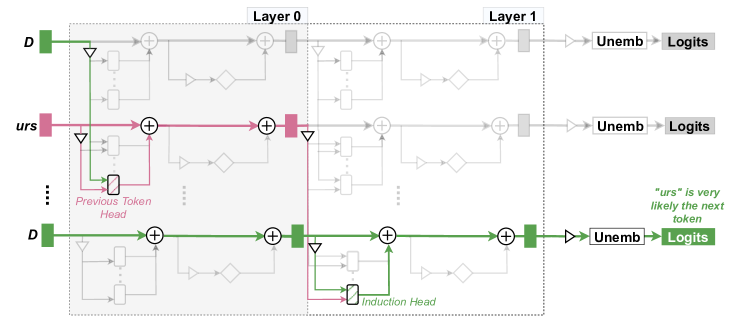
- Circuits reveal how LM behaviors (e.g., in-context learning, IOI, arithmetic) are implemented via specialized components and reused across tasks.
- Universality of features and circuits is mixed and depends on model size, initialization, and training; some components are shared, others differ across models.
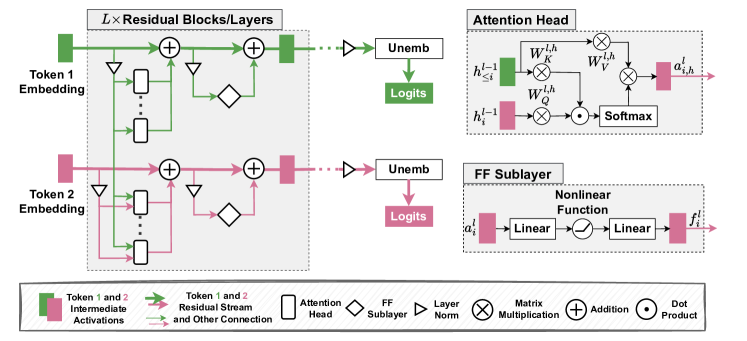
- Transformer components (residual stream, MHA, FF) have distinct roles, with heads showing specialized functions like copy suppression, induction, and knowledge storage.
- MI studies reveal clear progress in understanding capabilities and dynamics, but scalability, generalization, and safety-related questions remain open.
- A beginner-friendly workflow and roadmap are provided to help new researchers apply MI techniques to LMs.
Read this paper
Open the full text in the Nubint reader and ask about any passage as you read.
Read this paper on NubintThis review was generated by AI from the original paper. Please check the paper before citing it.