
[Paper Review] A Rainbow in Deep Network Black Boxes
This paper introduces rainbow networks, a probabilistic model of trained deep neural networks that assumes weight matrices across layers are related by rotations aligning input activations. It shows that in the infinite-width limit, activations converge to a deterministic kernel feature vector, explaining representation similarity in deep networks, with numerical validation on ResNets and scattering networks on CIFAR-10 and ImageNet.
A central question in deep learning is to understand the functions learned by deep networks. What is their approximation class? Do the learned weights and representations depend on initialization? Previous empirical work has evidenced that kernels defined by network activations are similar across initializations. For shallow networks, this has been theoretically studied with random feature models, but an extension to deep networks has remained elusive. Here, we provide a deep extension of such random feature models, which we call the rainbow model. We prove that rainbow networks define deterministic (hierarchical) kernels in the infinite-width limit. The resulting functions thus belong to a data-dependent RKHS which does not depend on the weight randomness. We also verify numerically our modeling assumptions on deep CNNs trained on image classification tasks, and show that the trained networks approximately satisfy the rainbow hypothesis. In particular, rainbow networks sampled from the corresponding random feature model achieve similar performance as the trained networks. Our results highlight the central role played by the covariances of network weights at each layer, which are observed to be low-rank as a result of feature learning.
Motivation & Objective
- To understand the joint probability distribution of trained deep neural network weights across layers.
- To explain the empirical observation that intermediate layer activations are highly correlated across independent network realizations.
- To model the functional space of trained networks by analyzing weight distributions and their evolution during training.
- To validate that weight covariances remain low-rank and that input activation covariances approximate weight covariance eigenspaces.
- To demonstrate that Gaussian rainbow networks with learned weight distributions can achieve strong performance on image classification tasks.
Proposed method
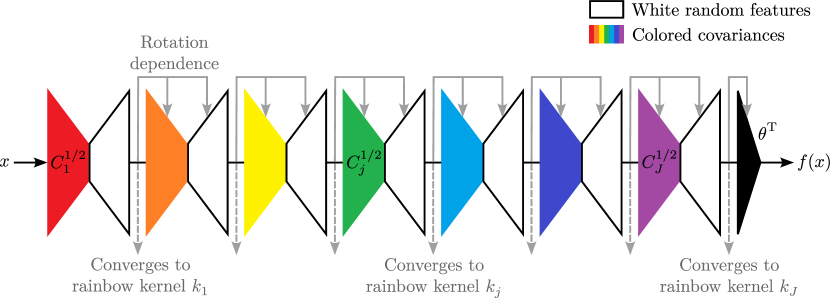
- Proposes a probabilistic model—rainbow networks—where weight matrices at each layer are related by rotations that align input activations, reducing inter-layer dependencies.
- Assumes that after alignment, neuron weights within a layer are independent and drawn from random feature maps with learned weight distributions.
- Shows that in the infinite-width limit, the network's output converges to a random rotation of a deterministic kernel feature vector.
- Uses wavelet scattering networks and ResNets as testbeds, with weight initialization via Glorot uniform distribution and training via SGD with momentum and weight decay.
- Computes activation covariances over channels and spatial locations to approximate the eigenspaces of weight covariance matrices.
- Extends the model to complex-valued activations (e.g., in scattering networks with skip-connections) by using unitary alignment operators.
Experimental results
Research questions
- RQ1What is the joint probability distribution of trained deep neural network weights across layers?
- RQ2Why do intermediate layer activations in different network realizations show high correlation despite random weight initialization?
- RQ3How do weight covariances evolve during training, and can they be approximated using unsupervised information from activation statistics?
- RQ4To what extent do trained networks converge to a deterministic functional space in the infinite-width limit?
- RQ5Can a Gaussian rainbow network model with low-rank weight covariances accurately represent trained network behavior on image classification tasks?
Key findings
- Rainbow networks explain the observed representation similarity in deep networks: activations converge to a random rotation of a deterministic kernel feature vector in the infinite-width limit.
- Numerical experiments confirm this convergence on ResNets trained on ImageNet and on scattering networks trained on CIFAR-10.
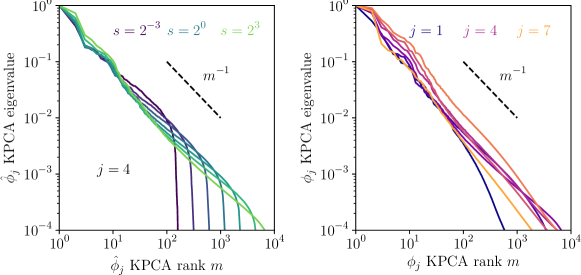
- Trained network weight distributions exhibit low-rank covariances, indicating that the effective parameter space is significantly lower-dimensional than the full weight space.
- Input activation covariances provide accurate approximations of the eigenspaces of weight covariance matrices, enabling unsupervised dimensionality reduction of the parameter space.
- Gaussian rainbow networks trained on CIFAR-10 with wavelet scattering architectures achieve strong performance, validating the model's predictive power.
- Despite uniform initialization, weight marginals become approximately Gaussian after a single training epoch, supporting the use of Gaussian assumptions in the model.
Read this paper
Open the full text in the Nubint reader and ask about any passage as you read.
Read this paper on NubintThis review was generated by AI from the original paper. Please check the paper before citing it.