
[Paper Review] A random-key GRASP for combinatorial optimization
This paper proposes a problem-independent GRASP metaheuristic, Random-Key GRASP (RK-GRASP), which uses a decoder to map solutions from the continuous unit hypercube to discrete combinatorial problem spaces. It achieves superior performance on five NP-hard problems, with RK-GRASP using Random Variable Neighborhood Descent (RVND) outperforming BRKGA and Multi-Start methods in 97% of THLP, 100% of SSP, and 75% of NCGPP instances.
This paper proposes a problem-independent GRASP metaheuristic using the random-key optimizer (RKO) paradigm. GRASP (greedy randomized adaptive search procedure) is a metaheuristic for combinatorial optimization that repeatedly applies a semi-greedy construction procedure followed by a local search procedure. The best solution found over all iterations is returned as the solution of the GRASP. Continuous GRASP (C-GRASP) is an extension of GRASP for continuous optimization in the unit hypercube. A random-key optimizer (RKO) uses a vector of random keys to encode a solution to a combinatorial optimization problem. It uses a decoder to evaluate a solution encoded by the vector of random keys. A random-key GRASP is a C-GRASP where points in the unit hypercube are evaluated employing a decoder. We describe random key GRASP consisting of a problem-independent component and a problem-dependent decoder. As a proof of concept, the random-key GRASP is tested on five NP-hard combinatorial optimization problems: traveling salesman problem, tree of hubs location problem, Steiner triple covering problem, node capacitated graph partitioning problem, and job sequencing and tool switching problem.
Motivation & Objective
- To develop a problem-independent GRASP metaheuristic for combinatorial optimization using the random-key paradigm.
- To enable reuse of a single solver framework across diverse combinatorial problems by decoupling the solver from problem-specific logic.
- To evaluate the effectiveness of RK-GRASP on a range of NP-hard combinatorial optimization problems using different local search strategies.
- To compare RK-GRASP’s performance against BRKGA and Multi-Start methods using runtime and solution quality metrics.
- To demonstrate the feasibility and superiority of the random-key GRASP framework through empirical testing on benchmark instances.
Proposed method
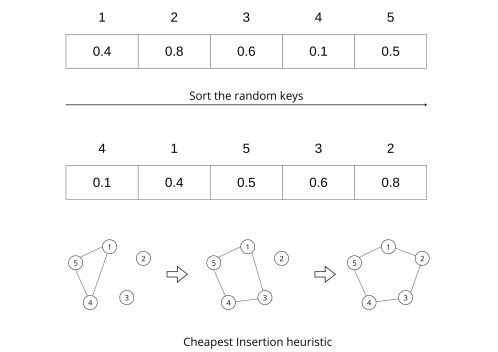
- RK-GRASP operates in the continuous unit hypercube, where solutions are represented as vectors of random keys in [0,1).
- A problem-specific decoder maps each random-key vector to a feasible solution in the discrete problem space and evaluates its cost.
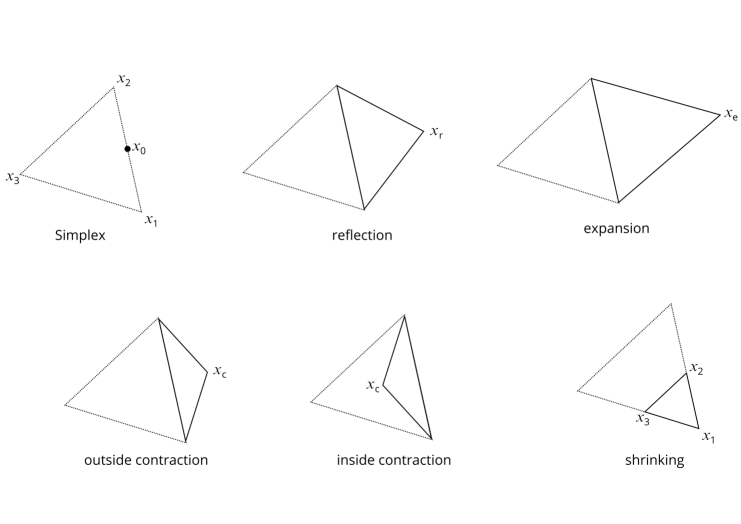
- The algorithm combines a greedy randomized construction phase with local search procedures, including Grid Search, Nelder-Mead Search, and Random Variable Neighborhood Descent (RVND).
- The best solution found over multiple iterations is returned, with local search applied to improve solution quality.
- The framework separates the metaheuristic (solver) from the problem-specific logic (decoder), enabling reuse across different optimization problems.
- Performance is evaluated using performance profiles based on CPU time and solution gap, with a 1% convergence threshold.
Experimental results
Research questions
- RQ1Can a problem-independent GRASP metaheuristic be effectively designed using the random-key optimizer (RKO) paradigm?
- RQ2How does RK-GRASP compare in performance and solution quality to BRKGA and Multi-Start methods across diverse NP-hard combinatorial problems?
- RQ3Which local search strategy—Grid Search, Nelder-Mead, or RVND—yields the best performance in the RK-GRASP framework?
- RQ4To what extent can RK-GRASP achieve new best-known solutions on benchmark instances of NP-hard problems?
- RQ5Does the random-key encoding and decoder-based mapping enable efficient and scalable optimization across different problem domains?
Key findings
- RK-GRASP with RVND outperformed BRKGA and Multi-Start methods in 97% of Tree of Hubs Location Problem (THLP) instances, 100% of Job Sequencing and Tool Switching Problem (SSP) instances, and 75% of Node Capacitated Graph Partitioning Problem (NCGPP) instances in terms of CPU time.
- For the Traveling Salesman Problem (TSP), both BRKGA and RK-GRASP with RVND solved 95% of instances within a performance ratio of 4, but RK-GRASP with RVND showed superior dominance in cumulative performance profiles.
- RK-GRASP with RVND achieved new best-known solutions for THLP, SSP, and NCGPP, demonstrating its effectiveness in finding high-quality solutions.
- In the Steiner Triple Covering Problem (STCP), both BRKGA and RK-GRASP with RVND solved 40% of instances within a performance ratio of 4, with no clear dominance observed.
- The performance profile analysis showed that RK-GRASP with RVND had the highest cumulative distribution of solutions within a factor of 4 for TSP, THLP, and SSP.
- The framework’s problem-independent design allows reuse of the same solver by simply plugging in different decoders, enabling efficient adaptation to new combinatorial optimization problems.
Read this paper
Open the full text in the Nubint reader and ask about any passage as you read.
Read this paper on NubintThis review was generated by AI from the original paper. Please check the paper before citing it.