
[Paper Review] A Rapid Review of Clustering Algorithms
This paper surveys clustering algorithms, classifies them across five dimensions, discusses evaluation metrics, and highlights trends and open challenges in clustering research.
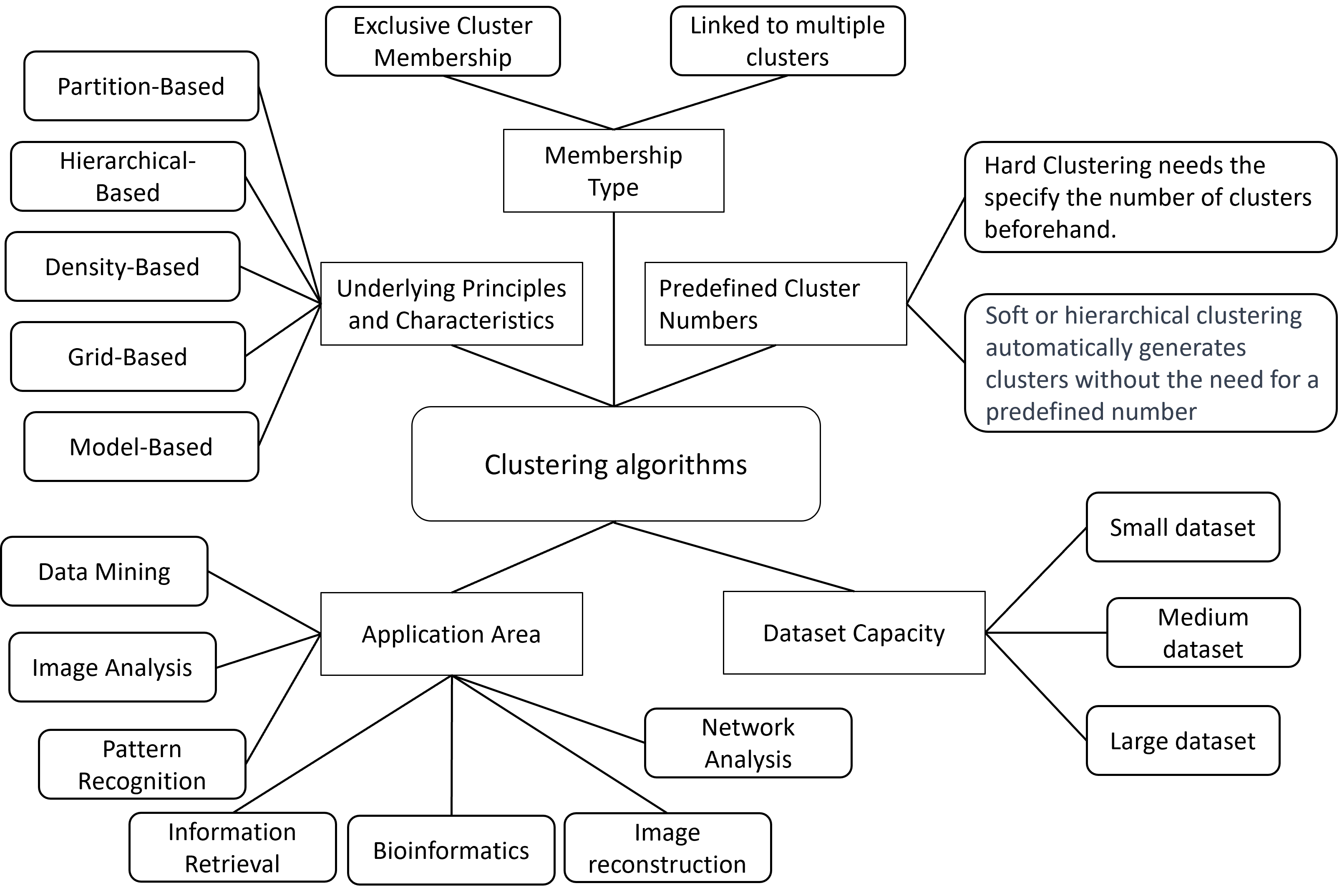
Clustering algorithms aim to organize data into groups or clusters based on the inherent patterns and similarities within the data. They play an important role in today's life, such as in marketing and e-commerce, healthcare, data organization and analysis, and social media. Numerous clustering algorithms exist, with ongoing developments introducing new ones. Each algorithm possesses its own set of strengths and weaknesses, and as of now, there is no universally applicable algorithm for all tasks. In this work, we analyzed existing clustering algorithms and classify mainstream algorithms across five different dimensions: underlying principles and characteristics, data point assignment to clusters, dataset capacity, predefined cluster numbers and application area. This classification facilitates researchers in understanding clustering algorithms from various perspectives and helps them identify algorithms suitable for solving specific tasks. Finally, we discussed the current trends and potential future directions in clustering algorithms. We also identified and discussed open challenges and unresolved issues in the field.
Motivation & Objective
- Summarize existing clustering algorithms and their underlying principles.
- Classify algorithms by principles, data point assignment, dataset capacity, predefined cluster numbers, and application area.
- Discuss evaluation metrics and their applicability under different data conditions.
- Highlight current trends, open challenges, and future directions in clustering research.
Proposed method
- Perform a literature survey using keywords related to clustering across Google Scholar, arXiv, and Scopus.
- Screen papers based on language (English), recency (last five years), and focus on novel clustering techniques.
- Analyze underlying principles, data point assignment, dataset capacity, predefined cluster numbers, and application areas to classify algorithms.
- Review internal and external evaluation metrics and their limitations.
- Discuss trends, applications, and open challenges in clustering, including integration with deep learning and hybrid methods.
Experimental results
Research questions
- RQ1What are the main underlying principles and characteristics used to categorize clustering algorithms?
- RQ2How do clustering algorithms differ in terms of data point assignment, dataset capacity, and need for predefined cluster numbers?
- RQ3What evaluation metrics are used for clustering, and what are their limitations in unsupervised settings?
- RQ4What are the current trends, applications, and open challenges in clustering research?
- RQ5How might future directions, such as deep learning integration or hybrid approaches, influence clustering methods?
Key findings
- Clustering algorithms are categorized into five principle-based families: partition-based, hierarchical, density-based, grid-based, and model-based.
- Algorithms vary in how they assign data points to clusters (hard vs soft) and in their requirements for the number of clusters.
- Dataset capacity influences method choice, with distinct support for small, medium, and large datasets and corresponding scalability considerations.
- Internal and external evaluation metrics are used to assess clustering quality, each with specific pros and limitations.
- There is a trend toward applying clustering to specific domains, incorporating deep learning, and developing hybrid approaches, with ongoing challenges in determining the optimal number of clusters.
Read this paper
Open the full text in the Nubint reader and ask about any passage as you read.
Read this paper on NubintThis review was generated by AI from the original paper. Please check the paper before citing it.