
[Paper Review] A Real-time Critical-scenario-generation Framework for Testing Autonomous Driving System
This paper proposes a real-time critical-scenario-generation (RTCSG) framework for testing autonomous driving systems, using an aggressive-driving algorithm with a self-adaptive cost function to efficiently generate failure-inducing scenarios. The method achieves 16× higher efficiency than reinforcement learning-based approaches while maintaining superior stability and success rates in generating critical scenarios for black-box controllers.
In order to find the most likely failure scenarios which may occur under certain given operation domain, critical-scenario-based test is supposed as an effective and widely used method, which gives suggestions for designers to improve the developing algorithm. However, for the state of art, critical-scenario generation approaches commonly utilize random-search or reinforcement learning methods to generate series of scenarios for a specific algorithm, which takes amounts of computing resource for testing a developing target that is always changing, and inapplicable for testing a real-time system. In this paper, we proposed a real-time critical-scenario-generation (RTCSG) framework to address the above challenges. In our framework, an aggressive-driving algorithm is proposed in controlling the virtual agent vehicles, a specially designed cost function is presented to guide scenarios to evolve towards critical conditions, and a self-adaptive coefficient iteration is designed that enable the approach to operate successfully in different conditions. With our proposed method, the critical-scenarios can be directly generated for the target under test which is a black-box system, and the real-time critical-scenario test can be brought into reality. The simulation results show that our approach is able to obtain more critical scenarios in most conditions than current methods, with a higher stability of success. For a real-time testing, our approach improves the efficiency around 16 times.
Motivation & Objective
- To address the inefficiency and inapplicability of existing scenario generation methods for real-time, black-box autonomous driving systems.
- To develop a framework that generates critical scenarios on-the-fly without relying on expensive learning or rewindable simulation.
- To improve stability and success rate in generating failure-inducing scenarios under diverse initial conditions.
- To enable direct, real-time testing of autonomous driving controllers by generating adversarial scenarios tailored to the target system.
Proposed method
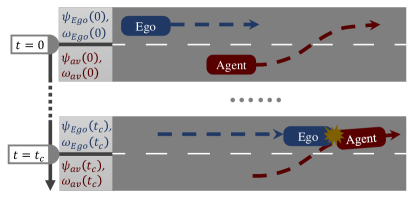
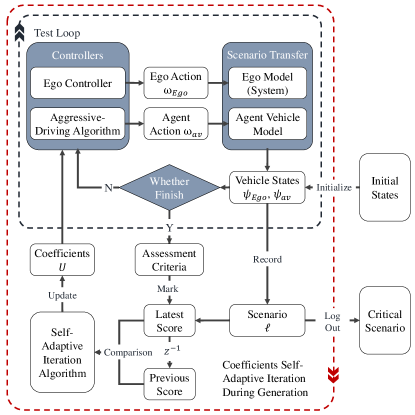
- The framework employs an aggressive-driving algorithm to simulate adversarial behavior in virtual agents, guiding them toward critical interactions with the ego vehicle.
- A custom cost function is designed to quantify danger levels based on proximity, relative velocity, and trajectory deviation, promoting near-miss conditions without extreme maneuvers.
- Self-adaptive coefficient iteration dynamically adjusts the cost function parameters to maintain performance across varying initial conditions and improve convergence.
- The method operates online, generating scenarios in real time without requiring simulation rollback or long training phases.
- The approach is applied directly to black-box controllers, enabling scenario generation without access to internal logic or control policies.
- The framework is evaluated through simulation using a variety of initial states, with performance measured via scenario score and step efficiency.
Experimental results
Research questions
- RQ1Can a real-time scenario generation framework be developed that efficiently targets black-box autonomous driving controllers without relying on reinforcement learning or simulation rollback?
- RQ2How does the proposed cost function with self-adaptive coefficients improve scenario generation stability and success rate across diverse initial conditions?
- RQ3To what extent does the RTCSG framework outperform RL-based and RRT-based methods in terms of generation efficiency and scenario quality?
- RQ4Can the framework consistently generate critical scenarios—especially near-misses—under adverse initial conditions where other methods fail?
- RQ5How does the framework’s performance scale across a wide range of initial relative positions and velocities between ego and agent vehicles?
Key findings
- The RTCSG framework achieved a median scenario score of 0.9433, significantly higher than RL-based (0.8728) and RRT-based (0.8661) methods, indicating better scenario quality and stability.
- In 85% of tested initial conditions, RTCSG outperformed both RL-based and RRT-based methods in scenario score, demonstrating superior reliability.
- The framework improved generation efficiency by a median factor of 16.0025 times compared to the RL-based method, as measured by step-spend-ratio.
- RTCSG showed minimal mild and no extreme outliers in performance, indicating consistent and robust behavior across diverse scenarios.
- The method maintained high performance even under adverse initial conditions (e.g., large initial distance or velocity difference), where RL and RRT methods often failed or required excessive steps.
- The self-adaptive coefficient iteration significantly enhanced the framework’s ability to converge under varying initial states, reducing sensitivity to initialization.
Better researchstarts right now
From reading papers to final review, dramatically reduce your research time.
No credit card · Free plan available
This review was created by AI and reviewed by human editors.