
[Paper Review] A Real-World WebAgent with Planning, Long Context Understanding, and Program Synthesis
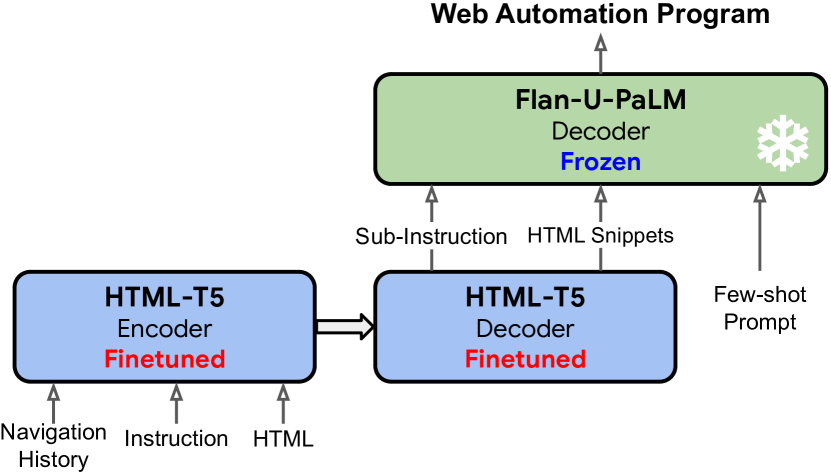
WebAgent combines an HTML-specialized planning/summarization model (HTML-T5) with a grounded code-generation model (Flan-U-PaLM) to automate real websites through Python Selenium programs, achieving over 50% higher success than baselines and state-of-the-art results on Mind2Web and MiniWoB++.
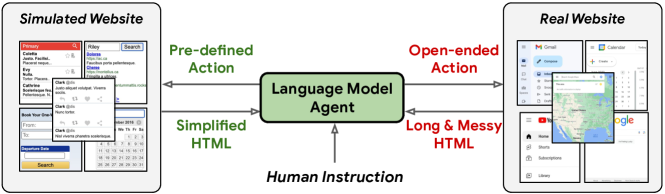
Pre-trained large language models (LLMs) have recently achieved better generalization and sample efficiency in autonomous web automation. However, the performance on real-world websites has still suffered from (1) open domainness, (2) limited context length, and (3) lack of inductive bias on HTML. We introduce WebAgent, an LLM-driven agent that learns from self-experience to complete tasks on real websites following natural language instructions. WebAgent plans ahead by decomposing instructions into canonical sub-instructions, summarizes long HTML documents into task-relevant snippets, and acts on websites via Python programs generated from those. We design WebAgent with Flan-U-PaLM, for grounded code generation, and HTML-T5, new pre-trained LLMs for long HTML documents using local and global attention mechanisms and a mixture of long-span denoising objectives, for planning and summarization. We empirically demonstrate that our modular recipe improves the success on real websites by over 50%, and that HTML-T5 is the best model to solve various HTML understanding tasks; achieving 18.7% higher success rate than the prior method on MiniWoB web automation benchmark, and SoTA performance on Mind2Web, an offline task planning evaluation.
Motivation & Objective
- Motivate autonomous web automation that works on real websites with open-ended actions and long HTML documents.
- Develop domain-specialized language models to handle planning, HTML summarization, and program synthesis under self-supervision.
- Enable end-to-end task completion by grounding language plans into executable Python scripts for browser control.
- Demonstrate improved generalization and robustness over prior baselines on real websites and standard benchmarks.
Proposed method
- Introduce HTML-T5, an encoder-decoder model with local and global attention tailored for long HTML documents.
- Pre-train HTML-T5 with a mixture of long-span denoising objectives on a large HTML corpus (CommonCrawl) and fine-tune with self-experience supervision.
- Employ Flan-U-PaLM as a grounded code generator to translate sub-instructions and HTML snippets into executable Python Selenium scripts.
- Use self-experience supervision to collect demonstrations from real website interactions and finetune HTML-T5 for planning and summarization.
- Combine planning (HTML-T5) and program synthesis (Flan-U-PaLM) in a modular WebAgent architecture to address open-ended actions and long-context HTML.
- Evaluate on real websites (real estate, social media, map) and benchmark HTML tasks (MiniWoB++, Mind2Web).
Experimental results
Research questions
- RQ1How does a modular combination of specialist language models improve real-world web automation compared to a single LLM approach?
- RQ2Can HTML-focused planning and long HTML summarization enable robust task grounding on real websites with long-context documents?
- RQ3What is the impact of self-experience supervision on planning accuracy and overall task success?
- RQ4How does HTML-T5 perform on standard HTML-based benchmarks (MiniWoB++, Mind2Web) relative to prior methods?
Key findings
- WebAgent increases real-world web automation success by over 50% compared with baselines.
- HTML-T5 outperforming prior language-model agents by 18.7% on MiniWoB++ and achieving state-of-the-art results on Mind2Web.
- HTML-T5 with self-experience supervision enables better planning and HTML summarization, yielding higher overall task success.
- Mind2Web offline action-prediction results show HTML-T5 with XL variants achieving SoTA across task/website/domain generalization.
- Real-world evaluation shows best combined planning + summarization modules (WebAgent) outperform open-loop planning and regex-based summarization.
- The ablation studies indicate that adaptive sub-instruction planning and HTML-aware summarization are critical for success.
Read this paper
Open the full text in the Nubint reader and ask about any passage as you read.
Read this paper on NubintThis review was generated by AI from the original paper. Please check the paper before citing it.