
[Paper Review] A Realistic Evaluation of Semi-Supervised Learning for Fine-Grained Classification
This paper evaluates semi-supervised learning (SSL) in realistic fine-grained classification settings with long-tailed class distributions and out-of-class unlabeled data. It finds that while SSL from scratch benefits from out-of-class data, transfer learning with fine-tuning and distillation-based self-training is far more effective and robust than SSL when using pre-trained experts, especially when out-of-class data is present.
We evaluate the effectiveness of semi-supervised learning (SSL) on a realistic benchmark where data exhibits considerable class imbalance and contains images from novel classes. Our benchmark consists of two fine-grained classification datasets obtained by sampling classes from the Aves and Fungi taxonomy. We find that recently proposed SSL methods provide significant benefits, and can effectively use out-of-class data to improve performance when deep networks are trained from scratch. Yet their performance pales in comparison to a transfer learning baseline, an alternative approach for learning from a few examples. Furthermore, in the transfer setting, while existing SSL methods provide improvements, the presence of out-of-class is often detrimental. In this setting, standard fine-tuning followed by distillation-based self-training is the most robust. Our work suggests that semi-supervised learning with experts on realistic datasets may require different strategies than those currently prevalent in the literature.
Motivation & Objective
- To evaluate the effectiveness of semi-supervised learning (SSL) in realistic scenarios with class imbalance and out-of-class data.
- To compare SSL performance when training from scratch versus fine-tuning pre-trained models (transfer learning).
- To investigate whether out-of-class unlabeled data improves or harms SSL performance in practical settings.
- To identify robust SSL strategies for fine-grained classification under realistic data distributions and domain shifts.
Proposed method
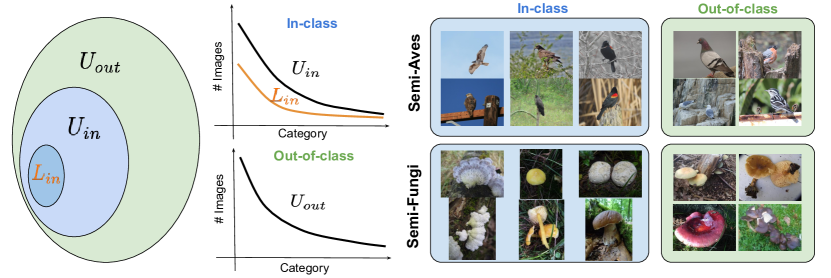
- The study constructs two benchmark datasets—Semi-Aves and Semi-Fungi—by sampling classes from the Aves and Fungi taxonomies, with long-tailed class distributions and unlabeled data from both in-class and out-of-class categories.
- It evaluates multiple SSL methods: Pseudo-Label, Curriculum Pseudo-Label, FixMatch, and distillation-based self-training, both from scratch and with pre-trained ImageNet and iNaturalist models.
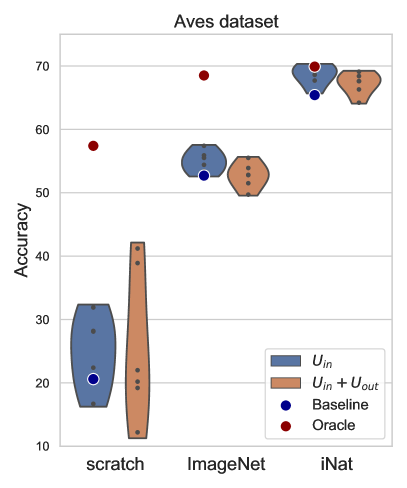
- The performance is assessed using in-domain unlabeled data ($U_{in}$) and combined in- and out-of-class data ($U_{in}+U_{out}$), with ablation studies on thresholding and distillation loss.
- The authors use both official and re-implemented code for FixMatch to ensure reproducibility and report the best results across implementations.
- They analyze model uncertainty via prediction confidence, entropy, and distillation loss to understand how SSL models treat in-class versus out-of-class data.
- Experiments compare supervised baselines, SSL methods, and transfer learning with and without out-of-class data, using accuracy as the primary metric.
Experimental results
Research questions
- RQ1Does semi-supervised learning effectively improve performance on fine-grained classification when data is long-tailed and contains out-of-class images?
- RQ2How does the presence of out-of-class unlabeled data affect SSL performance when using pre-trained models versus training from scratch?
- RQ3Can existing SSL methods reliably leverage out-of-class data in realistic benchmarks with domain shift?
- RQ4Is transfer learning with fine-tuning and distillation-based self-training more effective than SSL from scratch in few-shot settings?
Key findings
- When training from scratch, self-supervised pre-training followed by distillation-based self-training achieves the best performance, significantly benefiting from out-of-class data.
- Transfer learning with fine-tuning and distillation-based self-training outperforms all SSL methods, achieving 97.2% accuracy on Semi-Aves with 5k labels, surpassing even FixMatch trained from scratch.
- In the transfer learning setting, the presence of out-of-class unlabeled data often harms performance, particularly for methods like FixMatch and Pseudo-Label.
- Distillation-based self-training is the most robust SSL method in the presence of out-of-class data, maintaining stable performance across settings.
- Pseudo-Label is sensitive to threshold selection; higher thresholds reduce the negative impact of out-of-class data but also reduce the amount of usable unlabeled data.
- No SSL method reliably leverages out-of-class data even when the domain shift is small, indicating a key limitation in current approaches for realistic settings.
Read this paper
Open the full text in the Nubint reader and ask about any passage as you read.
Read this paper on NubintThis review was generated by AI from the original paper. Please check the paper before citing it.