
[Paper Review] A red giant orbiting a black hole
This paper identifies Gaia BH2, a dormant black hole with a mass of 8.9±0.3 M☉ orbiting a 1 M☉ red giant in a 1277-day, moderately eccentric orbit. Spectroscopic and photometric follow-up confirms the system's astrometric solution from Gaia DR3, and X-ray and radio nondetections support low-efficiency accretion models, establishing Gaia BH2 as the second-nearest known black hole and highlighting a population of wide, quiescent black hole binaries undetected by X-ray surveys.
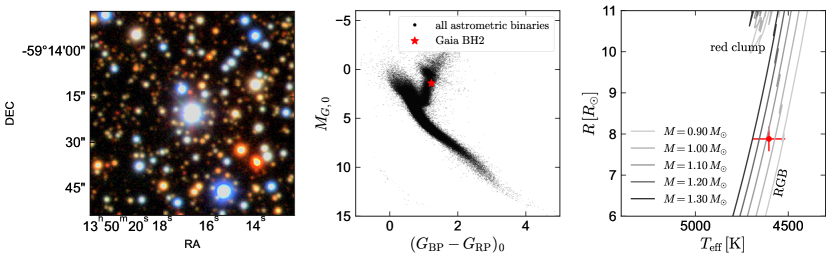
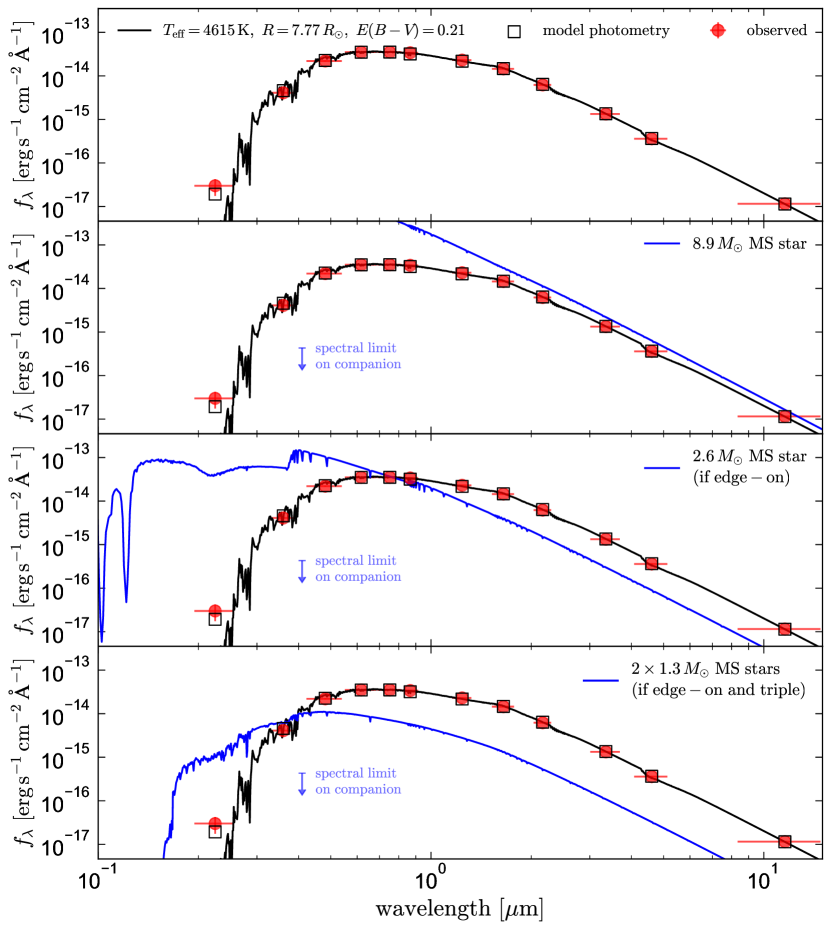
We report spectroscopic and photometric follow-up of a dormant black hole (BH) candidate from Gaia DR3. The system, which we call Gaia BH2, contains a $\sim 1M_{\odot}$ red giant and a dark companion with mass $M_2 = 8.9\pm 0.3\,M_{\odot}$ that is very likely a BH. The orbital period, $P_{ m orb} = 1277$ days, is much longer than that of any previously studied BH binary. Our radial velocity (RV) follow-up over a 7-month period spans more than 90% of the orbit's dynamic range in RV and is in excellent agreement with predictions of the Gaia solution. UV imaging and high-resolution optical spectra rule out all plausible luminous companions that could explain the orbit. The star is a bright ($G=12.3$), slightly metal-poor ($ m [Fe/H]=-0.22$) low-luminosity giant ($T_{ m eff}=4600\, m K$; $R = 7.8\,R_{\odot}$; $\log\left[g/\left({ m cm\,s^{-2}} ight) ight] = 2.6$). The binary's orbit is moderately eccentric ($e=0.52$). The giant is strongly enhanced in $α-$elements, with $ m [α/Fe] = +0.26$, but the system's Galactocentric orbit is typical of the thin disk. We obtained X-ray and radio nondetections of the source near periastron, which support BH accretion models in which the net accretion rate at the horizon is much lower than the Bondi-Hoyle-Lyttleton rate. At a distance of 1.16 kpc, Gaia BH2 is the second-nearest known BH, after Gaia BH1. Its orbit -- like that of Gaia BH1 -- seems too wide to have formed through common envelope evolution. Gaia BH1 and BH2 have orbital periods at opposite edges of the Gaia DR3 sensitivity curve, perhaps hinting at a bimodal intrinsic period distribution for wide BH binaries. Dormant BH binaries like Gaia BH1 and Gaia BH2 likely significantly outnumber their close, X-ray bright cousins, but their formation pathways remain uncertain.
Motivation & Objective
- To confirm the nature of a Gaia DR3 astrometric binary candidate (Gaia BH2) as a black hole binary through multi-wavelength follow-up.
- To determine the orbital parameters and dynamical mass of the unseen companion, ruling out stellar or compact object alternatives.
- To investigate the accretion state of the black hole via X-ray and radio non-detections, assessing radiative efficiency.
- To place Gaia BH2 in the context of black hole binary formation and the broader population of dormant black holes in the Milky Way.
Proposed method
- Spectroscopic radial velocity monitoring over 7 months to measure orbital motion and confirm the Gaia DR3 astrometric solution.
- High-resolution optical and UV spectroscopy to rule out luminous companions that could mimic the observed radial velocity curve.
- Astrometric analysis using Gaia DR3 data to derive orbital elements, including period, eccentricity, and inclination.
- X-ray and radio observations with Chandra and MeerKAT to search for accretion signatures and constrain the radiative efficiency.
- Stellar atmosphere modeling of the red giant to derive effective temperature, surface gravity, and metallicity.
- Comparison of the system's orbital parameters with binary evolution models to assess formation pathways.
Experimental results
Research questions
- RQ1Is the dark companion in Gaia BH2 consistent with a black hole, and what is its mass?
- RQ2What is the accretion state of the black hole, as inferred from X-ray and radio non-detections?
- RQ3How does the orbital architecture of Gaia BH2 compare to theoretical expectations for black hole binary formation?
- RQ4What does the existence of Gaia BH2 imply about the population of wide, dormant black hole binaries in the Milky Way?
- RQ5Why are the orbital periods of Gaia BH1 and Gaia BH2 located at opposite ends of Gaia DR3's sensitivity curve?
Key findings
- The system Gaia BH2 hosts a black hole with a mass of 8.9±0.3 M☉, confirmed through radial velocity monitoring and astrometric consistency with Gaia DR3.
- The red giant has a mass of approximately 1 M☉, effective temperature of 4600 K, radius of 7.8 R☉, and surface gravity of log(g) = 2.6 cm s⁻².
- The orbital period is 1277 days with an eccentricity of 0.52, and the periastron distance is 2.4 au, placing it beyond the expected radius of a red supergiant progenitor.
- X-ray and radio observations yielded no detections, implying a radiative efficiency less than 10⁻⁴, consistent with radiatively inefficient accretion models.
- The system is located at a distance of 1.16 kpc, making it the second-nearest known black hole after Gaia BH1.
- The orbital parameters suggest formation via high-mass main-sequence wind-driven evolution or dynamical processes, not standard common-envelope evolution.
Read this paper
Open the full text in the Nubint reader and ask about any passage as you read.
Read this paper on NubintThis review was generated by AI from the original paper. Please check the paper before citing it.