
[Paper Review] A regular black hole as the final state of evolution of a singular black hole
This paper proposes a unified black hole model in which a singular black hole (SBH) evolves into a regular black hole (RBH) as a final state through parameter evolution—specifically, when charge or horizon radius reaches its extreme value. The model uses $F(R)$ gravity to resolve the discrepancy between thermal and Wald entropy in RBHs, demonstrating geodesic completeness and finite curvature invariants, with explicit matter sources and quasinormal mode analysis confirming stability and thermodynamic consistency.
We propose a novel black hole model in which singular and regular black holes are combined as a whole and more precisely singular and regular black holes are regarded as different states of parameter evolution. We refer to them as singular and regular states, respectively. Furthermore, the regular state is depicted by the final state of parameter evolution in the model. We also present the sources that can generate such a black hole spacetime in the framework of $F(R)$ gravity. This theory of modified gravity is adopted because it offers a possible resolution to a tough issue in the thermodynamics of regular black holes, namely the discrepancy between the thermal entropy and Wald entropy. The dynamics and thermodynamics of the novel black hole model are also discussed when a singular state evolves into a regular state during the change of charge or horizon radius from its initial value to its extreme value.
Motivation & Objective
- To unify singular and regular black holes as distinct states of a single evolving system, with the regular black hole as the final state of parameter evolution.
- To resolve the long-standing discrepancy between thermal entropy and Wald entropy in regular black holes by employing $F(R)$ gravity.
- To construct a physically consistent model with well-defined matter sources and energy conditions that support the transition from singular to regular black hole states.
- To analyze the dynamics and thermodynamics of the evolution process, including quasinormal modes and phase transitions.
- To demonstrate that the final state is geodesically complete and has finite curvature invariants, confirming its regularity.
Proposed method
- Constructs a spherically symmetric black hole model with a single shape function that interpolates between singular and regular states based on parameter evolution (charge or horizon radius).
- Applies $F(R)$ gravity to derive the gravitational action and field equations, enabling a resolution to the thermal vs. Wald entropy discrepancy in regular black holes.
- Derives explicit matter sources via the energy-momentum tensor, ensuring energy conditions are satisfied for physical plausibility.
- Performs scalar field perturbation analysis using an ansatz for the scalar field $φ(r)$, enabling computation of quasinormal frequencies.
- Uses the Painlevé–Gullstrand coordinate system to ensure geodesic completeness at the center, confirming regularity in the final state.
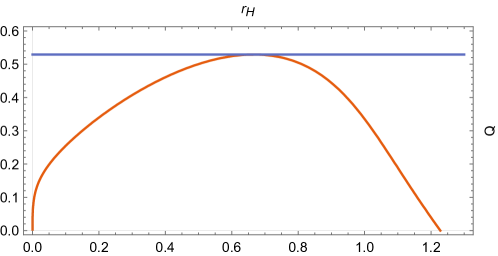
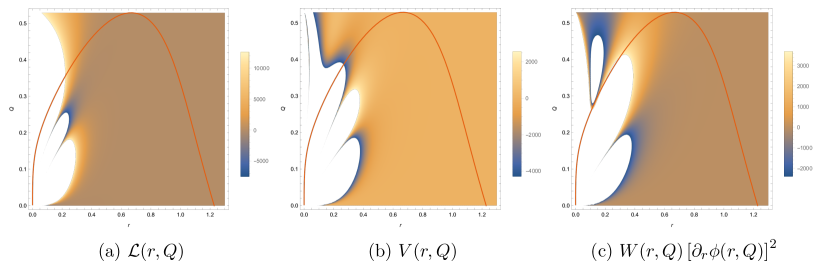
- Solves for the effective potential $V(\phi)$ and coupling $W(\phi)$ numerically, showing smooth evolution of the scalar field and potential structure.
Experimental results
Research questions
- RQ1Can a singular black hole evolve into a regular black hole as a final state through continuous parameter evolution?
- RQ2How can $F(R)$ gravity resolve the mismatch between thermal and Wald entropy in regular black holes?
- RQ3What are the physical matter sources and energy conditions required to support such a transition?
- RQ4Are the quasinormal modes of the final regular black hole stable, and what do they reveal about the system's dynamics?
- RQ5Is the final state geodesically complete and free of curvature singularities, confirming its regularity?
Key findings
- The model successfully unifies singular and regular black holes as different states of a single system, with the regular black hole emerging as the final state when charge or horizon radius reaches its extreme value.
- The final state exhibits finite curvature invariants and complete null and timelike geodesics, confirming its regularity under the coordinate-independent criterion.
- The $F(R)$ gravity framework resolves the thermal-Wald entropy discrepancy by providing a consistent thermodynamic description for the regular black hole.
- Quasinormal frequency analysis shows stable oscillations, with asymptotic frequencies derived analytically and confirmed numerically, indicating no instability in the final state.
- The matter sources are explicitly constructed and satisfy energy conditions, supporting the physical viability of the transition from singular to regular black hole.
- Numerical solutions for $V(\phi)$ and $W(\phi)$ demonstrate a smooth, well-behaved evolution of the scalar field and potential, confirming the model's consistency and stability.
Read this paper
Open the full text in the Nubint reader and ask about any passage as you read.
Read this paper on NubintThis review was generated by AI from the original paper. Please check the paper before citing it.