
[Paper Review] A Residual Diffusion Model for High Perceptual Quality Codec Augmentation
DIRAC augments a base image codec with a receiver-side diffusion residual model to smoothly traverse the rate-distortion-perception tradeoff, achieving high perceptual quality with competitive fidelity and enabling very fast sampling (as few as 20 steps).
Diffusion probabilistic models have recently achieved remarkable success in generating high quality image and video data. In this work, we build on this class of generative models and introduce a method for lossy compression of high resolution images. The resulting codec, which we call DIffuson-based Residual Augmentation Codec (DIRAC), is the first neural codec to allow smooth traversal of the rate-distortion-perception tradeoff at test time, while obtaining competitive performance with GAN-based methods in perceptual quality. Furthermore, while sampling from diffusion probabilistic models is notoriously expensive, we show that in the compression setting the number of steps can be drastically reduced.
Motivation & Objective
- Motivate and enable dynamic control over the rate-distortion-perception tradeoff in image compression.
- Leverage diffusion models to enhance perceptual quality while preserving fidelity.
- Offer a receiver-side enhancement that can work with both neural and traditional codecs.
- Reduce diffusion sampling cost to practical levels for high-resolution images.
Proposed method
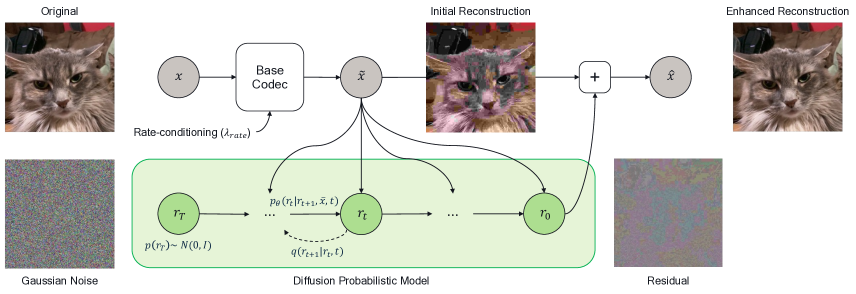
- Combine a base image codec with a residual diffusion model that predicts x - x̃ (the reconstruction residual).
- Train the diffusion model to predict residuals conditioned on the base reconstruction, optimizing a loss that includes residual prediction error and LPIPS-based perceptual distortion.
- Adopt DDIM-style sampling to enable flexible and reduced-step generation, up to 100 steps or fewer (e.g., 20) with late-start sampling.
- Introduce rate-dependent thresholding to clip intermediate residual predictions according to rate-specific residual distributions.
- Enable test-time control by allowing the diffusion process to be halted at any point to trade off distortion and perception.
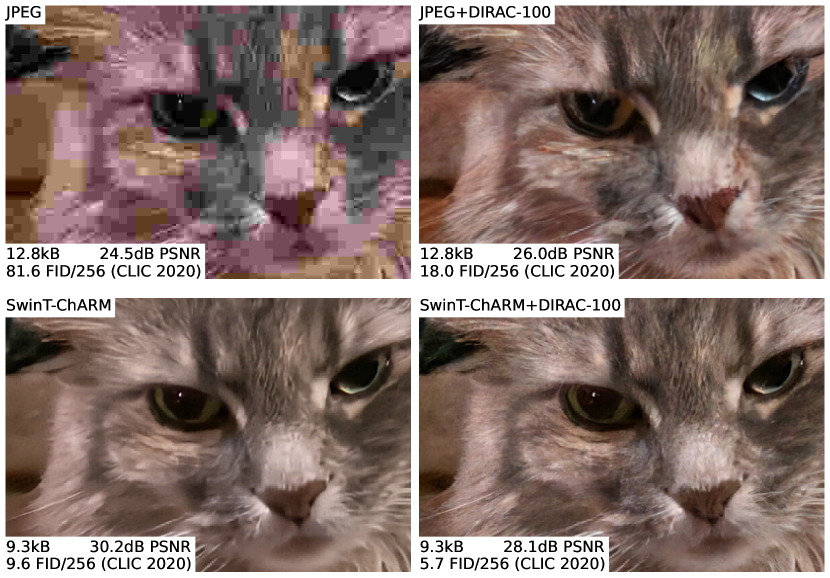
- Evaluate both generative compression (with neural base codecs) and enhancement of traditional codecs (JPEG, VTM).
Experimental results
Research questions
- RQ1Can a receiver-side diffusion-based enhancer provide controllable navigation of rate-distortion-perception at test time?
- RQ2How does residual-based diffusion modeling compare to end-to-end perceptual optimization in terms of PSNR and perceptual metrics (FID/256, LPIPS)?
- RQ3What sampling strategies (steps, late-start, rate-dependent clipping) yield practical speedups without sacrificing quality?
- RQ4Can the approach improve perceptual quality for traditional codecs like JPEG and VTM without harming fidelity?
- RQ5What is the tradeoff behavior across datasets (e.g., CLIC2020, Kodak, ImageNet-val1k) when using DIRAC?
Key findings
- DIRAC achieves smooth traversal between high fidelity and high perceptual quality, matching or surpassing state-of-the-art perceptual baselines at comparable fidelity.
- DIRAC-100 (100 diffusion steps) attains perceptual-quality levels competitive with HiFiC, while delivering better PSNR on tested datasets.
- For JPEG specifically, DIRAC can improve FID/256 by up to 78% without PSNR loss (vs. baseline JPEG with enhancement).
- DIRAC-1 (single sampling step) is close to base-codec fidelity (PSNR) while providing perceptual improvements, outperforming several enhancement baselines in perceptual metrics.
- Sampling efficiency improvements: extremely late-start sampling (start at t around 20) yields ~80% fewer steps with negligible loss in performance; rate-dependent thresholding further boosts PSNR without hurting FID/256.
- DIRAC also enhances traditional codecs (VTM, JPEG) on high-resolution data, achieving substantial perceptual gains (FID/256) with modest or no PSNR loss.
- The approach enables a test-time control of the distortion-perception tradeoff, with a single model supporting a range of operating points.
Read this paper
Open the full text in the Nubint reader and ask about any passage as you read.
Read this paper on NubintThis review was generated by AI from the original paper. Please check the paper before citing it.