
[Paper Review] A reversible system based on hybrid toggle radius-4 cellular automata and its application as a block cipher
This paper proposes HCA, a novel reversible block cipher based on hybrid toggle radius-4 cellular automata (CA) that ensures perfect reversibility through a heterogeneous mix of chaotic and additive toggle rules. The method uses backward CA evolution for encryption and forward for decryption, achieving high parallelism and security, with theoretical and empirical validation showing robustness against cryptanalytic attacks.
The dynamical system described herein uses a hybrid cellular automata (CA) mechanism to attain reversibility, and this approach is adapted to create a novel block cipher algorithm called HCA. CA are widely used for modeling complex systems and employ an inherently parallel model. Therefore, applications derived from CA have a tendency to fit very well in the current computational paradigm where scalability and multi-threading potential are quite desirable characteristics. HCA model has recently received a patent by the Brazilian agency INPI. Several evaluations and analyses performed on the model are presented here, such as theoretical discussions related to its reversibility and an analysis based on graph theory, which reduces HCA security to the well-known Hamiltonian cycle problem that belongs to the NP-complete class. Finally, the cryptographic robustness of HCA is empirically evaluated through several tests, including avalanche property compliance and the NIST randomness suite.
Motivation & Objective
- To design a reversible symmetric block cipher leveraging the inherent parallelism of cellular automata for high-performance cryptographic applications.
- To overcome limitations in prior CA-based ciphers by ensuring reversibility for all initial configurations through a hybrid toggle rule mechanism.
- To establish theoretical and empirical evidence of cryptographic robustness, including resistance to known attacks and compliance with randomness standards.
- To enable efficient implementation on high-performance computing (HPC) platforms such as FPGAs by exploiting the CA model's parallelism.
- To reduce the key recovery problem to the NP-complete Hamiltonian Cycle Problem, thereby indicating strong security guarantees.
Proposed method
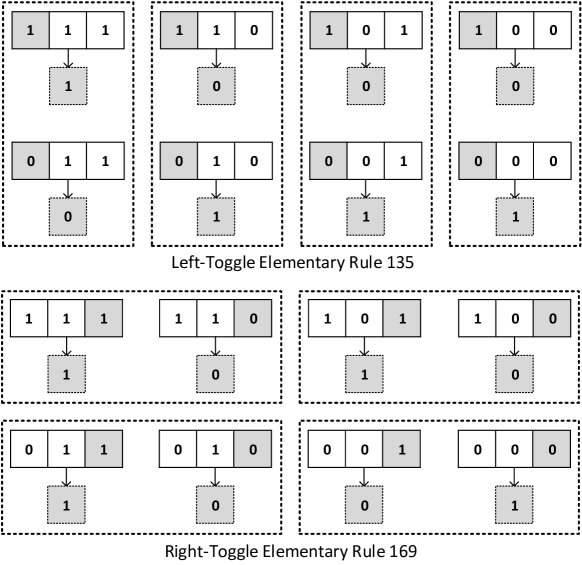
- The HCA model uses a hybrid toggle rule set combining chaotic and additive one-dimensional cellular automata rules with radius 4, ensuring reversibility through pre-image computation.
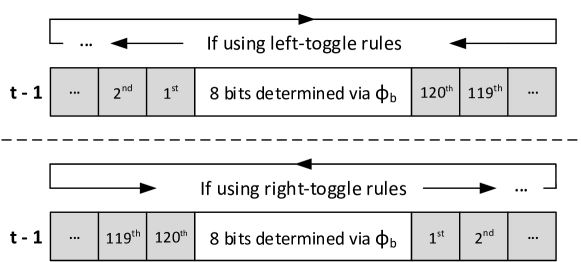
- Encryption is performed via backward CA evolution (pre-image computation), while decryption uses forward evolution, enabling symmetric operation with equal block size.
- The secret key is 257 bits: 256 bits define the main rule, and one bit controls rule selection, enabling a large key space and rule heterogeneity.
- A graph-theoretic analysis reduces the key recovery problem to the Hamiltonian Cycle Problem (HCP), known to be NP-complete, indicating strong cryptographic security.
- The model supports block sizes of 128 bits (N = T = 128), with theoretical performance gains in parallel execution: φ_c = 2T + N - m for encryption and φ_d = (N - m) × T for decryption.
- Implementation is available in software (x86) and designed for future deployment on FPGAs and HPC systems, exploiting massive inter-block and intra-block parallelism.
Experimental results
Research questions
- RQ1Can a hybrid toggle cellular automata system achieve full reversibility for all initial configurations, ensuring lossless encryption and decryption?
- RQ2How does the integration of chaotic and additive toggle rules in radius-4 CA enhance cryptographic security and resistance to cryptanalysis?
- RQ3To what extent can the HCA model’s security be reduced to a known NP-complete problem, such as the Hamiltonian Cycle Problem?
- RQ4What is the theoretical and practical performance gain of HCA when executed in parallel compared to sequential execution?
- RQ5Can the HCA framework be extended to larger block sizes or higher-radius rules while maintaining efficiency and security?
Key findings
- The HCA model is provably reversible for all initial configurations due to the heterogeneous combination of chaotic and additive toggle rules, ensuring no information loss.
- The security of HCA is theoretically reduced to the NP-complete Hamiltonian Cycle Problem, indicating that breaking the cipher is computationally intractable under standard complexity assumptions.
- Empirical evaluation confirms that HCA satisfies the avalanche effect and passes all tests in the NIST randomness suite, demonstrating strong statistical randomness.
- Theoretical performance analysis shows that parallel execution of HCA can achieve significant speedup: φ_d = (N - m) × T for decryption and φ_c = 2T + N - m for encryption, with N processing nodes.
- The model supports block sizes of 128 bits and can be extended to larger blocks (e.g., 256 bits) or higher-radius rules (e.g., radius-5) to increase key space and security.
- An open-source implementation of HCA is publicly available on GitHub, facilitating reproducibility and further research in CA-based cryptography.
Read this paper
Open the full text in the Nubint reader and ask about any passage as you read.
Read this paper on NubintThis review was generated by AI from the original paper. Please check the paper before citing it.