
[Paper Review] A Review of Deep Learning Techniques for Speech Processing
A comprehensive survey of deep learning architectures (RNNs, CNNs, transformers, conformers, diffusion models, GNNs) and their applications across speech tasks, datasets, and future directions.
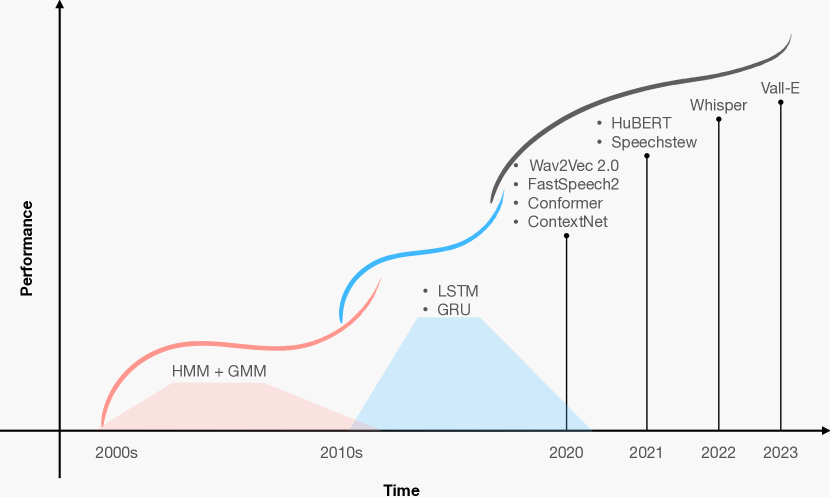
The field of speech processing has undergone a transformative shift with the advent of deep learning. The use of multiple processing layers has enabled the creation of models capable of extracting intricate features from speech data. This development has paved the way for unparalleled advancements in speech recognition, text-to-speech synthesis, automatic speech recognition, and emotion recognition, propelling the performance of these tasks to unprecedented heights. The power of deep learning techniques has opened up new avenues for research and innovation in the field of speech processing, with far-reaching implications for a range of industries and applications. This review paper provides a comprehensive overview of the key deep learning models and their applications in speech-processing tasks. We begin by tracing the evolution of speech processing research, from early approaches, such as MFCC and HMM, to more recent advances in deep learning architectures, such as CNNs, RNNs, transformers, conformers, and diffusion models. We categorize the approaches and compare their strengths and weaknesses for solving speech-processing tasks. Furthermore, we extensively cover various speech-processing tasks, datasets, and benchmarks used in the literature and describe how different deep-learning networks have been utilized to tackle these tasks. Additionally, we discuss the challenges and future directions of deep learning in speech processing, including the need for more parameter-efficient, interpretable models and the potential of deep learning for multimodal speech processing. By examining the field's evolution, comparing and contrasting different approaches, and highlighting future directions and challenges, we hope to inspire further research in this exciting and rapidly advancing field.
Motivation & Objective
- Trace the evolution of speech processing from traditional (MFCC, HMM) approaches to modern deep learning models.
- Categorize and compare deep learning architectures (RNNs, CNNs, Transformers, Conformers, diffusion models, GNNs) for speech tasks.
- Survey representation learning (supervised, unsupervised, semi-supervised, self-supervised) and their role in speech processing.
- Review a wide range of speech processing tasks (ASR, synthesis, speaker recognition, diarization, translation, enhancement, multimodal processing) and associated datasets/benchmarks.
- Discuss transfer learning techniques (domain adaptation, meta-learning, parameter-efficient methods) and outline future research directions.
Proposed method
- Provide a broad taxonomy of deep learning architectures used in speech processing (RNNs, CNNs, Transformers, Conformers, sequence-to-sequence models, reinforcement learning, graph neural networks, diffusion models).
- Describe speech representation learning paradigms (supervised, unsupervised, semi-supervised, self-supervised) and their implications for performance.
- Survey key speech processing tasks and the deep learning approaches that address them (ASR, synthesis, speaker recognition, diarization, translation, enhancement, VAD, quality assessment, separation, SLU, audiovisual processing).
- Discuss advanced transfer learning techniques relevant to speech processing (domain adaptation, meta-learning, parameter-efficient transfer learning).
- Highlight challenges (data efficiency, interpretability, robustness) and potential future directions (multimodal speech processing, efficiency, and generalization).
Experimental results
Research questions
- RQ1What are the relative strengths and limitations of major deep learning architectures for core speech tasks?
- RQ2How have datasets and benchmarks influenced progress across speech processing tasks?
- RQ3What is the role of representation learning (supervised vs. self-supervised) in improving speech task performance?
- RQ4What challenges limit deployment (data efficiency, interpretability, robustness) and what future directions appear most promising?
- RQ5How can transfer learning techniques advance speech processing across domains and modalities?
Key findings
- Deep learning has driven substantial progress across speech tasks such as recognition, synthesis, and speaker analysis compared to traditional methods.
- End-to-end RNN, CNN, and transformer-based models have become central to modern speech systems, often outperforming HMM-based pipelines.
- Self-supervised and semi-supervised representations are increasingly leveraged to reduce labeled data requirements and improve robustness.
- Multimodal approaches (audio-visual) show promise in challenging environments, particularly for speech activity detection and recognition.
- Transfer learning, including domain adaptation and parameter-efficient methods, is valuable for cross-domain speech processing tasks.
- The field continues to explore architectures that balance performance with computational efficiency and interpretability.
Read this paper
Open the full text in the Nubint reader and ask about any passage as you read.
Read this paper on NubintThis review was generated by AI from the original paper. Please check the paper before citing it.