
[Paper Review] A Review on Building Blocks of Decentralized Artificial Intelligence
This paper performs a systematic literature review of DEAI, identifying 13 core building blocks, and proposing future directions and evaluation methods for decentralized AI networks.
Artificial intelligence is transforming our lives, and technological progress and transfer from the academic and theoretical sphere to the real world are accelerating yearly. But during that progress and transition, several open problems and questions need to be addressed for the field to develop ethically, such as digital privacy, ownership, and control. These are some of the reasons why the currently most popular approaches of artificial intelligence, i.e., centralized AI (CEAI), are questionable, with other directions also being widely explored, such as decentralized artificial intelligence (DEAI), to solve some of the most reaching problems. This paper provides a systematic literature review (SLR) of existing work in the field of DEAI, presenting the findings of 71 identified studies. The paper's primary focus is identifying the building blocks of DEAI solutions and networks, tackling the DEAI analysis from a bottom-up approach. In the end, future directions of research and open problems are proposed.
Motivation & Objective
- Identify the current DEAI architecture and solutions.
- Extract common building blocks and their overlaps within DEAI networks.
- Propose evaluation metrics and highlight challenges and future directions.
Proposed method
- Follow Systematic Literature Review guidelines for software engineering.
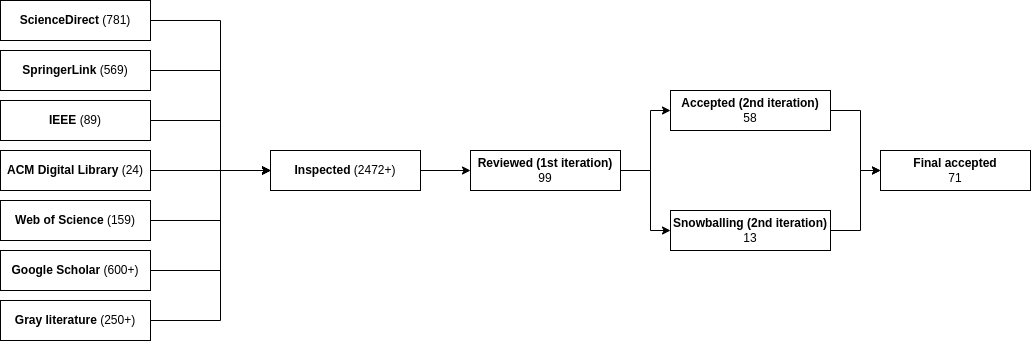
- Search seven sources (ScienceDirect, SpringerLink, IEEE Xplore, ACM DL, Web of Science, Google Scholar, gray literature) using DEAI-related keywords.
- Apply inclusion/exclusion criteria to select peer-reviewed and gray literature.
- Perform snowballing to supplement the initial set of articles.
- Code and classify papers based on building blocks, features, challenges, evaluation methods, and network type.
Experimental results
Research questions
- RQ1RQ1: What is the definition of a DEAI network?
- RQ2RQ2: What are the latest proposed architectural designs for DEAI networks?
- RQ3RQ3: How can decentralization improve AI and what are the advantages of a DEAI network?
- RQ4RQ4: What are the common building blocks of DEAI networks?
Key findings
- Identified 13 DEAI building blocks across the literature (e.g., Registry, Incentivization, Marketplace, Reputation, Ontology, Discoverability, Training, Inference, Ownership, Data, Governance, Cryptography and Privacy, Identity).
- Provided a bottom-up analysis mapping building blocks to features and challenges, with connections illustrated among blocks.
- Collected and described evaluation methods and metrics used to assess DEAI systems.
- Mapped architecture, concepts, and reviews, and analyzed progress, lessons, and gaps in the DEAI field.
- Highlighted the role of open registries, permissionless systems, and data/AI model provenance in DEAI.
- Discussed governance, security, transparency, standards, and interoperability as core concerns.

Read this paper
Open the full text in the Nubint reader and ask about any passage as you read.
Read this paper on NubintThis review was generated by AI from the original paper. Please check the paper before citing it.