
[Paper Review] A Safe Harbor for AI Evaluation and Red Teaming
The paper proposes legal and technical safe harbors to protect independent, public-interest evaluation and red-teaming of generative AI systems from legal liability and account-suspension risk.
Independent evaluation and red teaming are critical for identifying the risks posed by generative AI systems. However, the terms of service and enforcement strategies used by prominent AI companies to deter model misuse have disincentives on good faith safety evaluations. This causes some researchers to fear that conducting such research or releasing their findings will result in account suspensions or legal reprisal. Although some companies offer researcher access programs, they are an inadequate substitute for independent research access, as they have limited community representation, receive inadequate funding, and lack independence from corporate incentives. We propose that major AI developers commit to providing a legal and technical safe harbor, indemnifying public interest safety research and protecting it from the threat of account suspensions or legal reprisal. These proposals emerged from our collective experience conducting safety, privacy, and trustworthiness research on generative AI systems, where norms and incentives could be better aligned with public interests, without exacerbating model misuse. We believe these commitments are a necessary step towards more inclusive and unimpeded community efforts to tackle the risks of generative AI.
Motivation & Objective
- Motivate independent evaluation and red-teaming of generative AI systems to identify risks.
- Highlight legal, policy, and practical barriers that deter researchers from conducting good-faith safety research.
- Propose two voluntary commitments—legal and technical safe harbors—to safeguard researchers.
- Outline implementation pathways leveraging vulnerability disclosure norms and trusted third parties.
- Advocate for broader, independent participation to improve AI safety and accountability.
Proposed method
- Define and contextualize key terms (safe harbor, good faith research, vulnerability disclosure) to support a regulatory-friendly framework.
- Analyze current terms of service, enforcement practices, and researcher access programs across major AI developers.
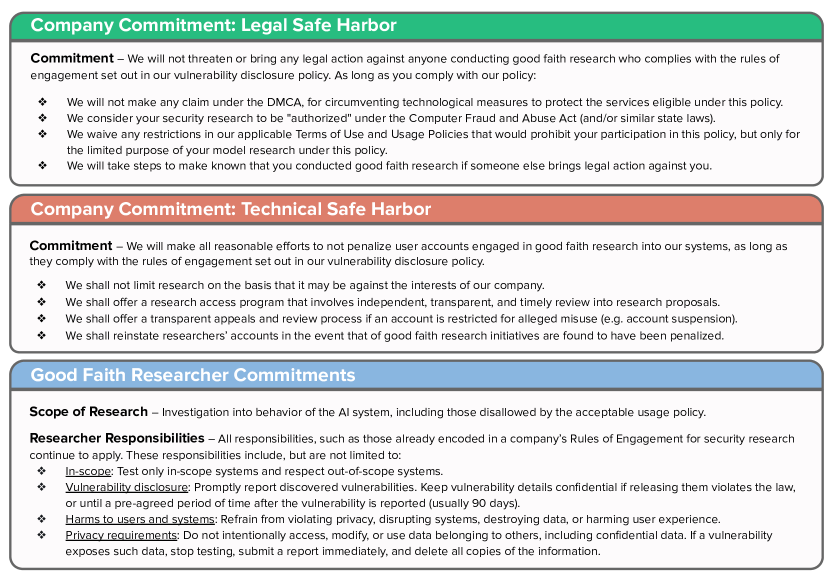
- Argue for two coordinated commitments: a legal safe harbor and a technical safe harbor for independent safety research.
- Propose delegation of account authorization to trusted third parties (e.g., universities, nonprofits) to scale and depoliticize access.
- Outline mechanisms for independent review, appeals, and transparent processes to protect researchers while preventing misuse.
- Position the proposals within existing safety research and governance literatures (e.g., bug bounties, NAIRR, policy guidelines).
Experimental results
Research questions
- RQ1How do current terms of service and enforcement practices deter independent AI evaluation and red-teaming?
- RQ2What legal and technical protections are needed to shield researchers conducting good-faith safety research?
- RQ3How can safe harbors be implemented in practice to scale independent evaluation without enabling misuse?
- RQ4What roles should universities, nonprofits, or public-interest bodies play in authorizing research access?
- RQ5What governance mechanisms (appeals, transparency) are required to sustain independent safety research?
Key findings
- Independent AI evaluation is hampered by inconsistent, opaque policies and the threat of account suspensions.
- Current researcher access programs are insufficiently representative, underfunded, and lack independence from corporate incentives.
- A pair of voluntary commitments—a legal safe harbor and a technical safe harbor—could substantially increase participation and protect researchers.
- Delegating access authorization to trusted third parties and establishing transparent appeals can reduce corporate favoritism and chilling effects.
- A legal safe harbor would protect good-faith research conducted under established vulnerability disclosure policies, while a technical safe harbor would protect researchers from account termination.
- These protections align safety research with public interests without undermining safeguards against model misuse.
Read this paper
Open the full text in the Nubint reader and ask about any passage as you read.
Read this paper on NubintThis review was generated by AI from the original paper. Please check the paper before citing it.