
[Paper Review] A shared accretion instability for black holes and neutron stars
This paper proposes a shared accretion instability driven by radiation pressure in accretion disks around both black holes and neutron stars, explaining multiwavelength variability through cyclic inner disk depletion and refilling. The instability produces relativistic ejections and accounts for 'heartbeat' patterns in X-ray and optical bands, with strong evidence in Swift J1858, a neutron star system showing correlated X-ray, UV, optical, IR, and radio variability with time-lagged responses consistent with irradiation-driven oscillations.
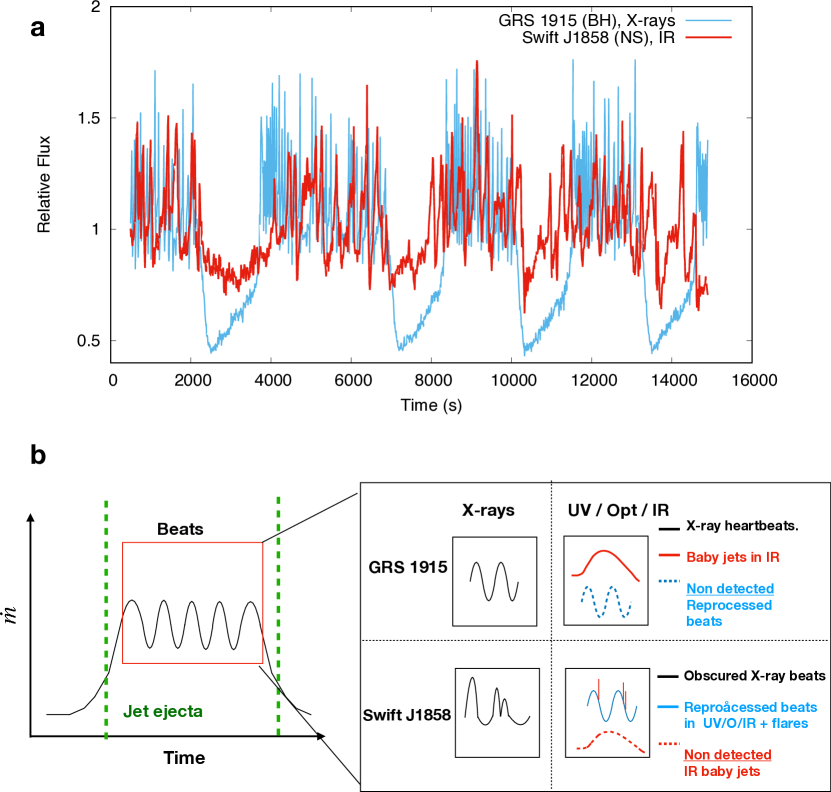
Accretion disks around compact objects are expected to enter an unstable phase at high luminosity. One instability may occur when the radiation pressure generated by accretion modifies the disk viscosity, resulting in the cyclic depletion and refilling of the inner disk on short timescales. Such a scenario, however, has only been quantitatively verified for a single stellar-mass black hole. Although there are hints of these cycles in a few isolated cases, their apparent absence in the variable emission of most bright accreting neutron stars and black holes has been a lingering puzzle. Here we report the presence of the same multiwavelength instability around an accreting neutron star. Moreover, we show that the variability across the electromagnetic spectrum-from radio to X-ray-of both black holes and neutron stars at high accretion rates can be explained consistently if the accretion disks are unstable, producing relativistic ejections during transitions that deplete or refill the inner disk. Such new association allows us to identify the main physical components responsible for the fast multiwavelength variability of highly accreting compact objects.
Motivation & Objective
- To resolve the long-standing puzzle of why high-luminosity accreting neutron stars lack the cyclic variability seen in black holes.
- To test whether the same radiation-pressure-driven accretion instability responsible for 'heartbeat' states in black holes also operates in neutron stars.
- To establish a unified physical framework explaining fast multiwavelength variability across compact objects via disk instability and irradiation-driven oscillations.
- To identify the physical conditions—particularly luminosity, magnetic field, and magnetospheric radius—under which such instabilities emerge in neutron stars.
- To map the parameter space of accreting neutron stars and compare their locations with theoretical instability boundaries to validate the model.
Proposed method
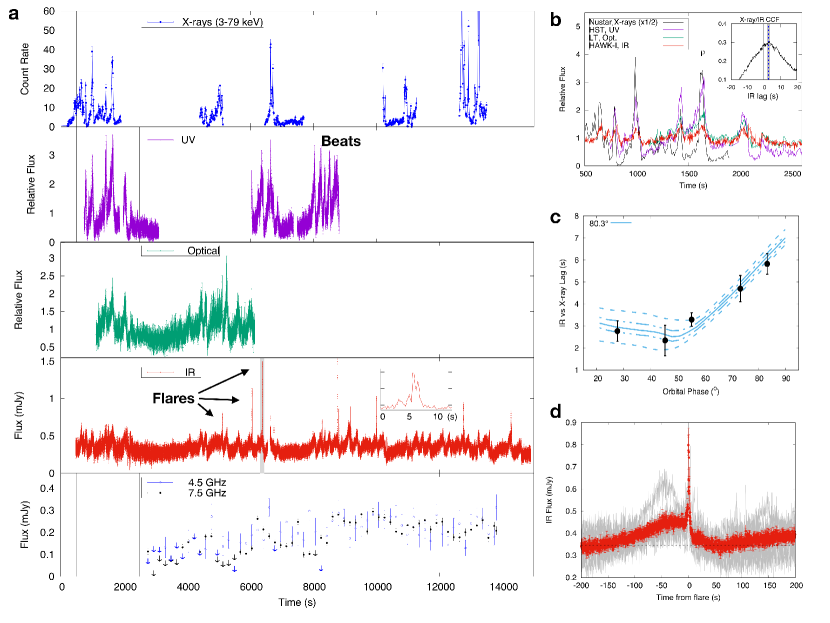
- Conducted a multiwavelength simultaneous observation campaign on Swift J1858 using NuSTAR (X-rays), Hubble (UV), Liverpool Telescope (optical), VLT/HAWK-I (near-IR), and VLA (radio) over ~4 hours.
- Computed cross-correlation functions (CCFs) between X-ray (NuSTAR) and near-IR (HAWK-I) light curves to measure time lags, finding IR lags of 2.5–5.5 s behind X-rays.
- Modeled the observed lags as due to X-ray variability irradiating the disk and donor star, with orbital inclination ~80°, consistent with the observed orbital modulation.
- Applied theoretical models of radiation-pressure-dominated accretion disks, using the condition that the magnetospheric radius exceeds the stellar radius to predict instability onset.
- Derived critical luminosity thresholds for instability using equations involving viscosity (α), neutron star mass (m), radius (R*,6), and magnetic field (B12), distinguishing regimes for low, intermediate, and high B fields.
- Mapped observed neutron stars with 'GRS 1915-like' variability onto a luminosity vs. magnetic field diagram to test consistency with the radiation-pressure-dominated instability regime.
Experimental results
Research questions
- RQ1Can the same accretion instability responsible for 'heartbeat' states in black holes also explain variability in neutron stars?
- RQ2What physical conditions—specifically luminosity, magnetic field, and magnetospheric radius—enable radiation-pressure-driven disk instabilities in neutron stars?
- RQ3Why do most bright accreting neutron stars lack the cyclic variability seen in black holes, and can this be explained by a shared instability mechanism?
- RQ4How do time lags between X-ray and IR variability constrain the origin of multiwavelength oscillations in highly accreting systems?
- RQ5Do sources like the Bursting Pulsar, Rapid Burster, and ULX NGC 3621 lie within the predicted parameter space for radiation-pressure-dominated disk instabilities?
Key findings
- Swift J1858 exhibits strong, correlated multiwavelength variability across X-ray, UV, optical, IR, and radio bands, with IR lagging X-rays by 2.5–5.5 seconds, consistent with irradiation of the disk and donor star.
- The source shows 'beats' on ~100 s timescales and fast flares in IR, resembling the 'heartbeat' pattern seen in GRS 1915+105, indicating a shared instability mechanism.
- The observed time lags and orbital modulation are fully consistent with a model where X-ray variability irradiates the disk and donor star at high orbital inclination (~80°).
- Swift J1858 lies in the radiation-pressure-dominated disk regime of the L–B parameter space, with luminosity ~10^37 erg s⁻¹ and magnetic field consistent with intermediate values.
- A total of 10 neutron stars with 'GRS 1915-like' patterns—including the Bursting Pulsar, Rapid Burster, and NGC 3621—lie in the radiation-pressure-dominated instability region, supporting the model.
- Theoretical thresholds show that neutron stars with L > 10^36 erg s⁻¹ and B < 10^12 G can enter the instability regime, and sources like Z sources and PULXs are consistent with this framework due to observed outflows and disk winds.
Read this paper
Open the full text in the Nubint reader and ask about any passage as you read.
Read this paper on NubintThis review was generated by AI from the original paper. Please check the paper before citing it.