
[Paper Review] A Sign Language Recognition System with Pepper, Lightweight-Transformer, and LLM
This paper presents a real-time American Sign Language (ASL) recognition system using the Pepper robot, a lightweight Transformer-based model on an NVIDIA Jetson module, and a fine-tuned LLM (ChatGPT) for context-aware gesture and dialogue generation. The system achieves 79.8% ASL recognition accuracy on embedded hardware and enables natural, multimodal human-robot interactions through integrated sign recognition and LLM-driven co-speech gestures.
This research explores using lightweight deep neural network architectures to enable the humanoid robot Pepper to understand American Sign Language (ASL) and facilitate non-verbal human-robot interaction. First, we introduce a lightweight and efficient model for ASL understanding optimized for embedded systems, ensuring rapid sign recognition while conserving computational resources. Building upon this, we employ large language models (LLMs) for intelligent robot interactions. Through intricate prompt engineering, we tailor interactions to allow the Pepper Robot to generate natural Co-Speech Gesture responses, laying the foundation for more organic and intuitive humanoid-robot dialogues. Finally, we present an integrated software pipeline, embodying advancements in a socially aware AI interaction model. Leveraging the Pepper Robot's capabilities, we demonstrate the practicality and effectiveness of our approach in real-world scenarios. The results highlight a profound potential for enhancing human-robot interaction through non-verbal interactions, bridging communication gaps, and making technology more accessible and understandable.
Motivation & Objective
- To enable the Pepper humanoid robot to understand American Sign Language (ASL) in real time using resource-efficient AI models.
- To address the challenge of deploying computationally intensive sign language recognition on low-power embedded systems like the NVIDIA Jetson module.
- To enhance human-robot interaction by generating contextually appropriate co-speech gestures and dialogues using large language models (LLMs).
- To develop an integrated, end-to-end pipeline for socially aware, multimodal human-robot interaction using sign recognition and LLM-driven responses.
- To improve accessibility for Deaf and hard-of-hearing individuals by enabling robots to communicate via sign language and natural gestures.
Proposed method
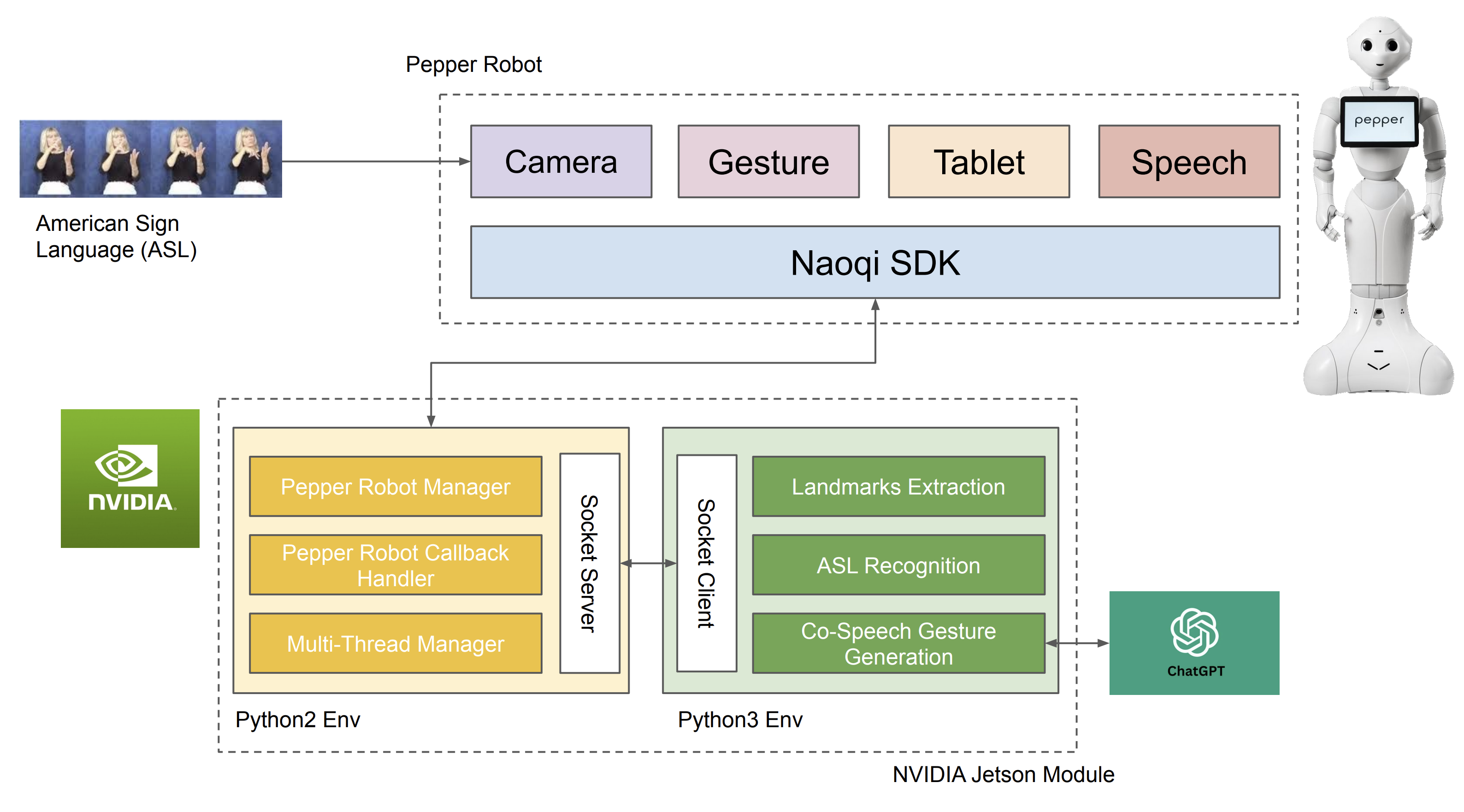
- A lightweight Deep Neural Network (DNN) model based on the Transformer architecture is trained and quantized for deployment on the NVIDIA Jetson module to enable real-time ASL recognition.
- MediaPipe Holistic is used to extract 2D and 3D body landmarks (hands, face, pose) from video input captured by Pepper’s cameras.
- The extracted landmarks are fed into the lightweight DNN model to classify ASL signs in real time.
- A socket-based TCP/IP network communication protocol enables bidirectional data exchange between the Pepper robot (Python 2) and the Jetson module (Python 3).
- A prompt-engineered LLM (ChatGPT) generates context-aware dialogues and corresponding co-speech gestures based on recognized signs, enabling natural interaction.
- The entire pipeline is integrated into a real-time system where sign recognition, LLM inference, and robot gesture execution are synchronized.
Experimental results
Research questions
- RQ1Can a lightweight Transformer-based model achieve high ASL recognition accuracy while operating efficiently on embedded hardware like the NVIDIA Jetson?
- RQ2How effectively can a large language model (LLM) generate contextually relevant, multimodal responses (speech and gestures) for sign language interactions?
- RQ3To what extent can a real-time, end-to-end system integrating sign recognition and LLM-driven responses enable natural and socially aware human-robot interaction?
- RQ4What are the limitations of current landmark detection tools (e.g., MediaPipe) in capturing depth and temporal dynamics for sign language recognition?
- RQ5How can multimodal AI components be effectively orchestrated in a low-latency, resource-constrained robotic platform?
Key findings
- The lightweight DNN model achieved an ASL recognition accuracy of 79.8% on the NVIDIA Jetson module, demonstrating feasibility for real-time deployment on embedded systems.
- MediaPipe Holistic provided accurate 2D landmark detection for hands, face, and body, but exhibited limitations in depth prediction, affecting 3D spatial understanding.
- The LLM (ChatGPT) successfully generated context-aware dialogues and a diverse range of co-speech gestures, demonstrating multimodal interaction potential.
- The integrated pipeline functioned seamlessly across all stages—landmark extraction, sign recognition, LLM inference, and robot gesture execution—confirming system coherence and scalability.
- The system demonstrated the practicality of combining lightweight models and LLMs for socially aware, non-verbal human-robot interaction in real-world settings.
- Despite promising results, challenges remain in depth estimation and robustness to signer variability, indicating areas for future refinement.

Read this paper
Open the full text in the Nubint reader and ask about any passage as you read.
Read this paper on NubintThis review was generated by AI from the original paper. Please check the paper before citing it.