
[Paper Review] A Simple but Effective Approach to Improve Structured Language Model Output for Information Extraction
This paper proposes G&O, a two-stage prompting method that improves structured language model output for information extraction by first generating free-form natural language responses, then structuring them into desired formats. The approach significantly boosts zero-shot performance on NER and RE tasks across multiple LLMs, with gains of up to 14.5% in F1 score over one-step prompting, while remaining simple and composable with other techniques.
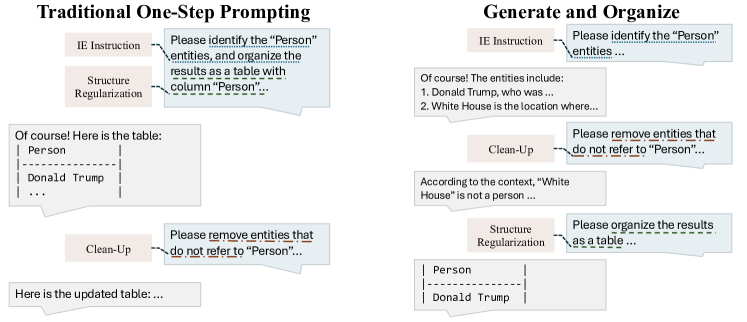
Large language models (LLMs) have demonstrated impressive abilities in generating unstructured natural language according to instructions. However, their performance can be inconsistent when tasked with producing text that adheres to specific structured formats, which is crucial in applications like named entity recognition (NER) or relation extraction (RE). To address this issue, this paper introduces an efficient method, G&O, to enhance their structured text generation capabilities. It breaks the generation into a two-step pipeline: initially, LLMs generate answers in natural language as intermediate responses. Subsequently, LLMs are asked to organize the output into the desired structure, using the intermediate responses as context. G&O effectively separates the generation of content from the structuring process, reducing the pressure of completing two orthogonal tasks simultaneously. Tested on zero-shot NER and RE, the results indicate a significant improvement in LLM performance with minimal additional efforts. This straightforward and adaptable prompting technique can also be combined with other strategies, like self-consistency, to further elevate LLM capabilities in various structured text generation tasks.
Motivation & Objective
- To address the inconsistent performance of LLMs in generating structured outputs for information extraction tasks.
- To reduce the cognitive load of simultaneously generating content and enforcing structure by decoupling the two tasks.
- To improve zero-shot performance on named entity recognition (NER) and relation extraction (RE) without requiring task-specific fine-tuning.
- To develop a simple, generalizable prompting strategy that enhances LLM output quality while remaining compatible with existing methods like self-consistency.
- To demonstrate that separating content generation from structuring leads to measurable gains in structured output fidelity and task performance.
Proposed method
- The method splits generation into two stages: first, an LLM generates a free-form natural language response to the input prompt.
- Second, a separate prompting step instructs the same or another LLM to organize the intermediate natural language response into a predefined structured format (e.g., JSON, list, or table).
- A clean-up component is applied to the intermediate response before structuring to reduce noise and improve final output quality.
- The approach is compatible with existing prompting strategies such as chain-of-thought (CoT) and few-shot prompting, allowing for composability.
- The method is evaluated using zero-shot settings on standard NER and RE benchmarks, comparing G&O against standard one-step prompting.
- The framework is implemented and released publicly to support reproducibility and further research.
Experimental results
Research questions
- RQ1Can separating content generation from structural formatting improve the reliability and accuracy of LLM-generated structured outputs?
- RQ2How does the G&O method compare to standard one-step prompting in zero-shot NER and relation extraction tasks?
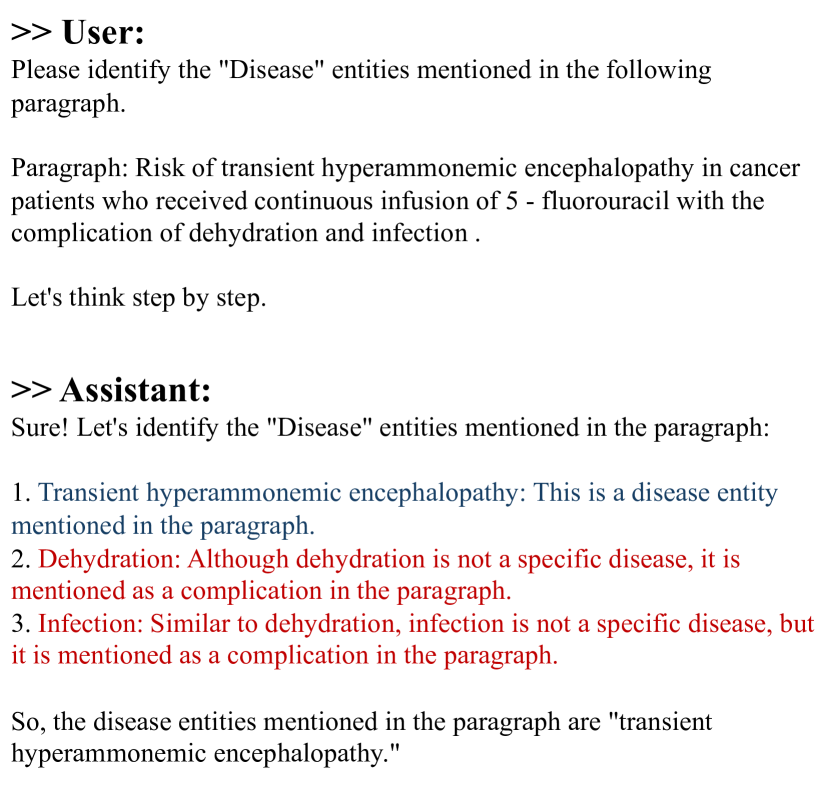
- RQ3To what extent does the clean-up step contribute to the final performance improvement?
- RQ4Can G&O be effectively combined with other prompting techniques like self-consistency or chain-of-thought?
- RQ5Does the two-stage approach generalize across different LLM architectures and downstream information extraction tasks?
Key findings
- G&O significantly improves zero-shot F1 scores on NER tasks, with gains of up to 14.5% over one-step prompting on the NCBI Disease dataset using GPT-3.5.
- On the CoNLL-2004 NER dataset, G&O improved F1 from 0.404 (one-step) to 0.447 (G&O-RE) with GPT-3.5, and from 0.334 to 0.361 with Llama 2 70B.
- On the NYT relation extraction dataset, G&O improved F1 from 0.106 (one-step) to 0.160 (G&O-RE) with GPT-3.5, and from 0.152 to 0.156 with Llama 2 70B.
- The clean-up component contributed meaningfully to performance, improving F1 by 0.042 on GPT-3.5 for NCBI Disease (from 0.6475 to 0.6935).
- The method achieved consistent improvements across multiple LLMs, including GPT-3.5, Llama 2 7B/70B, Mistral 7B, and Mixtral 8x7B, across both NER and RE tasks.
- G&O outperformed even fine-tuned baselines in some settings, such as on PolyIE with Mixtral 8x7B, where G&O achieved 0.5275 F1 compared to fine-tuned models at 0.5210.
Read this paper
Open the full text in the Nubint reader and ask about any passage as you read.
Read this paper on NubintThis review was generated by AI from the original paper. Please check the paper before citing it.