
[Paper Review] A superconducting-nanowire single-photon camera with 400,000 pixels
This paper presents a 400,000-pixel superconducting-nanowire single-photon camera based on a thermally coupled, row-column multiplexed architecture using interleaved WSi nanowires. The device achieves 5×5 µm pixel resolution, unity quantum efficiency at 370 nm and 635 nm, a dark count rate of 0.13 cps across the array, and operates at 0.8 K with scalable readout via four microwave coax lines.
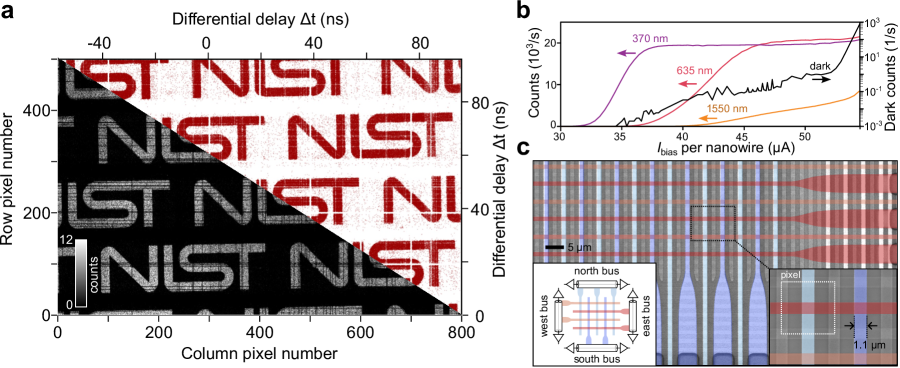
For the last 50 years, superconducting detectors have offered exceptional sensitivity and speed for detecting faint electromagnetic signals in a wide range of applications. These detectors operate at very low temperatures and generate a minimum of excess noise, making them ideal for testing the non-local nature of reality, investigating dark matter, mapping the early universe, and performing quantum computation and communication. Despite their appealing properties, however, there are currently no large-scale superconducting cameras - even the largest demonstrations have never exceeded 20 thousand pixels. This is especially true for one of the most promising detector technologies, the superconducting nanowire single-photon detector (SNSPD). These detectors have been demonstrated with system detection efficiencies of 98.0%, sub-3-ps timing jitter, sensitivity from the ultraviolet (250nm) to the mid-infrared (10um), and dark count rates below 6.2e-6 counts per second (cps), but despite more than two decades of development they have never achieved an array size larger than a kilopixel. Here, we report on the implementation and characterization of a 400,000 pixel SNSPD camera, a factor of 400 improvement over the previous state-of-the-art. The array spanned an area 4x2.5 mm with a 5x5um resolution, reached unity quantum efficiency at wavelengths of 370 nm and 635 nm, counted at a rate of 1.1e5 cps, and had a dark count rate of 1e-4 cps per detector (corresponding to 0.13 cps over the whole array). The imaging area contains no ancillary circuitry and the architecture is scalable well beyond the current demonstration, paving the way for large-format superconducting cameras with 100% fill factors and near-unity detection efficiencies across a vast range of the electromagnetic spectrum.
Motivation & Objective
- To overcome the scalability limitations of superconducting nanowire single-photon detectors (SNSPDs) by enabling large-format, high-density pixel arrays.
- To address the challenge of multiplexing SNSPDs, which produce low-amplitude, broadband pulses that are difficult to read out efficiently at scale.
- To develop a scalable, low-noise readout architecture that maintains high signal-to-noise ratio and minimizes crosstalk in kilopixel and beyond arrays.
- To achieve near-unity quantum efficiency and low dark count rates across a large imaging area with a 100% fill factor.
- To demonstrate a practical, reproducible fabrication process for large-scale SNSPD arrays using standard lithography and thermal coupling principles.
Proposed method
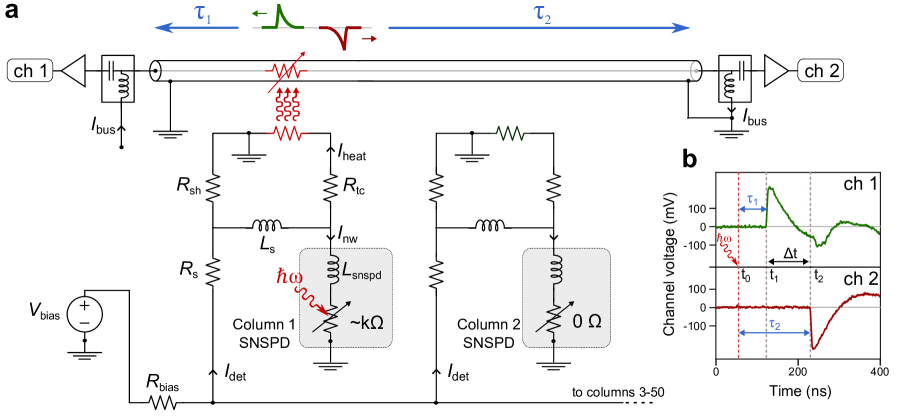
- Employed a thermally coupled, row-column multiplexed architecture where SNSPDs are arranged in a grid and connected to shared readout buses via resistive thermal couplers.
- Used interleaved row and column nanowire detectors made from 4-nm-thick WSi films with Tc = 3.4 K and kinetic inductance of 250 pH/sq, patterned with 1.1 µm width and 5 µm spacing.
- Implemented a four-bus readout system using 8 microwave coax lines, with each bus connected to 50 detectors via thermal couplers to enable multiplexing.
- Optimized circuit parameters (R_bias = 1000 Ω, R_s = 80 Ω, R_sh = 16 Ω, R_tc = 16 Ω, L_s = 1.25 µH, L_snspd = 1.14 µH) to ensure uniform current distribution, low crosstalk, and fast reset times.
- Utilized a stepper lithography technique to replicate a 10-detector unit cell across a 1000×1000 array, enabling scalable fabrication with uniform yield.
- Applied time-tagging and histogramming of time-delay data from the buses to reconstruct 2D images and quantify detection performance.
Experimental results
Research questions
- RQ1Can a scalable, low-crosstalk readout architecture be developed for large-format SNSPD arrays using thermal coupling and multiplexing?
- RQ2What is the maximum achievable pixel count in a superconducting nanowire single-photon camera while maintaining high quantum efficiency and low dark count rates?
- RQ3How does the thermal row-column architecture compare to previous multiplexing schemes in terms of signal-to-noise ratio and scalability?
- RQ4To what extent can fabrication yield and uniformity be maintained in large-scale SNSPD arrays using standard lithographic techniques?
- RQ5Can a 400,000-pixel SNSPD array achieve near-unity quantum efficiency and sub-cps dark count rates simultaneously?
Key findings
- The SNSPD array achieved 400,000 pixels with a 5×5 µm pixel resolution, representing a 400-fold increase over the previous state-of-the-art of 1,024 pixels.
- The array demonstrated unity quantum efficiency at 370 nm and 635 nm, indicating near-perfect photon detection across visible wavelengths.
- The dark count rate was measured at 1.0×10⁻⁴ cps per detector, corresponding to a total of 0.13 cps across the entire array, confirming low noise operation.
- The system operated at 0.8 K with a count rate of 1.1×10⁵ cps, indicating high dynamic range and fast reset capability.
- The readout architecture used only four microwave coax lines for the entire array, enabling scalable, low-thermal-load multiplexing with minimal crosstalk.
- The fabricated array showed no ancillary circuitry in the imaging area, achieving a 100% fill factor and demonstrating full scalability to larger formats.
Read this paper
Open the full text in the Nubint reader and ask about any passage as you read.
Read this paper on NubintThis review was generated by AI from the original paper. Please check the paper before citing it.