
[Paper Review] A Survey for Biomedical Text Summarization: From Pre-trained to Large Language Models
A systematic review of biomedical text summarization (BTS) focusing on pre-trained language models (PLMs) and large language models (LLMs), covering datasets, methods, evaluation, challenges, and future directions, with open resources available.
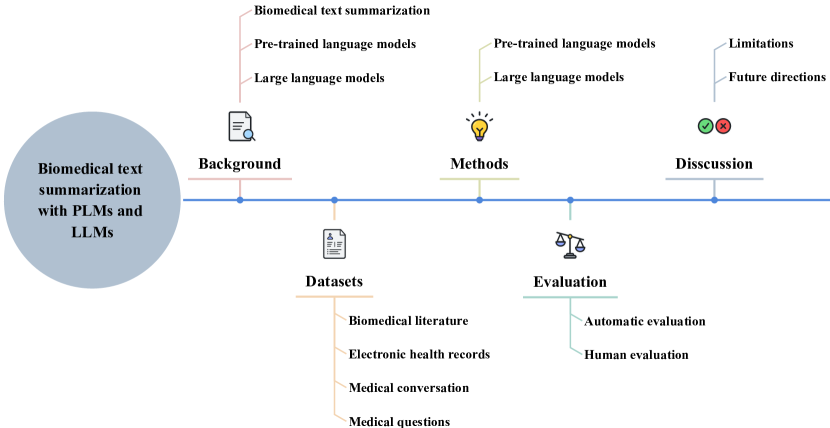
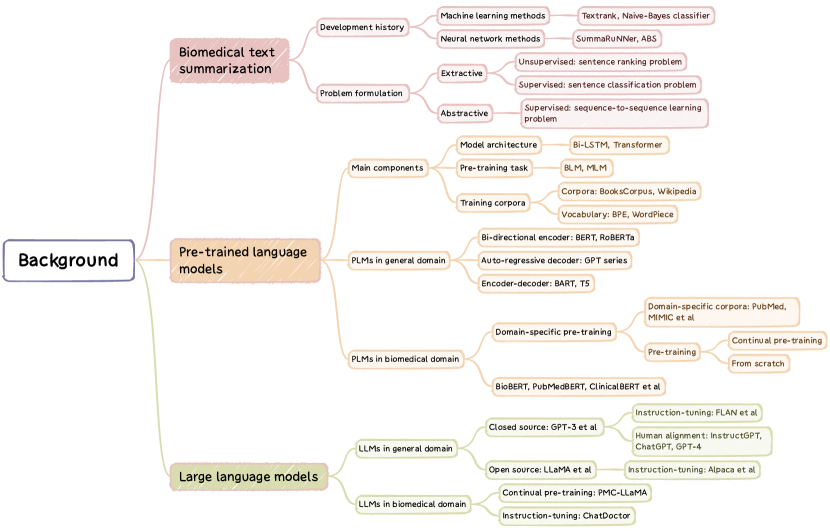
The exponential growth of biomedical texts such as biomedical literature and electronic health records (EHRs), poses a significant challenge for clinicians and researchers to access clinical information efficiently. To tackle this challenge, biomedical text summarization (BTS) has been proposed as a solution to support clinical information retrieval and management. BTS aims at generating concise summaries that distill key information from single or multiple biomedical documents. In recent years, the rapid advancement of fundamental natural language processing (NLP) techniques, from pre-trained language models (PLMs) to large language models (LLMs), has greatly facilitated the progress of BTS. This growth has led to numerous proposed summarization methods, datasets, and evaluation metrics, raising the need for a comprehensive and up-to-date survey for BTS. In this paper, we present a systematic review of recent advancements in BTS, leveraging cutting-edge NLP techniques from PLMs to LLMs, to help understand the latest progress, challenges, and future directions. We begin by introducing the foundational concepts of BTS, PLMs and LLMs, followed by an in-depth review of available datasets, recent approaches, and evaluation metrics in BTS. We finally discuss existing challenges and promising future directions in the era of LLMs. To facilitate the research community, we line up open resources including available datasets, recent approaches, codes, evaluation metrics, and the leaderboard in a public project: https://github.com/KenZLuo/Biomedical-Text-Summarization-Survey/tree/master. We believe that this survey will be a useful resource to researchers, allowing them to quickly track recent advancements and provide guidelines for future BTS research within the research community.
Motivation & Objective
- Clarify foundational BTS concepts and the role of PLMs and LLMs in biomedical text summarization.
- Catalog and analyze benchmark BTS datasets across biomedical literature, EHRs, and conversations.
- Review existing BTS approaches leveraging PLMs and LLMs, highlighting strengths and limitations.
- Discuss evaluation metrics, current challenges, and future directions in the era of LLMs.
Proposed method
- Systematic literature review of BTS work since 2018 focusing on PLMs and LLMs.
- Categorization of methods by extractive vs abstractive in the PLM/LLM era.
- Compilation of benchmark datasets and their task settings (single vs multi-document).
- Discussion of evaluation metrics and leaderboards, with an emphasis on open resources.
- Identification of limitations and future directions in BTS under LLMs.
Experimental results
Research questions
- RQ1What are the benchmark datasets and evaluation standards used in BTS with PLMs and LLMs?
- RQ2How have PLMs and LLMs been applied to extractive and abstractive BTS tasks in biomedical domains?
- RQ3What are the current limitations and promising future directions for BTS in the era of LLMs?
Key findings
- PLMs and LLMs have become the dominant methods for BTS, enabling improved encoding and summarization of biomedical texts.
- There are extensive public BTS datasets spanning biomedical literature, EHRs, medical conversations, and questions, with single and multi-document tasks.
- LLMs enable zero-shot and instruction-tuned capabilities that can match or surpass smaller PLMs in BTS tasks under certain settings.
- Open-source and public datasets, code, and leaderboards are highlighted to support rapid progress in BTS research.
- Biomedicine-specific PLMs (e.g., BioBERT, PubMedBERT) address vocabulary and terminology gaps present in general-domain PLMs.
Read this paper
Open the full text in the Nubint reader and ask about any passage as you read.
Read this paper on NubintThis review was generated by AI from the original paper. Please check the paper before citing it.